# A B C D E F G H I J K L M N O P Q R S T U V W X Y Z

Roland D-BASS 115 D- Bass Amplifier Owner's Manual

Summary

The Roland D-BASS series amplifier is professional audio equipment designed for robust bass performance. This comprehensive owner's manual serves as an essential guide for users selecting, operating, and maintaining the unit. It covers crucial safety instructions, detailed panel descriptions, advanced usage tips (including stacking configurations), full technical specifications, and troubleshooting advice. Whether you are a professional musician or sound engineer looking to optimize your low-end output, this resource ensures you understand every feature of your new bass amplifier safely and effectively.
📄 Preview 📖 Table of Contents Contents PAGE OF 24

Page 1 Text Content

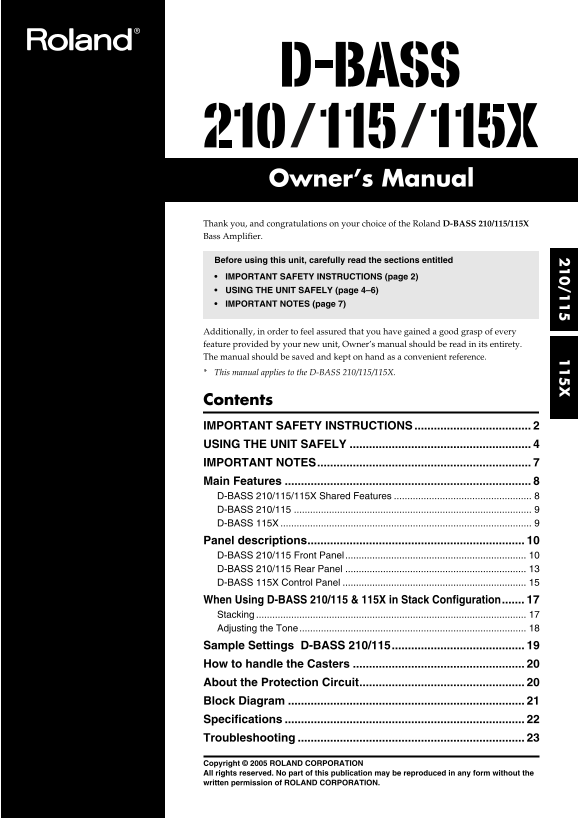
Owner’s Manual Thank you, and congratulations on your choice of the Roland D-BASS 210/115/115X

Bass Amplifier.

Before using this unit, carefully read the sections entitled IMPORTANT SAFETY INSTRUCTIONS (page 2) USING THE UNIT SAFELY (page 4–6) IMPORTANT NOTES (page 7)

Additionally, in order to feel assured that you have gained a good grasp of every feature provided by your new unit, Owner’s manual should be read in its entirety. The manual should be saved and kept on hand as a convenient reference. This manual applies to the D-BASS 210/115/115X.

Contents IMPORTANT SAFETY INSTRUCTIONS USING THE UNIT SAFELY IMPORTANT NOTES.................................................................. Main Features D-BASS 210/115/115X Shared Features D-BASS 210/115 D-BASS 115X Panel descriptions................................................................... D-BASS 210/115 Front Panel D-BASS 210/115 Rear Panel D-BASS 115X Control Panel When Using D-BASS 210/115 & 115X in Stack Configuration Stacking Adjusting the Tone.................................................................................... Sample Settings D-BASS 210/115......................................... How to handle the Casters About the Protection Circuit................................................... Block Diagram Specifications Troubleshooting

Copyright © 2005 ROLAND CORPORATION All rights reserved. No part of this publication may be reproduced in any form without the written permission of ROLAND CORPORATION.

Page Summary Contents For Roland D-BASS 115 D- Bass Amplifier Owner's Manual

Page 1 Owner’s Manual Thank you, and congratulations on your choice of the Roland D-BASS 210/115/115X Bass Amplifier. Before using this unit, carefully read the sections entitled IMPORTANT SAFETY INSTRUCTION...
Page 2 IMPORTANT SAFETY INSTRUCTIONS WARNING: To reduce the risk of fire or electric shock, do not expose this apparatus to rain or moisture. The lightning flash with arrowhead symbol, within an CAUTION equi...
Page 3 For EU Countries This product complies with the requirements of European Directives EMC 89/336/EEC and LVD 73/23/EEC. For the USA FEDERAL COMMUNICATIONS COMMISSION RADIO FREQUENCY INTERFERENCE STATEME...
Page 4 USING THE UNIT SAFELY Used for instructions intended to alert The symbol alerts the user to important instructions the user to the risk of death or severe or warnings.The specific meaning of the symbo...
Page 5 Immediately turn the power off, remove the When using the D-BASS 210 in combination with the D- power cord from the outlet, and request servicing BASS 115X, and when using the D-BASS 115 in combi- by ...
Page 6 101a The unit should be located so that its location or Placement position does not interfere with its proper venti- lation. Using the unit near power amplifiers (or other equipment containing large p...
Page 7 IMPORTANT NOTES 291b In addition to the items listed under “IMPORTANT SAFETY INSTRUCTIONS” and “USING THE UNIT SAFELY” on pages 2 and 4–6, please read and observe the following: Power Supply Additiona...
Page 8 Main Features The D-BASS 210 and 115 are powerful yet lightweight professional bass amps, which utilize Roland’s FFP technology incorporating new Active Speaker Control. The D-BASS 115X is a powered e...
Page 9 Main Features D-BASS 210/115 D-BASS 115X Also Features Piezo Input Jack for The Optimal Powered Extension Acoustic Basses Speaker for the D-BASS 210/115 The D-BASS is equipped with a Ultra-high-impeda...
Page 10 Panel descriptions D-BASS 210/115 Front Panel 1. INPUT Jack Inputting in excess of the optimal level can cause unintended Connect your bass guitar here. distortion and may prevent the COMPRESSION effe...
Page 11 Panel descriptions Models the wide-range sound of tweeter- 11.FREQUENCY Knob equipped bass amps in use since the ’80s. Adjusts the frequency of the middle range. This amp type produces a dynamic tone ...
Page 12 Panel descriptions 16.MUTE Switch Knob Connection Mix Balance This switches the Mute function on and off. Settings Status When muting is turned on, the indicator flashes, and the output from the speak...
Page 13 Panel descriptions D-BASS 210/115 Rear Panel fig.01-02 The pin assignment for the XLR type connectors is as shown below. Before making any connections, make sure that this pin assignment is compatible...
Page 14 Panel descriptions 5. TUNER OUT Jack Connect tuners to this jack. Other than the PICKUP TYPE switch, none of the D-BASS 210/115’s switches/knobs affect the TUNER OUT output. 6. BALANCED OUT Jack Use t...
Page 15 Panel descriptions D-BASS 115X Control Panel fig.02-01 INPUT SUB OUT Q: The volume level of the instrument connected to the D-BASS 115X is too low. A: Could you be using a connection cable that contai...
Page 16 Panel descriptions 5. FREQUENCY Knob In the SUB WOOFER mode, this adjusts the frequency range played back from the unit’s speaker. Adjust this according to the character of the connected bass guitar, ...
Page 17 When Using D-BASS 210/115 & 115X in Stack Configuration Stacking The D-BASS 210/115 can be used in a stacked configuration with the D-BASS 115X. When stacking, be sure to follow the instructions b...
Page 18 When Using D-BASS 210/115 & 115X in Stack Configuration ol um Adjusting the Tone The following steps are effective in adjusting the tone when the D-BASS 210/115 and 115X are used together (stacked...
Page 19 Sample Settings D-BASS 210/115 Set the VOLUME knob at appropriate volume level. WOODY JAZZ fig.sample_1 STANDARDOFF A warm bass sound perfectly suited for jazz. This provides a natural sound even when...
Page 20 How to handle the Casters Attaching and Removing the Casters You can attach or remove casters as shown in the following figure. To ensure adequate stability, be sure to attach all four wheels whenever...
Page 21 Block Diagram D-BASS 210 TUNER OUT EFFECT SEND RETURN TWEETER PIEZO VOLUME POWER AMP (TRI-AMP) AMPLIFIER FFP TW SUPER EFFECT INPUT COMP EQ NORMAL FLAT SHAPE BLEND LOW VINTAGE SHAPE MODERN SHAPE FFP ST...
Page 22 Specifications D-BASS 210 D-BASS 115 Rated Power Output 400 W (Woofer 160 W x 2 + Tweeter 80 W) 330 W (Woofer 250 W + Tweeter 80 W) INPUT PIEZO: -13 d Bu/4.7 MΩ INPUT NORMAL: -10 d Bu/1 MΩ (PICKUP TYP...
Page 23 Troubleshooting D-BASS 115X Rated Power Output 330 W (Woofer 250 W + Tweeter 80 W) Nominal Input Level INPUT: +4 d Bu/22 kΩ Nominal Output Level THRU OUT: +4 d Bu Speaker 38 cm (15 inches) x 1 + Tweet...
Page 24 SD000219 1DH

Manual Details

Brand Roland
Pages 24
File Size 1.98 MB
Published June 02, 2026
90 views

Enter the captcha to get the download link:

captcha

Frequently Asked Questions

What precautions should I take before using this amplifier?

Always read all safety instructions and heed warnings regarding fire, electric shock, or injury to persons.

How do I connect external effects processors?

Ensure the external effects processor's output level is adequately checked if connecting in a series connection.

What happens if the D-BASS 210/115 TWEETER knob is fully turned down?

The signals in the tweeter’s frequency range will not be output from SUB OUT, diminishing the effect of the 115X’s TWEETER knob.

What kind of plugs should I use for safety?

Use polarized or grounding-type plugs; never defeat the safety purpose of these connections.