Page 1
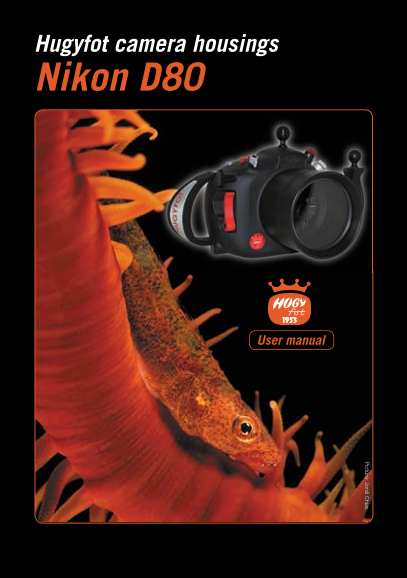
icture: Jordi C hias Hugyfot camera housings Nikon D80 User manual Hugyfot Housing for Nikon D80 User manual
Page 2
Dear Dive buddy, Regardless which model of Hugyfot you hold in you hand, you can be sure that it is not only the best housing on the market but also the best looking one. Hugyfot builds underwater hou...
Page 3
Contents 1. Preface .....................................� 2. Techical information .� 3. Hugyfot for Nikon D80 ............................................................................................
Page 4
1. Preface A camera in an underwater housing offers a lot of advantages to the profes- sional and amateur underwater photographer: impeccable exposure due to the use of the most modern exposure tech...
Page 5
2. Techical information 1. Front shell - 2. Exposure lever - 3. Neoprene handstrap - 4. Aperture control - 5. On/Off switch - 6. Ball-and-socket joint for mounting flash arm - 7. External flash connec...
Page 6
3. Hugyfot for Nikon D80 It is a trend in underwater photography to use a digital camera that can be used by the amateur as well as by the professional. Nothing is as simple as taking pictures with th...
Page 7
4. Opening and closing the housing The HUGYFOT Nikon D80 housing is opened and closed by means of 2 built-in countersunk bolts. This guarantees the safest way of closing. Only with the right key you c...
Page 8
5. Port with bayonet catch The front port bayonet catch is a secure and fast method to connect the dif- ferent ports to the HUGYFOT Nikon D80 housing. The port has a mark which has to be positioned op...
Page 9
6. Flash connections Hugyfot housings can be equiped with Nikonos 5-pins or S-6 flash connec- tions. These flash connections are plugged into a circuit board inside the housing. An optional TTL-conver...
Page 10
Hugyfot Strobe Connections The Hugyfot strobe connections are integrated in the leakage detector circuit board. This circuit board runs on a single 3.6 Volt 1/2 AA Lithium battery. The main parts of t...
Page 11
7. Mounting the camera Prepare yourself at ease and try to avoid stress! Obligations when using underwater housings for cameras: Mount zoom (or focus) control gear (if applicable). Slide the zoom ge...
Page 12
Turn the countersunk bolds in without using any pressure so that the two shells are nicely put together. This point is reached when the tightening suddenly generates resistance. Check all operatio...
Page 13
8. Operation of the leakage indicator The leakage indicator is nicely fit into the circuit board mounted at the left of the housing. The moisture sensor is installed at the bottom of the hou- sing. Th...
Page 14
9. Maintenance and service The Hugyfot o-rings are of a very high quality. Their lifetime may be estimated at 5 years. Nevertheless it is advised to have a spare of the main and the port o-ring. When ...
Page 15
A service of all passages is necessary once a year. If you can do this yourself, the following procedure is to be followed: - Unscrew and unmount all the control switches in the housing with the small...
Page 16
10. Photo practice With a Nikon D80 camera in a HUGYFOT housing one can take pictures almost completely automated. To use the camera with all its possibilities one has to beware of some basic principl...
Page 17
When taking shots at depths deeper than 3 meters, the use of a “flash” is necessary to regain the natural colours. The Nikon D80 can be combined with a flash in 3 modes: Manual flashes: using this mod...
Page 18
11. Accessories Ports: According to the objective used on the camera, different ports are available. - Flat ports for macro lenses - Wide angle ports for wide angle lenses - Fish eye ports for fisheye...
Page 19
into any position. This configuration provides the most compact deployment and offers a wide range of angles in which the flash can be deployed. Flash arm Power closing TTL converter: Most ‘old style’...