# A B C D E F G H I J K L M N O P Q R S T U V W X Y Z

NATIONAL SEMICONDUCTOR LM7341 Owner's Manual

Summary

The LM7341 is a compact, high-performance operational amplifier featuring rail-to-rail input and output capability, making it ideal for low voltage signal conditioning. This SOT-23 package component delivers excellent performance with a 4.6 MHz gain bandwidth and robust stability across extreme temperatures (-40°C to 125°C). The manual provides comprehensive details on the device's electrical characteristics, including high Common Mode Rejection Ratio (CMRR) and wide voltage compatibility (up to $\pm 15V$). It is the professional choice for demanding applications such as automotive electronics, industrial sensing systems, and battery-powered devices.
📄 Preview 📖 Table of Contents Contents PAGE OF 20

Page 1 Text Content

il-to -R il In t/O tp t, ± , 4 .6 z G , O ra tio l A lifie r in -2

October 13, 2008

LM7341 Rail-to-Rail Input/Output ±15V, 4.6 MHz GBW, Operational Amplifier in SOT-23 Package General Description Features The LM7341 is a rail-to-rail input and output amplifier in a (VS = ±15V, TA = 25°C, typical values.) small SOT-23 package with a wide supply voltage and tem- Tiny 5-pin SOT-23 package saves space perature range. The LM7341 has a 4.6 MHz gain bandwidth

Greater than rail-to-rail input CMVR −15.3V to 15.3V

and a 1.9 volt per microsecond slew rate, and draws 0.75 m A

Rail-to-rail output swing −14.84V to 14.86V

of supply current at no load.

Supply current 0.7 m A

The LM7341 is tested at −40°C, 125°C and 25°C with modern

Gain bandwidth 4.6 MHz

automatic test equipment. Detailed performance specifica-

Slew Rate 1.9 V/µs

tions at 2.7V, ±5V, and ±15V and over a wide temperature

Wide supply range 2.7V to 32V

range make the LM7341 a good choice for automotive, in-

High power supply rejection ratio 106 d B

dustrial, and other demanding applications.

High common mode rejection ratio 115 d B

Greater than rail-to-rail input common mode range with a

Excellent gain 106 d B

minimum 76 d B of common mode rejection at ±15V makes

Temperature range −40°C to 125°C

the LM7341 a good choice for both high and low side sensing

applications. Tested at −40°C, 125°C and 25°C at 2.7V, ±5V and ±15V

LM7341 performance is consistent over a wide voltage range,

making the part useful for applications where the supply volt- Applications

age can change, such as automotive electrical systems and

Automotive

battery powered electronics.

Industrial robotics

The LM7341 uses a small SOT23-5 package, which takes up

Sensor output buffers

little board space, and can be placed near signal sources to

Multiple voltage power supplies

reduce noise pickup.

Reverse biasing of photodiodes Low current optocouplers High side sensing Comparator Battery chargers Test point output buffers Below ground current sensing

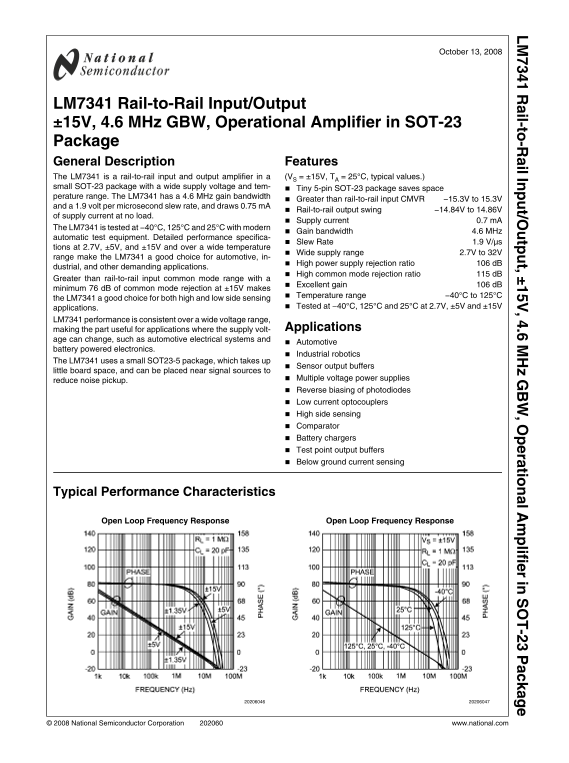
Typical Performance Characteristics

Open Loop Frequency Response Open Loop Frequency Response

© 2008 National Semiconductor Corporation www.national.com

Page Summary Contents For NATIONAL SEMICONDUCTOR LM7341 Owner's Manual

Page 1 il-to -R il In t/O tp t, ± , 4 .6 z G , O ra tio l A lifie r in -2 October 13, 2008 LM7341 Rail-to-Rail Input/Output ±15V, 4.6 MHz GBW, Operational Amplifier in SOT-23 Package General Description Feat...
Page 2 Power Supply Current 25 m A Absolute Maximum Ratings (Note 1) Soldering Information If Military/Aerospace specified devices are required, Infrared or Convection (20 sec) 235°C please contact the Natio...
Page 3 Symbol Parameter Conditions Min Typ Max Units (Note 6) (Note 5) (Note 6) GBW Gain Bandwidth f = 100 k Hz, RL = 100 kΩ 3.6 MHz en Input Referred Voltage Noise Density f = 1 k Hz n V/ in Input Referred ...
Page 4 Symbol Parameter Conditions Min Typ Max Units (Note 6) (Note 5) (Note 6) en Input Referred Voltage Noise Density f = 1 k Hz n V/ in Input Referred Voltage Noise Density f = 1 k Hz 0.26 p A/ THD+N Tota...
Page 5 Symbol Parameter Conditions Min Typ Max Units (Note 6) (Note 5) (Note 6) tr Rise Time 20% to 80% (Note 7) µs tf Fall Time 80% to 20% (Note 7) µs Note 1: Absolute Maximum Ratings indicate limits beyond...
Page 6 Typical Performance Characteristics Output Swing vs. Sourcing Current Output Swing vs. Sinking Current Output Swing vs. Sourcing Current Output Swing vs. Sinking Current Output Swing vs. Sourcing Curr...
Page 7 VOS Distribution VOS vs. VCM (Unit 1) VOS vs. VCM (Unit 2) VOS vs. VCM (Unit 3) VOS vs. VCM (Unit 1) VOS vs. VCM (Unit 2) www.national.com
Page 8 VOS vs. VCM (Unit 3) VOS vs. VCM (Unit 1) VOS vs. VCM (Unit 2) VOS vs. VCM (Unit 3) VOS vs. VS (Unit 1) VOS vs. VS (Unit 2) www.national.com
Page 9 VOS vs. VS (Unit 3) VOS vs. VS (Unit 1) VOS vs. VS (Unit 2) VOS vs. VS (Unit 3) IBIAS vs. VCM IBIAS vs. VCM www.national.com
Page 10 IBIAS vs. VCM IBIAS vs. VS IBIAS vs. VS IS vs. VCM IS vs. VCM IS vs. VCM www.national.com
Page 11 IS vs. VCM IS vs. VCM Positive Output Swing vs. Supply Voltage Positive Output Swing vs. Supply Voltage Negative Output Swing vs. Supply Voltage Negative Output Swing vs. Supply Voltage www.national.c...
Page 12 Open Loop Frequency with Various Capacitive Load Open Loop Frequency with Various Resistive Load Open Loop Frequency with Various Supply Voltage Open Loop Frequency Response with Various Temperatures ...
Page 13 -PSRR vs. Frequency Small Signal Step Response Large Signal Step Response Input Referred Noise Density vs. Frequency Input Referred Noise Density vs. Frequency Input Referred Noise Density vs. Frequen...
Page 14 THD+N vs. Frequency SPECIFIC ADVANTAGES OF 5-Pin SOT-23 (Tiny Pak) Application Information The obvious advantage of the 5-pin SOT-23, Tiny Pak, is that GENERAL INFORMATION it can save board space, a c...
Page 15 Typical Applications HANDHELD REMOTE CONTROLS The LM7341 offers outstanding specifications for applications requiring good speed/power trade-off. In applications such as remote control operation, wher...
Page 16 INVERTING COMPARATOR WITH HYSTERESIS sistors can be presented as R2||R3 in series with R1. The The inverting comparator with hysteresis requires a three re- upper trip voltage VA2 is defined as sistor...
Page 17 NON-INVERTING COMPARATOR WITH HYSTERESIS VIN2 = (VREF (R1+ R2) - VCCR1)/R2 A non-inverting comparator with hysteresis requires a two re- The hysteresis of this circuit is the difference between VIN1 s...
Page 18 Physical Dimensions inches (millimeters) unless otherwise noted 5-Pin SOT-23 NS Package Number MF05A www.national.com
Page 19 Notes www.national.com
Page 20 il -t -R il t/ tp t, .6 ra ti li fi in -2 Notes For more National Semiconductor product information and proven design tools, visit the following Web sites at: Products Design Support Amplifiers www.na...

Manual Details

Brand National
Pages 20
File Size 575.00 KB
Published June 01, 2026
84 views

Enter the captcha to get the download link:

captcha

Frequently Asked Questions

What is the function of the LM7341?

It is a rail-to-rail input and output operational amplifier available in a small SOT-23 package.

What types of applications suit the LM7341 due to its wide voltage range?

It is suitable for automotive, industrial robotics, battery powered electronics, and other demanding applications where supply voltage can change.

How does the amplifier perform at extreme temperatures?

The device operates from -40°C to 125°C, making it good for both high and low side sensing in harsh environments.

What is the maximum operating supply voltage range?

The recommended operating range is 2.7V to 32V.