MAXIM MAX975 MAX977 Single Dual, +3V +5V Dual-Speed Comparators with Auto-Standby User Manual
Summary
These dual-speed comparators (MAX975/MAX977) are ideal for engineers designing precision interface circuitry. They offer high-speed performance with robust auto-standby features, allowing operation in low-power mode that automatically wakes up upon signal detection. The manual provides comprehensive technical specifications on operating modes (+3V/+5V), adjustable timeout periods, and rail-to-rail I/O for battery-powered systems, keyless entry, and monitoring applications.
Page 1 Text Content
19-1141; Rev 2; 2/07
Single/Dual, +3V/+5V Dual-Speed Comparators with Auto-Standby General Description ____________________________Features
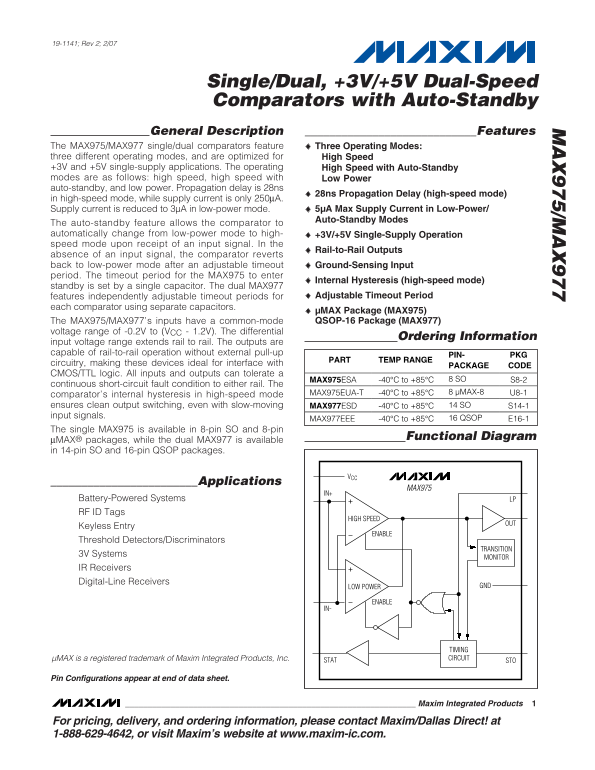
The MAX975/MAX977 single/dual comparators feature Three Operating Modes: three different operating modes, and are optimized for High Speed +3V and +5V single-supply applications. The operating High Speed with Auto-Standby modes are as follows: high speed, high speed with Low Power auto-standby, and low power. Propagation delay is 28ns
28ns Propagation Delay (high-speed mode)
in high-speed mode, while supply current is only 250µA.
Supply current is reduced to 3µA in low-power mode. 5µA Max Supply Current in Low-Power/ Auto-Standby Modes
The auto-standby feature allows the comparator to automatically change from low-power mode to high- +3V/+5V Single-Supply Operation speed mode upon receipt of an input signal. In the
Rail-to-Rail Outputs
absence of an input signal, the comparator reverts back to low-power mode after an adjustable timeout Ground-Sensing Input period. The timeout period for the MAX975 to enter
Internal Hysteresis (high-speed mode)
standby is set by a single capacitor. The dual MAX977
features independently adjustable timeout periods for Adjustable Timeout Period
each comparator using separate capacitors.
µMAX Package (MAX975) The MAX975/MAX977’s inputs have a common-mode QSOP-16 Package (MAX977)
voltage range of -0.2V to (VCC - 1.2V). The differential
Ordering Information
input voltage range extends rail to rail. The outputs are capable of rail-to-rail operation without external pull-up
PIN- PKG
PART TEMP RANGE
circuitry, making these devices ideal for interface with
PACKAGE CODE
CMOS/TTL logic. All inputs and outputs can tolerate a
MAX975ESA -40°C to +85°C 8 SO S8-2
continuous short-circuit fault condition to either rail. The
MAX975EUA-T -40°C to +85°C 8 µMAX-8 U8-1
comparator’s internal hysteresis in high-speed mode
ensures clean output switching, even with slow-moving MAX977ESD -40°C to +85°C 14 SO S14-1
input signals.
MAX977EEE -40°C to +85°C 16 QSOP E16-1
The single MAX975 is available in 8-pin SO and 8-pin
Functional Diagram
µMAX® packages, while the dual MAX977 is available in 14-pin SO and 16-pin QSOP packages.
________________________Applications
MAX975
Battery-Powered Systems LP RF ID Tags
HIGH SPEED
Keyless Entry
ENABLE
Threshold Detectors/Discriminators
TRANSITION
3V Systems
MONITOR
IR Receivers Digital-Line Receivers
LOW POWER GND
ENABLE
TIMING µMAX is a registered trademark of Maxim Integrated Products, Inc. CIRCUIT
STAT STO
Pin Configurations appear at end of data sheet.
Maxim Integrated Products
For pricing, delivery, and ordering information, please contact Maxim/Dallas Direct! at 1-888-629-4642, or visit Maxim’s website at www.maxim-ic.com.
Page Summary Contents For MAXIM MAX975 MAX977 Single Dual, +3V +5V Dual-Speed Comparators with Auto-Standby User Manual
Manual Details
| Brand | Dual |
|---|---|
| Pages | 17 |
| File Size | 585.23 KB |
| Published | May 30, 2026 |
Enter the captcha to get the download link:

Frequently Asked Questions
What operating modes does the comparator feature?
It supports three modes: high speed, low power auto-standby, and simple low power operation.
How is the timeout period adjusted in high-speed mode?
The MAX975 or dual MAX977 allow for independently adjustable timeout periods using separate capacitors.
Can this device interface with standard digital logic like CMOS/TTL?
Yes, its rail-to-rail outputs make it ideal for interfacing with CMOS/TTL logic without external pull-up circuitry.