LINEAR DUAL MONOLITHIC BUCK WITH TEMP MONITOR & COMPARATOR BLOCK - DESIGN NOTE 492 LINAR 36V, 3.5A Dual Monolithic Buck with Integrated Die Temperature Monitor and Standalone Comparator Block Design Note 492 Edwin Li Owner's Manual
Summary
This powerful dual monolithic regulator is engineered for demanding, space-constrained applications requiring robust power delivery up to 36V. Featuring on-die temperature monitoring, standalone comparators, adjustable current limiting, and independent synchronization, it provides superior thermal management performance comparable to complex multichip solutions. This guide covers detailed application circuitry, optimal configuration of these advanced features, and design considerations for engineers building reliable power management systems in harsh or compact environments.
Page 1 Text Content
36V, 3.5A Dual Monolithic Buck with Integrated Die Temperature Monitor and Standalone Comparator Block Design Note 492 Edwin Li INTRODUCTION HIGH INPUT VOLTAGE WITH HIGH TRANSIENT
CAPABILITY
Multioutput monolithic regulators are easy to use and fi t into spaces where multichip solutions cannot. Neverthe- The LT3692A can operate up to an input voltage of 36V less, the popularity of multioutput regulators is tempered and can sustain a transient voltage up to 60V for 1 second, by a lack of options for input voltages above 30V and making it suitable for harsh operating environments such support of high output currents. The LT3692A fi lls this as those commonly found in automotive environments. gap with a dual monolithic regulator that operates from
ON-DIE TEMPERATURE MONITORING
inputs up to 36V. It also includes a number of channel optimization features that allow the LT3692A’s per-channel The LT3692A provides an on-die temperature monitoring performance to rival that of multichip solutions. function which facilitates the application circuit design,
debugging and package thermal optimization. The voltage
The LT3692A is available in two packages: a 5mm × 5mm
at TJ pin is directly proportional to the die temperature in
QFN and a 38-lead plastic TSSOP. Although Both include
Celsius (i.e., 250m V equals 25°C and 1.5V equals 150°C).
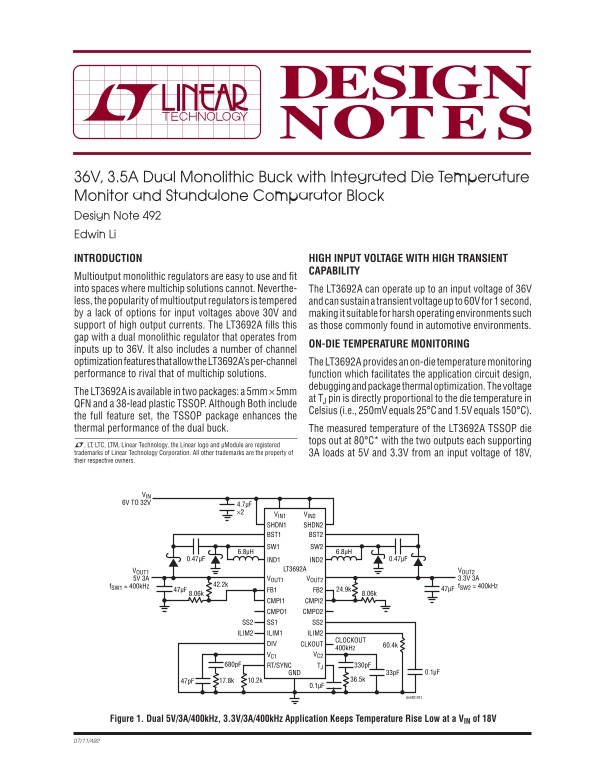
the full feature set, the TSSOP package enhances the thermal performance of the dual buck. The measured temperature of the LT3692A TSSOP die
tops out at 80°C* with the two outputs each supporting
L, LT, LTC, LTM, Linear Technology, the Linear logo and μModule are registered trademarks of Linear Technology Corporation. All other trademarks are the property of 3A loads at 5V and 3.3V from an input voltage of 18V, their respective owners.
VIN 6V TO 32V 4.7μF
VIN1 VIN2
SHDN1 SHDN2
BST1 BST2 SW1 SW2
IND1 IND20.47μF 0.47μF
VOUT1 LT3692A VOUT2
5V 3A VOUT1 VOUT2 3.3V 3A
f SW1 = 400k Hz 42.2k f SW2 = 400k Hz
47μF FB1 FB2 24.9k 47μF
CMPI1 CMPI2 CMPO1 CMPO2 SS2 SS1 SS2
ILIM2 ILIM1 ILIM2
CLOCKOUT
DIV CLKOUT 60.4k
400k Hz VC1 VC2
680p F RT/SYNC TJ 330p F
GND 33p F 0.1μF
dn492 F01
Figure 1. Dual 5V/3A/400k Hz, 3.3V/3A/400k Hz Application Keeps Temperature Rise Low at a VIN of 18V
Page Summary Contents For LINEAR DUAL MONOLITHIC BUCK WITH TEMP MONITOR & COMPARATOR BLOCK - DESIGN NOTE 492 LINAR 36V, 3.5A Dual Monolithic Buck with Integrated Die Temperature Monitor and Standalone Comparator Block Design Note 492 Edwin Li Owner's Manual
Manual Details
| Brand | Linear |
|---|---|
| Pages | 2 |
| File Size | 99.90 KB |
| Published | May 29, 2026 |
Enter the captcha to get the download link:

Frequently Asked Questions
What is the maximum input voltage the device supports?
The LT3692A can operate up to an input voltage of 36V and sustain transients of up to 60V for one second.
How do I monitor die temperature precisely?
Temperature monitoring uses a T pin where the voltage is directly proportional to the die's temperature in Celsius.
Can I set custom operational limits on the outputs?
Yes, you can independently adjust the current limit (from 2A to 4.8A) and program the switching frequency for each channel.
What functionality does the comparator block provide?
It provides open-collector signals that can be configured as a power good flag or act as a customizable voltage monitoring point.