LINEAR Dual Monolithic Ideal Diode Management of Multiple Power Inputs Design Note DN356 - Data Sheet & User Manual
Summary
The LTC4413 is a dual monolithic ideal diode designed for robust, low-loss power management in demanding portable electronics. This single-chip solution automatically handles PowerPath switching between multiple sources—such as batteries, USB ports, and wall adapters—guaranteeing uninterrupted, reliable operation. The manual details how the device maintains stable voltage and optimizes battery life through seamless transition control, making it ideal for applications requiring high dependability.
Page 1 Text Content
advertisement
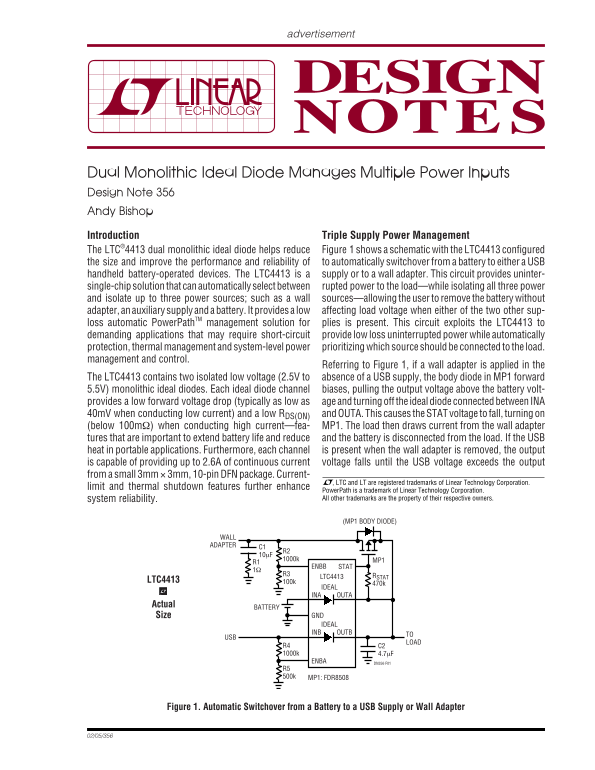
Dual Monolithic Ideal Diode Manages Multiple Power Inputs Design Note 356 Andy Bishop Introduction Triple Supply Power Management The LTC®4413 dual monolithic ideal diode helps reduce Figure 1 shows a schematic with the LTC4413 configured the size and improve the performance and reliability of to automatically switchover from a battery to either a USB handheld battery-operated devices. The LTC4413 is a supply or to a wall adapter. This circuit provides uninter- single-chip solution that can automatically select between rupted power to the load—while isolating all three power and isolate up to three power sources; such as a wall sources—allowing the user to remove the battery without adapter, an auxiliary supply and a battery. It provides a low affecting load voltage when either of the two other sup- loss automatic Power Path TM management solution for plies is present. This circuit exploits the LTC4413 to
demanding applications that may require short-circuit provide low loss uninterrupted power while automatically protection, thermal management and system-level power prioritizing which source should be connected to the load.
management and control.
Referring to Figure 1, if a wall adapter is applied in the The LTC4413 contains two isolated low voltage (2.5V to absence of a USB supply, the body diode in MP1 forward 5.5V) monolithic ideal diodes. Each ideal diode channel biases, pulling the output voltage above the battery volt- provides a low forward voltage drop (typically as low as age and turning off the ideal diode connected between INA 40m V when conducting low current) and a low RDS(ON) and OUTA. This causes the STAT voltage to fall, turning on (below 100mΩ) when conducting high current—fea- MP1. The load then draws current from the wall adapter tures that are important to extend battery life and reduce and the battery is disconnected from the load. If the USB heat in portable applications. Furthermore, each channel is present when the wall adapter is removed, the output is capable of providing up to 2.6A of continuous current voltage falls until the USB voltage exceeds the output
from a small 3mm × 3mm, 10-pin DFN package. Current-
, LTC and LT are registered trademarks of Linear Technology Corporation.
limit and thermal shutdown features further enhance
Power Path is a trademark of Linear Technology Corporation. system reliability. All other trademarks are the property of their respective owners.
(MP1 BODY DIODE)
WALL ADAPTER C1
R2 10µF 1000k MP1
ENBB STAT
R3 RSTAT
LTC4413
LTC4413 100k
IDEAL INA OUTA
Actual
BATTERY
Size GND IDEAL INB OUTB
ENBA DN356 F01
R5 500k MP1: FDR8508
Figure 1. Automatic Switchover from a Battery to a USB Supply or Wall Adapter
Page Summary Contents For LINEAR Dual Monolithic Ideal Diode Management of Multiple Power Inputs Design Note DN356 - Data Sheet & User Manual
Manual Details
| Brand | Linear |
|---|---|
| Pages | 2 |
| File Size | 57.12 KB |
| Published | June 21, 2026 |
Enter the captcha to get the download link:

Frequently Asked Questions
How does the LTC4413 manage automatic power switching?
It constantly monitors multiple sources (battery, USB, wall adapter) and automatically selects the lowest loss path to supply continuous power to the load.
What is the maximum continuous current output when running from USB?
Each ideal diode channel can provide up to 2.6A of continuous current when powered by a USB source.
Does the system handle battery replacement reliably?
Yes, it allows the battery to be replaced without affecting the load voltage or disrupting the connected power path.