LINEAR Handheld High Power Battery Charger Design Note 393 Owner's Manual
Summary
Introducing the LTC4001, a high-efficiency, switching-based Li-ion battery charger designed for next-generation handheld devices. This guide details its advanced capabilities, including ultra-small QFN packaging, remote voltage sensing, and programmable soft-start for optimal performance in confined spaces. It features comprehensive protection against over-temperature and deep discharge, along with multiple flexible charge termination modes (time or current indication). Ideal for electrical engineers developing compact, reliable power management solutions that require exceptional efficiency and minimum footprint.
Page 1 Text Content
advertisement
Handheld High Power Battery Charger Design Note 393 Mark Gurries Introduction small 1206-size 10µF ceramic capacitors, and a few other
As the performance of many handheld devices approaches tiny components. Furthermore, even simpler confi gura- that of laptop computers, design complexity also increas- tions are possible (see Figure 2). This monolithic 2A, es. Chief among them is thermal management—how do 1.5MHz synchronous PWM standalone battery charger you meet increasing performance demands while keeping is packaged in a 4mm × 4mm 16-pin QFN package, a compact and small product cool in the user’s hand? which contains the built-in switching MOSFETs and charge termination controller. Figure 3 shows an actual
For instance, as battery capacities inevitably increase,
PCB solution.
charge currents will also increase to maintain or improve
their charge times. Traditional linear regulator-based bat- Advanced Features and Functions
tery chargers will not be able to meet the charge current One of the more unique features of the LTC4001 is its and effi ciency demands necessary to allow a product to full remote voltage sense capability which permits faster run cool. What is needed is a switching-based charger charge rates by bypassing voltage drops in narrow PCB that takes just about the same amount of space as a linear traces, EMI fi lters or current sense resistors for gas gauge solution—but without the heat. related support; this is placed on the system side of the
battery connector. Eliminating these losses in the sense
Small PCB Footprint
circuit can signifi cantly shorten the constant voltage
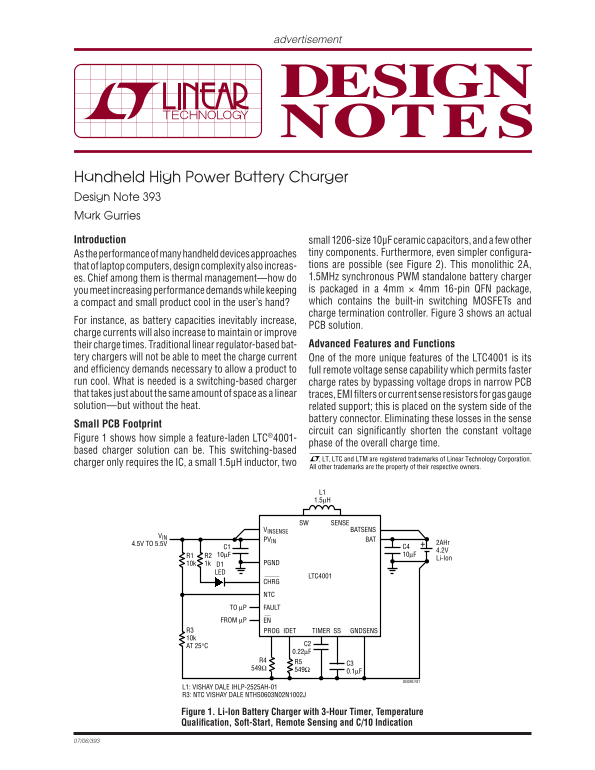
Figure 1 shows how simple a feature-laden LTC®4001-
phase of the overall charge time.
based charger solution can be. This switching-based
, LT, LTC and LTM are registered trademarks of Linear Technology Corporation.
charger only requires the IC, a small 1.5µH inductor, two
All other trademarks are the property of their respective owners.
SW SENSE
VINSENSE BATSENS
PVIN BAT
4.5V TO 5.5V 2AHr
Li-Ion
10k 1k D1 PGND
LTC4001
CHRG NTC FAULTTO µP
FROM µP EN
R3 PROG IDET TIMER SS GNDSENS 10k
AT 25°C
DN393 F01
L1: VISHAY DALE IHLP-2525AH-01 R3: NTC VISHAY DALE NTHS0603N02N1002J
Figure 1. Li-Ion Battery Charger with 3-Hour Timer, Temperature Qualifi cation, Soft-Start, Remote Sensing and C/10 Indication
Page Summary Contents For LINEAR Handheld High Power Battery Charger Design Note 393 Owner's Manual
Manual Details
| Brand | High Power |
|---|---|
| Pages | 2 |
| File Size | 99.81 KB |
| Published | May 30, 2026 |
Enter the captcha to get the download link:

Frequently Asked Questions
Does this charger minimize energy losses during operation?
Yes, it uses a switching-based solution with remote voltage sense to eliminate substantial losses from long PCB traces or current sense resistors.
How does the system protect against overheating during charging?
The device includes thermal management that detects out-of-range temperatures and stops charging immediately if a temperature fault occurs.
What is its functionality for deeply discharged batteries?
It features DET recovery, allowing it to charge batteries that have fallen below 3V per cell.
What physical advantages does the LTC4001 offer?
It provides high performance with a compact footprint, making it suitable for low-size handheld devices.