LINEAR DSOL44 Data Manual
Summary
Designed for engineers building high-sensitivity, wideband digital receivers, this manual provides detailed application guidance for advanced ADCs. It addresses the complex demands of low-noise environments, such as satellite or base station links, by leveraging unique onboard features. Learn how integrated transparent dithering circuits and optional digital randomizers dramatically boost Signal Fidelity (SFDR) and enable stable high performance even at extremely low input levels. The resource simplifies receiver design for demanding applications requiring superior dynamic range and high spectral purity.
Page 1 Text Content
Design Solutions 44 October 2005
High Sensitivity Receiver Applications Benefi t from Unique Features in 16-Bit 130Msps ADC by Alison Smith
RF IF
ADC DDC/DSP
BPF BPF RF IN
ADC Driver
LO1 DSOL44F01
Figure 1. Direct IF to Digital Single Conversion Receiver
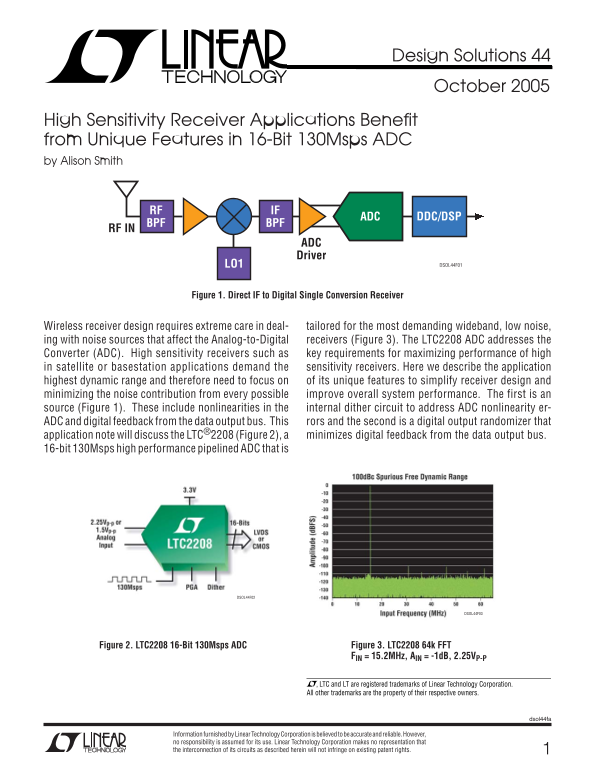
Wireless receiver design requires extreme care in deal- tailored for the most demanding wideband, low noise, ing with noise sources that affect the Analog-to-Digital receivers (Figure 3). The LTC2208 ADC addresses the Converter (ADC). High sensitivity receivers such as key requirements for maximizing performance of high in satellite or basestation applications demand the sensitivity receivers. Here we describe the application highest dynamic range and therefore need to focus on of its unique features to simplify receiver design and minimizing the noise contribution from every possible improve overall system performance. The first is an source (Figure 1). These include nonlinearities in the internal dither circuit to address ADC nonlinearity er- ADC and digital feedback from the data output bus. This rors and the second is a digital output randomizer that application note will discuss the LTC®2208 (Figure 2), a minimizes digital feedback from the data output bus. 16-bit 130Msps high performance pipelined ADC that is
DSOL44F02
DSOL44F03
Figure 2. LTC2208 16-Bit 130Msps ADC Figure 3. LTC2208 64k FFT
FIN = 15.2MHz, AIN = -1d B, 2.25VP-P
, LTC and LT are registered trademarks of Linear Technology Corporation. All other trademarks are the property of their respective owners.
dsol44fa
Information furnished by Linear Technology Corporation is believed to be accurate and reliable. However, no responsibility is assumed for its use. Linear Technology Corporation makes no representation that the interconnection of its circuits as described herein will not infringe on existing patent rights.
Page Summary Contents For LINEAR DSOL44 Data Manual
Manual Details
| Brand | Linear |
|---|---|
| Pages | 5 |
| File Size | 322.14 KB |
| Published | May 30, 2026 |
Enter the captcha to get the download link:

Frequently Asked Questions
How does the LTC2208 improve performance for low-level signals?
It uses a pseudo-random number generator and internal transparent dither circuit to significantly improve SFDR and decorrelate spurious tones.
What output formats are available for the LTC2208?
Outputs include low voltage CMOS or LVDS outputs, plus an optional high-frequency digital randomizer feature.
Can the ADC handle wideband signals?
Yes, it can accept high frequency, wide bandwidth inputs up to a bandwidth of 700MHz and is rated at 130Msps.
What requirements must be considered for high sensitivity receivers?
Key requirements include maximizing performance, highest dynamic range, and minimizing noise contribution throughout the system.