LINEAR dn364f Data Manual
Summary
This comprehensive guide details the LTC3770, a high-efficiency synchronous step-down DC/DC controller designed for demanding power management applications. The manual provides in-depth technical coverage of advanced features, including precise output voltage tracking, programmable margining, and fast start-up sequencing. It is essential reading for electrical engineers and hardware designers developing reliable, regulated power supplies, such as those needed for core compute and I/O circuits that require high accuracy across wide input voltage ranges (4V to 32V).
Page 1 Text Content
advertisement
High Accuracy Synchronous Step-Down Controller Provides Output Tracking and Programmable Margining – Design Note 364 Charlie Zhao
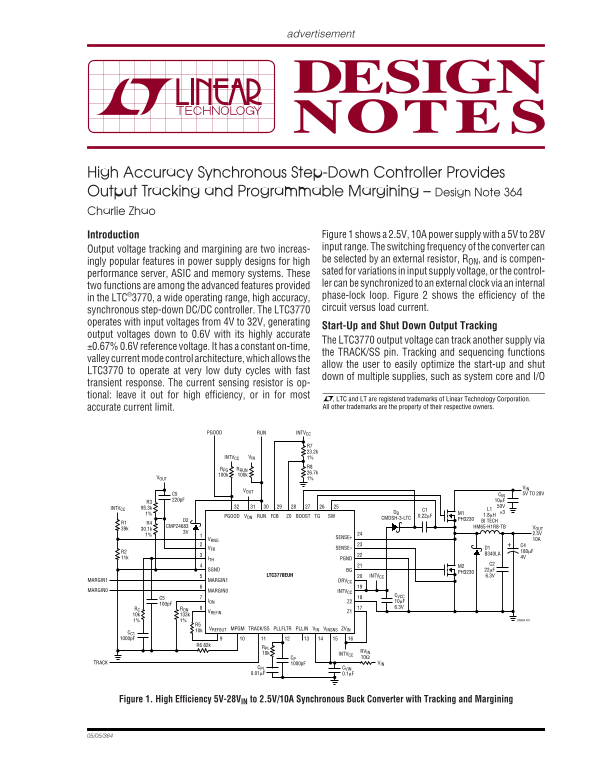
Introduction Figure 1 shows a 2.5V, 10A power supply with a 5V to 28V Output voltage tracking and margining are two increas- input range. The switching frequency of the converter can be selected by an external resistor, RON, and is compen-
ingly popular features in power supply designs for high
sated for variations in input supply voltage, or the control-
performance server, ASIC and memory systems. These
ler can be synchronized to an external clock via an internal
two functions are among the advanced features provided
phase-lock loop. Figure 2 shows the efficiency of the
in the LTC®3770, a wide operating range, high accuracy,
circuit versus load current.
synchronous step-down DC/DC controller. The LTC3770 operates with input voltages from 4V to 32V, generating
Start-Up and Shut Down Output Tracking
output voltages down to 0.6V with its highly accurate
The LTC3770 output voltage can track another supply via
±0.67% 0.6V reference voltage. It has a constant on-time,
the TRACK/SS pin. Tracking and sequencing functions
valley current mode control architecture, which allows the
allow the user to easily optimize the start-up and shut
LTC3770 to operate at very low duty cycles with fast
down of multiple supplies, such as system core and I/O
transient response. The current sensing resistor is op- tional: leave it out for high efficiency, or in for most
, LTC and LT are registered trademarks of Linear Technology Corporation. accurate current limit. All other trademarks are the property of their respective owners.
PGOOD RUN INTVCC
VININTVCC 1%
RPG RRUN
VOUT 1%
C5 CIN 5V TO 28V
INTVCC 95.3k 50V C1 L1 1% DB M1 ×3 PGOOD VON RUN FCB Z0 BOOST TG SW 0.22µF 1.8µH
CMDSH-3-LTC PH3230
D2 BI TECH
CMPZ4683 HM65-H1R8-TB VOUT
VRNG SENSE+ 10A
VFB SENSE– D1
B340LA
11k ITH PGND 4V
SGND BG 22µF
PH3230
LTC3770EUH INTVCC 6.3V
MARGIN1 MARGIN1 DRVCC
MARGIN0 MARGIN0 INTVCC
ION Z2 10µF
RC RON 6.3V
VREFIN Z1
1% 1% DN364 F01
R5 VREFOUT MPGM TRACK/SS PLLFLTR PLLIN VIN VINSNS ZVIN 10k
CC1 1000p F
10k RVIN
INTVCC
CP 10Ω
TRACK 1000p F VIN
CPL CVIN 0.01µF 0.1µF
Figure 1. High Efficiency 5V-28VIN to 2.5V/10A Synchronous Buck Converter with Tracking and Margining
Page Summary Contents For LINEAR dn364f Data Manual
Manual Details
| Brand | Linear |
|---|---|
| Pages | 2 |
| File Size | 81.20 KB |
| Published | June 05, 2026 |
Enter the captcha to get the download link:

Frequently Asked Questions
What is the input voltage range of the LTC3770 controller?
The LTC3770 operates with a wide input voltage range from 4V to 32V.
How does the device support complex supply requirements like tracking?
It supports accurate output voltage tracking (coincident or ratiometric) up to ±0.67% via dedicated MARGIN1 and MARGIN0 pins.
What is programmable voltage margining primarily used for?
It dynamically adjusts the output voltage during production testing to stress load circuitry and verify system reliability.
Is current sensing optional, and if so, when should it be omitted?
Yes, omitting the current sensing resistor enhances high efficiency but should be included if an accurate current limit is required.