LINEAR Application Note 58 5V to 3.3V Converters for Microprocessor Systems
Summary
This application note provides comprehensive selection guidelines for high-performance voltage regulators, specifically designed to convert 5V down to a stable 3.3V supply for modern microprocessor systems. It details both linear and high-efficiency switching converters, helping engineers determine the optimal choice based on required current capacity, efficiency needs, and low dropout performance. The manual is essential reading for hardware designers building embedded or portable electronics that require stable power management, particularly addressing critical details like transient load handling, capacitor requirements, and component suitability for robust system operation.
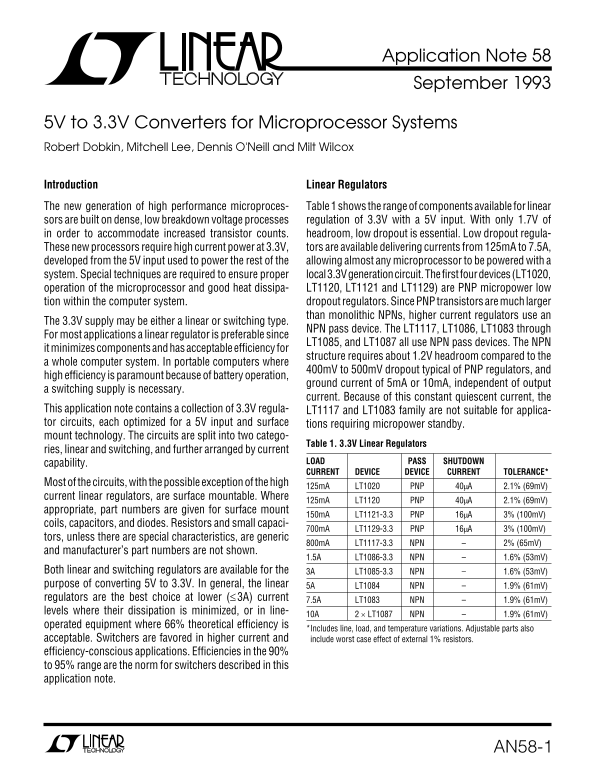
Page 1 Text Content
Application Note 58 September 1993
5V to 3.3V Converters for Microprocessor Systems Robert Dobkin, Mitchell Lee, Dennis O'Neill and Milt Wilcox
Introduction Linear Regulators
The new generation of high performance microproces- Table 1 shows the range of components available for linear sors are built on dense, low breakdown voltage processes regulation of 3.3V with a 5V input. With only 1.7V of in order to accommodate increased transistor counts. headroom, low dropout is essential. Low dropout regula- These new processors require high current power at 3.3V, tors are available delivering currents from 125m A to 7.5A, developed from the 5V input used to power the rest of the allowing almost any microprocessor to be powered with a system. Special techniques are required to ensure proper local 3.3V generation circuit. The first four devices (LT1020, operation of the microprocessor and good heat dissipa- LT1120, LT1121 and LT1129) are PNP micropower low tion within the computer system. dropout regulators. Since PNP transistors are much larger
than monolithic NPNs, higher current regulators use an
The 3.3V supply may be either a linear or switching type.
NPN pass device. The LT1117, LT1086, LT1083 through
For most applications a linear regulator is preferable since
LT1085, and LT1087 all use NPN pass devices. The NPN
it minimizes components and has acceptable efficiency for
structure requires about 1.2V headroom compared to the
a whole computer system. In portable computers where
400m V to 500m V dropout typical of PNP regulators, and
high efficiency is paramount because of battery operation,
ground current of 5m A or 10m A, independent of output
a switching supply is necessary.
current. Because of this constant quiescent current, the
This application note contains a collection of 3.3V regula- LT1117 and LT1083 family are not suitable for applica- tor circuits, each optimized for a 5V input and surface tions requiring micropower standby. mount technology. The circuits are split into two catego-
Table 1. 3.3V Linear Regulators
ries, linear and switching, and further arranged by current
capability. LOAD PASS SHUTDOWN CURRENT DEVICE DEVICE CURRENT TOLERANCE*
Most of the circuits, with the possible exception of the high
125m A LT1020 PNP 40µA 2.1% (69m V)
current linear regulators, are surface mountable. Where
125m A LT1120 PNP 40µA 2.1% (69m V)
appropriate, part numbers are given for surface mount
150m A LT1121-3.3 PNP 16µA 3% (100m V)
coils, capacitors, and diodes. Resistors and small capaci-
700m A LT1129-3.3 PNP 16µA 3% (100m V)
tors, unless there are special characteristics, are generic
800m A LT1117-3.3 NPN 2% (65m V)
and manufacturer’s part numbers are not shown.
1.5A LT1086-3.3 NPN 1.6% (53m V)
Both linear and switching regulators are available for the 3A LT1085-3.3 NPN 1.6% (53m V) purpose of converting 5V to 3.3V. In general, the linear 5A LT1084 NPN 1.9% (61m V) regulators are the best choice at lower (≤3A) current
7.5A LT1083 NPN 1.9% (61m V)
levels where their dissipation is minimized, or in line-
10A 2 × LT1087 NPN 1.9% (61m V)
operated equipment where 66% theoretical efficiency is
*Includes line, load, and temperature variations. Adjustable parts also
acceptable. Switchers are favored in higher current and include worst case effect of external 1% resistors. efficiency-conscious applications. Efficiencies in the 90% to 95% range are the norm for switchers described in this application note.
AN58-1
Page Summary Contents For LINEAR Application Note 58 5V to 3.3V Converters for Microprocessor Systems
Manual Details
| Brand | Linear |
|---|---|
| Pages | 16 |
| File Size | 302.88 KB |
| Published | June 17, 2026 |
Enter the captcha to get the download link:

Frequently Asked Questions
Which type of regulator is best for most general applications converting 5V to 3.3V?
Linear regulators are generally preferred applications due to minimizing components and possessing acceptable efficiency for whole computer systems.
What is mandatory when dealing with processor load transients?
A capacitor, typically ranging from 10μF to 100μF, must be used to provide an energy reservoir during fast load transients.
Are these voltage converters suitable for battery-powered equipment that requires high efficiency?
No. For portable computers where high efficiency is paramount because of battery operation, a switching supply is necessary.
Can I install the specified components on a circuit board?
Most circuits listed are surface mountable, with certain exceptions like the LT1020 and LT1120 that have specific mounting requirements.