Ideal 61-700/1/2/4 200 AAC Clamp Meter Instructions
Summary
Measure electrical circuits and components with this professional 700 Series multimeter and clamp meter. Designed for technicians and electricians, it provides comprehensive diagnostics including Non-contact voltage (NCV) detection, AC/DC voltage, frequency, resistance, and capacitance testing. This manual offers detailed operational guides, essential safety warnings, connection instructions, and maintenance procedures to ensure accurate performance across various high-voltage environments.
Page 1 Text Content
ND 2356-1 61-700/1/2 multimeter 1/15/08 11:18 AM Page 1
700 Series 200 Amp Clamp Meters
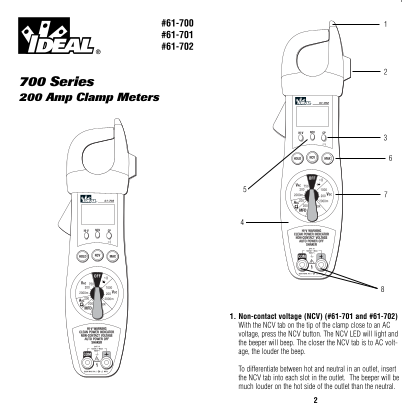
1. Non-contact voltage (NCV) (#61-701 and #61-702) With the NCV tab on the tip of the clamp close to an AC voltage, press the NCV button. The NCV LED will light and the beeper will beep. The closer the NCV tab is to AC volt- age, the louder the beep.
To differentiate between hot and neutral in an outlet, insert the NCV tab into each slot in the outlet. The beeper will be much louder on the hot side of the outlet than the neutral.
Page Summary Contents For Ideal 61-700/1/2/4 200 AAC Clamp Meter Instructions
Manual Details
| Brand | Ideal |
|---|---|
| Pages | 6 |
| File Size | 217.07 KB |
| Published | May 23, 2026 |
Enter the captcha to get the download link:

Frequently Asked Questions
How do I determine if a circuit has more than 5% harmonic distortion?
Observe the green LED indicator (#61-702). If it is not on, the circuit may have more than 5% total harmonic distortion.
What are the temperature and voltage limits for high voltage measurements?
Voltage cannot exceed 600 Volts for #61-700 or #61-701, nor 750VAC or 1000VDC for #61-702.
How do I properly test for Non-contact voltage (NCV)?
Close the NCV tab to an AC voltage and press the NCV button. The LED will light, and the beeper will beep; closeness determines beep loudness.
What precautions should be taken before resistance/capacitance measurements?
Turn off power to the circuit or device, fully discharge all capacitors, and remember that these functions must not be performed on circuits delivering greater than 600 Volts.