Honeywell PMT-AM-TIMS-LTM6300-PCM45F-PTM5000 Series Data Sheet
Summary
Honeywell's line of thermally conductive Phase Change Materials (PCMs) offers essential thermal management solutions for high-performance integrated circuits. Available as pads and pastes, these materials are engineered to minimize interface thermal resistance, ensuring superior reliability even in demanding, long-life applications. This document provides comprehensive technical specifications—including thermal conductivity and impedance data—for various PTM series parts. It is designed for engineers and product designers who require robust, low-thermal-impedance components to efficiently manage heat dissipation in advanced electronic devices.
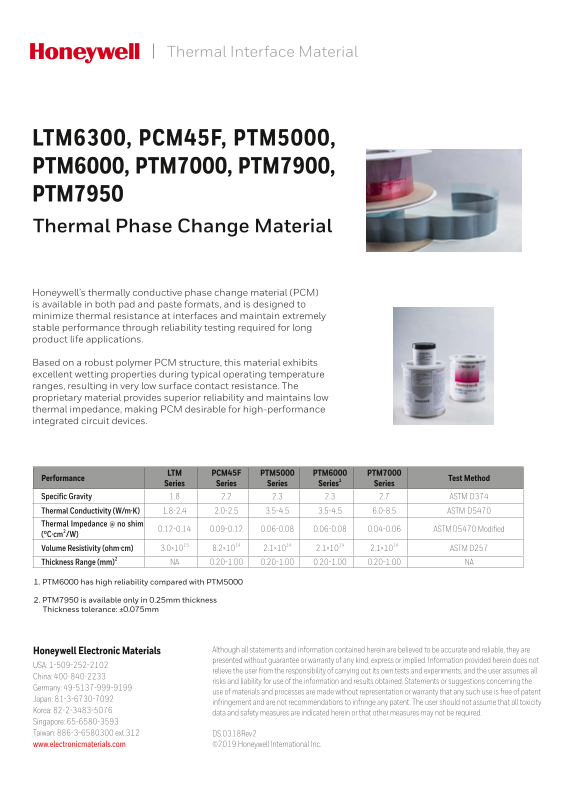
Page 1 Text Content
Thermal Interface Material
LTM6300, PCM45F, PTM5000, PTM6000, PTM7000, PTM7900, PTM7950 Thermal Phase Change Material
Honeywell’s thermally conductive phase change material (PCM) is available in both pad and paste formats, and is designed to minimize thermal resistance at interfaces and maintain extremely stable performance through reliability testing required for long product life applications.
Based on a robust polymer PCM structure, this material exhibits excellent wetting properties during typical operating temperature ranges, resulting in very low surface contact resistance. The proprietary material provides superior reliability and maintains low thermal impedance, making PCM desirable for high-performance integrated circuit devices.
LTM PCM45F PTM5000 PTM6000 PTM7000
Performance Test Method
Series Series Series Series1 Series
Specific Gravity 1.8 2.2 2.3 2.3 2.7 ASTM D374 Thermal Conductivity (W/m·K) 1.8-2.4 2.0-2.5 3.5-4.5 3.5-4.5 6.0-8.5 ASTM D5470 Thermal Impedance @ no shim
0.12-0.14 0.09-0.12 0.06-0.08 0.06-0.08 0.04-0.06 ASTM D5470 Modified
(°C·cm2/W) Volume Resistivity (ohm·cm) 3.0×10¹⁵ 8.2×10¹⁴ 2.1×10¹⁴ 2.1×10¹⁴ 2.1×10¹⁴ ASTM D257 Thickness Range (mm)2 NA 0.20-1.00 0.20-1.00 0.20-1.00 0.20-1.00 NA
1. PTM6000 has high reliability compared with PTM5000
2. PTM7950 is available only in 0.25mm thickness Thickness tolerance: ±0.075mm
Honeywell Electronic Materials Although all statements and information contained herein are believed to be accurate and reliable, they are presented without guarantee or warranty of any kind, express or implied. Information provided herein does not
USA: 1-509-252-2102
relieve the user from the responsibility of carrying out its own tests and experiments, and the user assumes all
China: 400-840-2233
risks and liability for use of the information and results obtained. Statements or suggestions concerning the
Germany: 49-5137-999-9199
use of materials and processes are made without representation or warranty that any such use is free of patent
Japan: 81-3-6730-7092
infringement and are not recommendations to infringe any patent. The user should not assume that all toxicity
Korea: 82-2-3483-5076
data and safety measures are indicated herein or that other measures may not be required.
Singapore: 65-6580-3593 Taiwan: 886-3-6580300 ext.312 DS.0318Rev2 www.electronicmaterials.com ©2019 Honeywell International Inc.
Page Summary Contents For Honeywell PMT-AM-TIMS-LTM6300-PCM45F-PTM5000 Series Data Sheet
Manual Details
| Brand | Honeywell |
|---|---|
| Pages | 1 |
| File Size | 65.24 KB |
| Published | June 03, 2026 |
Enter the captcha to get the download link:

Frequently Asked Questions
What is the primary function of using a thermally conductive phase change material?
It minimizes thermal resistance at interfaces and helps maintain extremely stable performance through reliability testing.
What is the typical reliable operating thickness range for these materials?
The general thickness range listed across models is 0.20-1.00 mm, although PTM7950 is limited to a 0.25mm thickness.
How does PTM6000 compare in terms of reliability with PTM5000?
The manual specifically notes that the PTM6000 model has high reliability when compared with the PTM5000.
Are these materials guaranteed for a user's specific application without risk?
No, all information is presented without guarantee or warranty; users are responsible for carrying out their own tests and experiments.