Fairchild Audible Noise Reduction Techniques for FPS Applications - Data Handbook
Summary
This technical guide provides essential engineering techniques for minimizing audible noise generated by switched-mode power supplies utilizing Fairchild Power Switches. It addresses major sources of buzzing, including mechanical resonance from transformers and piezoelectric effects from capacitors. Key solutions covered include implementing slope compensation circuits, modifying transformer designs to reduce flux swing, and selecting appropriate capacitor replacements to ensure quiet operation in demanding SMPS applications.
Page 1 Text Content
www.fairchildsemi.com
Application Note AN4148 Audible Noise Reduction Techniques for FPS Applications
1. Introduction - Capacitor Audible Noise Ceramic capacitors can also produce audible noise, since
In general, switched mode power supplies do not generate
they have piezoelectric characteristics. If there is still too
audible noise when they operate at constant ultrasonic
much audible noise in burst operation after gluing or
frequencies (>20k Hz). However, some switched mode
varnishing the transformer properly, the capacitor in the
power supplies can produce audible noise at certain load
snubber network should be examined.
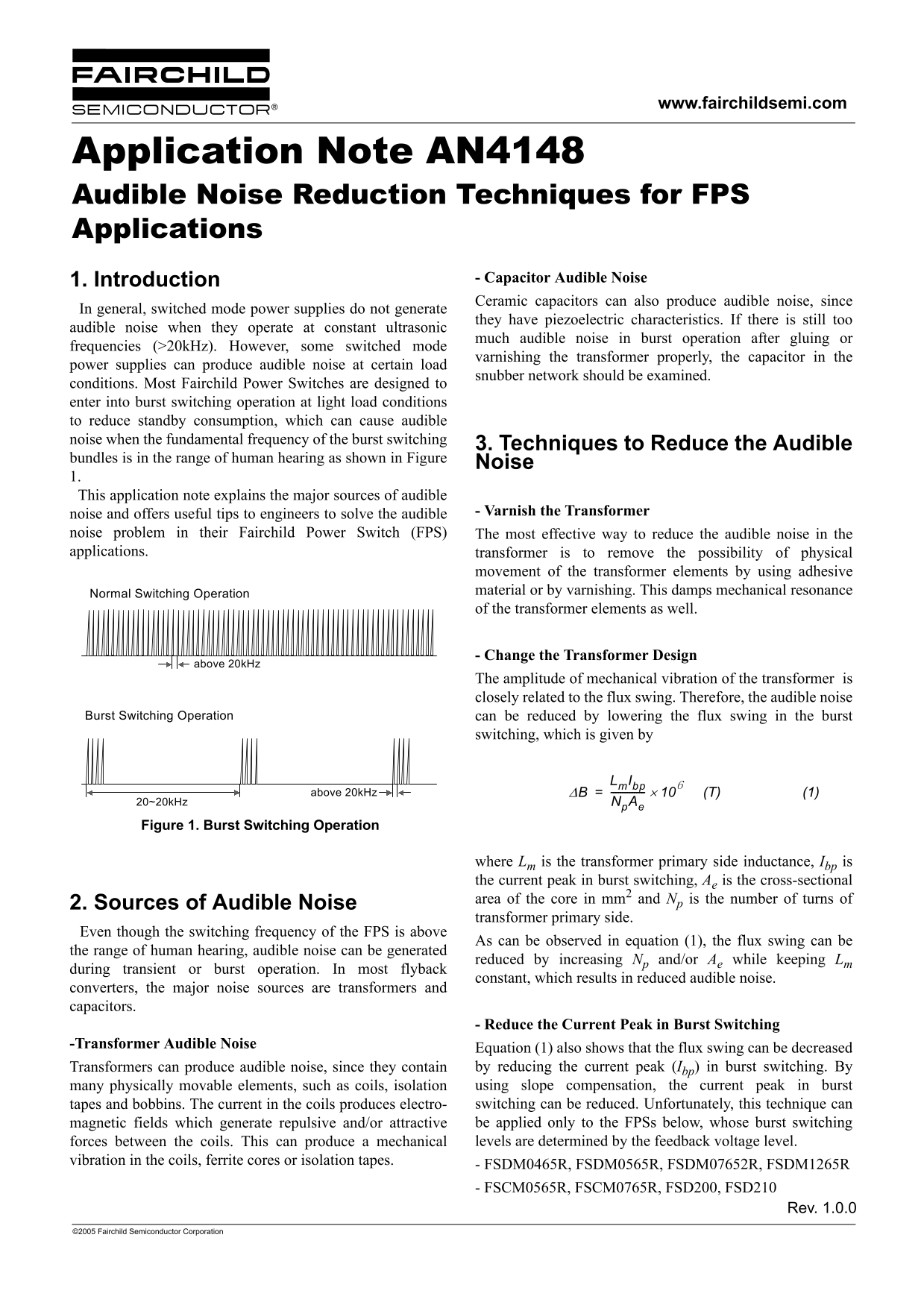
conditions. Most Fairchild Power Switches are designed to enter into burst switching operation at light load conditions to reduce standby consumption, which can cause audible noise when the fundamental frequency of the burst switching
3. Techniques to Reduce the Audible
bundles is in the range of human hearing as shown in Figure
Noise
1. This application note explains the major sources of audible
noise and offers useful tips to engineers to solve the audible - Varnish the Transformer
noise problem in their Fairchild Power Switch (FPS) The most effective way to reduce the audible noise in the applications. transformer is to remove the possibility of physical
movement of the transformer elements by using adhesive Normal Switching Operation material or by varnishing. This damps mechanical resonance of the transformer elements as well.
- Change the Transformer Design
above 20k Hz
The amplitude of mechanical vibration of the transformer is closely related to the flux swing. Therefore, the audible noise
Burst Switching Operation can be reduced by lowering the flux swing in the burst
switching, which is given by
Lm Ibp
above 20k Hz ∆B 106 (T)×= (1)
20~20k Hz Np Ae Figure 1. Burst Switching Operation
where Lm is the transformer primary side inductance, Ibp is the current peak in burst switching, Ae is the cross-sectional area of the core in mm2 and Np is the number of turns of
2. Sources of Audible Noise
transformer primary side.
Even though the switching frequency of the FPS is above
As can be observed in equation (1), the flux swing can be
the range of human hearing, audible noise can be generated
reduced by increasing Np and/or Ae while keeping Lm
during transient or burst operation. In most flyback
constant, which results in reduced audible noise.
converters, the major noise sources are transformers and capacitors.
- Reduce the Current Peak in Burst Switching
-Transformer Audible Noise
Equation (1) also shows that the flux swing can be decreased Transformers can produce audible noise, since they contain by reducing the current peak (Ibp) in burst switching. By many physically movable elements, such as coils, isolation using slope compensation, the current peak in burst tapes and bobbins. The current in the coils produces electro- switching can be reduced. Unfortunately, this technique can magnetic fields which generate repulsive and/or attractive be applied only to the FPSs below, whose burst switching forces between the coils. This can produce a mechanical levels are determined by the feedback voltage level.
vibration in the coils, ferrite cores or isolation tapes.
- FSDM0465R, FSDM0565R, FSDM07652R, FSDM1265R - FSCM0565R, FSCM0765R, FSD200, FSD210
Rev. 1.0.0
©2005 Fairchild Semiconductor Corporation
Page Summary Contents For Fairchild Audible Noise Reduction Techniques for FPS Applications - Data Handbook
Manual Details
| Brand | Fairchild |
|---|---|
| Pages | 5 |
| File Size | 215.16 KB |
| Published | July 15, 2026 |
Enter the captcha to get the download link:

Frequently Asked Questions
What causes audible noise when using ceramic capacitors?
Ceramic capacitors can produce audible noise due to their piezoelectric characteristics.
How can transformer audible noise be reduced during operation?
Varnishing the transformer or changing its design (e.g., keeping flux swing below 20kHz) can damp mechanical resonance and reduce audible noise.
What is a technique for reducing current peaks during burst switching?
Implementing a slope compensation circuit using a resistor and capacitor introduces necessary voltage dips in the feedback signal, thus lowering the current peak.
Can other components contribute to audible noise?
Yes; capacitors (ceramic types) and transformer physical elements are major sources of audible noise besides the main switching action.