Fairchild AN-5008 Data Manual
Summary
Fairchild Semiconductor application note AN-5008 on FSTU undershoot-protected bus switch family. The document explains undershoot conditions in digital buses, protection mechanisms against negative voltage transients, and advantages over standard bus transceivers in hot-swap and reflective-wave applications. Target users are hardware engineers designing reliable bus architectures for computers, telecommunications, and data communications systems.
Page 1 Text Content
-5008 F - U ersh t P ro tected airch ild itch am ily
AN-5008 Fairchild Semiconductor Application Note March 1999 Revised October 2006
FSTU - Undershoot Protected Fairchild Switch Family
Undershoot conditions can occur on busses that are poorly
Introduction
terminated, on signals with very fast edge rates, or on bus-
Fairchild Switch (FST) Bus Switch products have become
ses that allow hot-swapping. The first solution to under-
powerful tools in the modern personal computer as well as
shoot events is to ensure proper termination of
increasing in popularity in telecommunications and data
transmission lines. Some systems are designed to be
communications applications. The Fairchild Switch Family
reflective-wave and therefore rely on the impedance mis-
has a number of positive attributes over the standard bus
match to increase signal levels at the receiver. The PCI
transceivers. FST parts introduce virtually no propagation
Bus is an example of an intentionally reflective-wave bus. It
delay into the line, consume a negligible amount of power,
is reflected-wave architecture that minimizes the amount of
and introduce none of the noise issues associated with the
drive required for PCI devices. Yet these reflections can
typical high-drive bus transceiver. In most applications, use
also cause undershoot conditions.
of FST Bus Switches will alleviate the problems of the bus
Another potential source of undershoot are the early volt-
transceiver without creating new ones.
ages present during the hot-swapping of boards in applica-
In the presence of large amounts of system signal under-
tions such as ser vers and telecommunications systems.
shoot voltage on I/O po rts, the typical NMOS bus switch
Changes are continuing to be made to hot-swap sequenc-
can malfunction. Usually concern with undershoot voltages
ing and electrical requirements within standards specifica-
pertains to latch-up. This is not a con cern with FST prod-
tions such as Compact PCI. These changes make it even
ucts. FST Bus Switches have been characterized for latch-
more critical to ensure that bus switches do not malfunction
up and exceed the 500 m A upper limit of the latch-up
under such conditions.
tester. The real issue is the potential coupling of data from
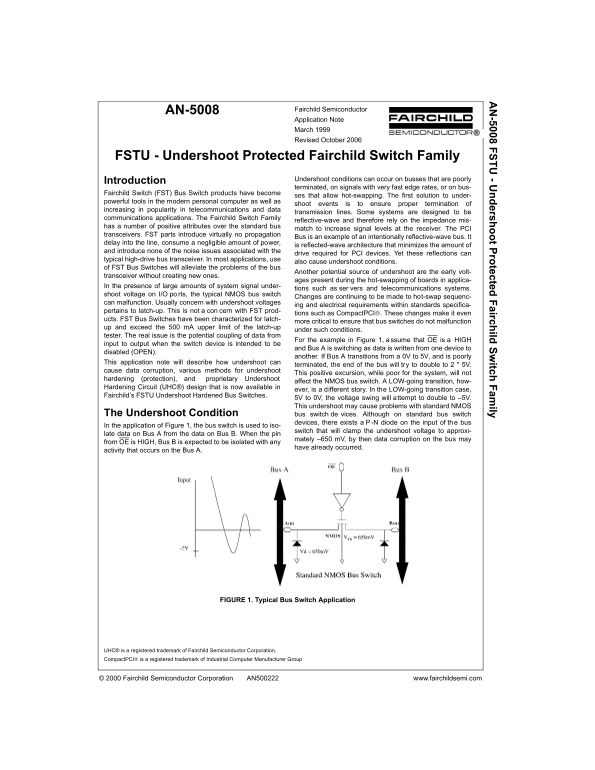
For the example in Figure 1, a ssume that OE is a HIGH
input to output when the switch device is intended to be
and Bus A is switching as data is written from one device to
disabled (OPEN).
another. If Bus A transitions from a 0V to 5V, and is poorly
This application note will describe how undershoot can
terminated, the end of the bus will try to double to 2 * 5V.
cause data corruption, various methods for undershoot
This positive excursion, while poor for the system, will not
hardening (protection), and proprietary Undershoot
affect the NMOS bus switch. A LOW-going transition, how-
Hardening Circuit (UHC®) design that is now available in
ever, is a different story. In the LOW-going transition case,
Fairchild’s FSTU Undershoot Hardened Bus Switches.
5V to 0V, the voltage swing will attempt to double to –5V. This undershoot may cause problems with standard NMOS
The Undershoot Condition bus switch de vices. Although on standard bus switch
devices, there exists a P -N diode on the input of the bus
In the application of Figure 1, the bus switch is used to iso-
switch that will clamp the undershoot voltage to approxi-
late data on Bus A from the data on Bus B. When the pin
mately –650 m V, by then data corruption on the bus may
from OE is HIGH, Bus B is expected to be isolated with any
have already occurred.
activity that occurs on the Bus A.
FIGURE 1. Typical Bus Switch Application
UHC® is a registered trademark of Fairchild Semiconductor Corporation. Compact PCI is a registered trademark of Industrial Computer Manufacturer Group
© 2000 Fairchild Semiconductor Corporation AN500222 www.fairchildsemi.com
Page Summary Contents For Fairchild AN-5008 Data Manual
Manual Details
| Brand | Fairchild |
|---|---|
| Pages | 4 |
| File Size | 122.37 KB |
| Published | June 17, 2026 |
Enter the captcha to get the download link:

Frequently Asked Questions
What is undershoot and when does it occur?
Undershoot can occur on poorly terminated busses, signals with fast edge rates, or busses allowing hot-swapping.
How can undershoot cause problems in a bus switch?
Undershoot can cause data corruption by potentially coupling data from input to output when the switch is supposed to be disabled.
What is Fairchild's proprietary solution for undershoot protection?
Fairchild offers the FSTU family of undershoot hardened bus switches using a proprietary Undershoot Hardening Circuit (UHC®).