Dell P1914S Monitor Statement of Volatility
Summary
The Statement of Volatility for Dell P1914S details volatile and non-volatile memory components. It identifies serial flash, VGA EDID EEPROM, DVI EDID EEPROM, and OSD EEPROM as non-volatile. DDR3 memory loses data when power is removed. Target users are security professionals and government agencies assessing memory volatility for data sanitization and disposal compliance.
Page 1 Text Content
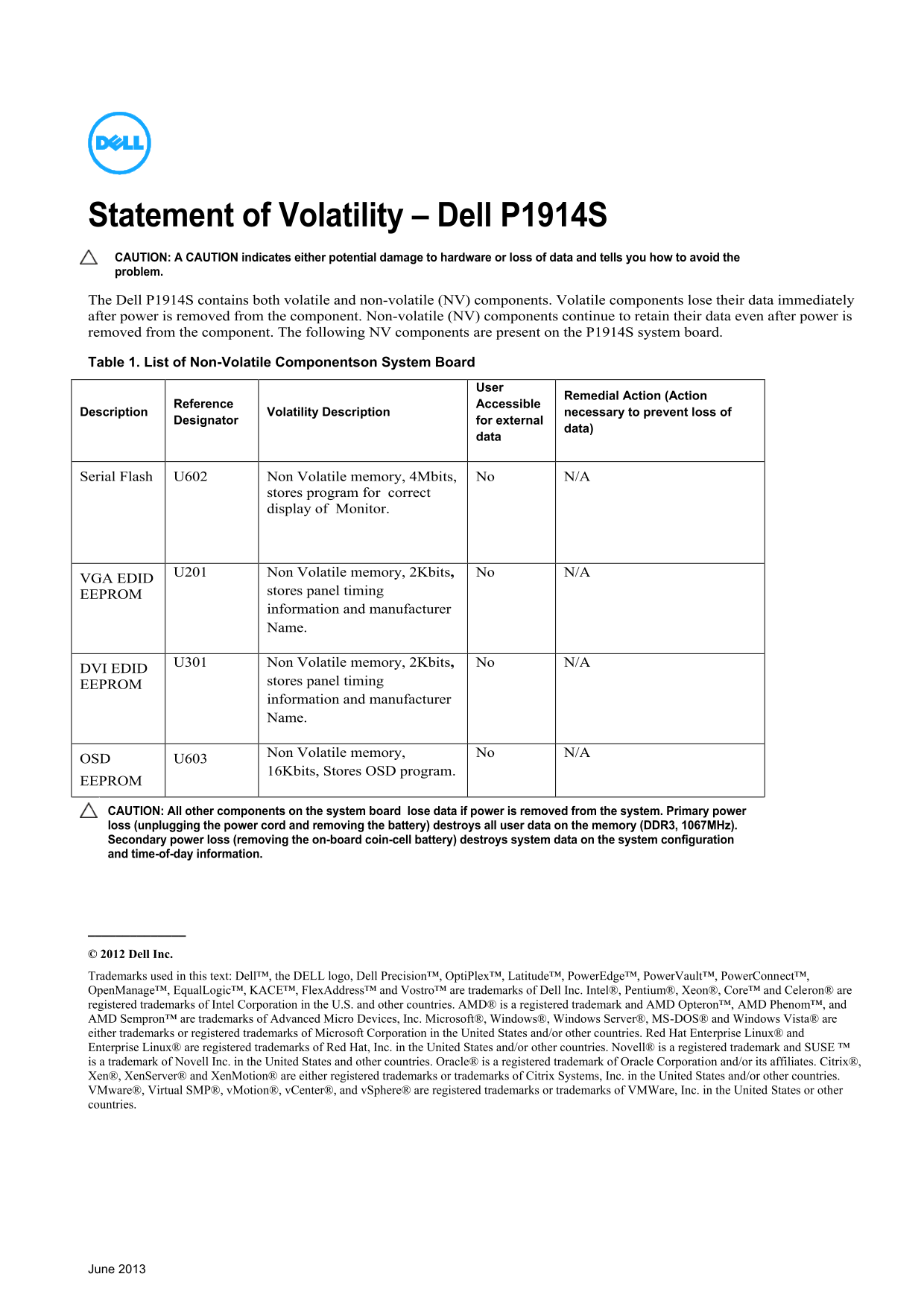
Statement of Volatility – Dell P1914S CAUTION: A CAUTION indicates either potential damage to hardware or loss of data and tells you how to avoid the problem. The Dell P1914S contains both volatile and non-volatile (NV) components. Volatile components lose their data immediately after power is removed from the component. Non-volatile (NV) components continue to retain their data even after power is removed from the component. The following NV components are present on the P1914S system board. Table 1. List of Non-Volatile Componentson System Board
Remedial Action (Action
Reference Accessible
Description Volatility Description necessary to prevent loss of
Designator for external
data)
Serial Flash U602 Non Volatile memory, 4Mbits, No N/A
stores program for correct display of Monitor.
U201 Non Volatile memory, 2Kbits, No N/A
VGA EDID
stores panel timing
EEPROM
information and manufacturer Name.
U301 Non Volatile memory, 2Kbits, No N/A
DVI EDID
stores panel timing
EEPROM
information and manufacturer Name.
No N/A
OSD U603 Non Volatile memory,
16Kbits, Stores OSD program.
EEPROM
CAUTION: All other components on the system board lose data if power is removed from the system. Primary power loss (unplugging the power cord and removing the battery) destroys all user data on the memory (DDR3, 1067MHz). Secondary power loss (removing the on-board coin-cell battery) destroys system data on the system configuration and time-of-day information.
© 2012 Dell Inc.
Trademarks used in this text: Dell™, the DELL logo, Dell Precision™, Opti Plex™, Latitude™, Power Edge™, Power Vault™, Power Connect™, Open Manage™, Equal Logic™, KACE™, Flex Address™ and Vostro™ are trademarks of Dell Inc. Intel®, Pentium®, Xeon®, Core™ and Celeron® are registered trademarks of Intel Corporation in the U.S. and other countries. AMD® is a registered trademark and AMD Opteron™, AMD Phenom™, and AMD Sempron™ are trademarks of Advanced Micro Devices, Inc. Microsoft®, Windows®, Windows Server®, MS-DOS® and Windows Vista® are either trademarks or registered trademarks of Microsoft Corporation in the United States and/or other countries. Red Hat Enterprise Linux® and Enterprise Linux® are registered trademarks of Red Hat, Inc. in the United States and/or other countries. Novell® is a registered trademark and SUSE ™ is a trademark of Novell Inc. in the United States and other countries. Oracle® is a registered trademark of Oracle Corporation and/or its affiliates. Citrix®, Xen®, Xen Server® and Xen Motion® are either registered trademarks or trademarks of Citrix Systems, Inc. in the United States and/or other countries. VMware®, Virtual SMP®, v Motion®, v Center®, and v Sphere® are registered trademarks or trademarks of VMWare, Inc. in the United States or other countries.
June 2013
Page Summary Contents For Dell P1914S Monitor Statement of Volatility
Manual Details
| Brand | Dell |
|---|---|
| Pages | 1 |
| File Size | 221.47 KB |
| Published | June 27, 2026 |
Enter the captcha to get the download link:

Frequently Asked Questions
What type of data is stored on volatile components?
Volatile components lose their data immediately after power is removed from them.
Which memory types retain data even without power?
Non-volatile (NV) components, such as Flash U602 and EEPROMs, continue to retain their data.
What causes the loss of user data on DDR3 memory?
Primary power loss, which is defined as unplugging the power cord or removing the battery, destroys all user data.
How does secondary power loss affect system configuration data?
Secondary power loss (removing the coin-cell battery) destroys system configuration and time-of-day information.