Dell Measuring Performance of Intel Broadwell-EP Processors with WRF and NAMD Applications Owner's Manual
Summary
Gain deep insights into high-performance computing with this technical analysis of Intel Broadwell processors. This comprehensive guide assesses the performance capabilities of various E5-26xx v4 series chips using industry-standard workloads, including Weather Research and Forecasting (WRF) and NAnoscale Molecular Dynamics (NAMD). The manual compares results from Broadwell against previous generations across massive comparative data sets, while also detailing how BIOS tuning options impact overall system efficiency. Ideal for HPC architects, researchers, and technical professionals needing to optimize compute-intensive environments.
Page 1 Text Content
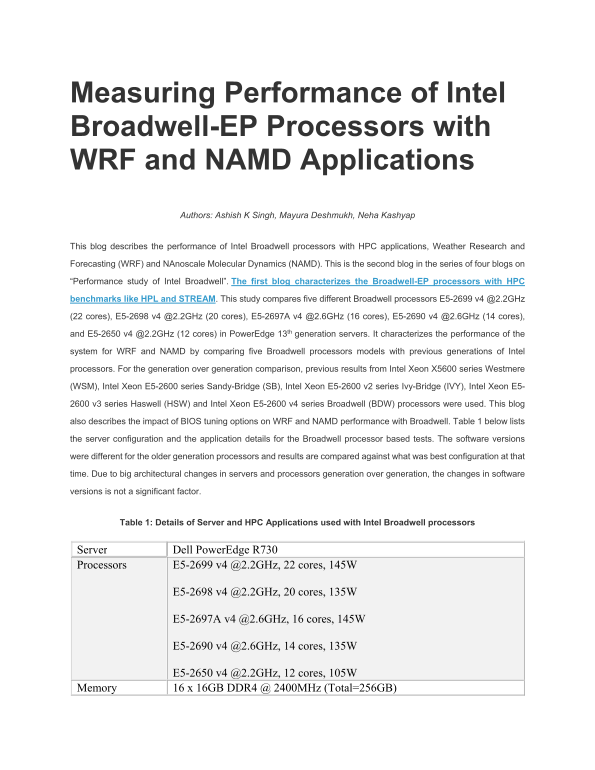
Measuring Performance of Intel Broadwell-EP Processors with WRF and NAMD Applications Authors: Ashish K Singh, Mayura Deshmukh, Neha Kashyap This blog describes the performance of Intel Broadwell processors with HPC applications, Weather Research and Forecasting (WRF) and NAnoscale Molecular Dynamics (NAMD). This is the second blog in the series of four blogs on “Performance study of Intel Broadwell”. The first blog characterizes the Broadwell-EP processors with HPC benchmarks like HPL and STREAM. This study compares five different Broadwell processors E5-2699 v4 @2.2GHz (22 cores), E5-2698 v4 @2.2GHz (20 cores), E5-2697A v4 @2.6GHz (16 cores), E5-2690 v4 @2.6GHz (14 cores), and E5-2650 v4 @2.2GHz (12 cores) in Power Edge 13th generation servers. It characterizes the performance of the system for WRF and NAMD by comparing five Broadwell processors models with previous generations of Intel processors. For the generation over generation comparison, previous results from Intel Xeon X5600 series Westmere (WSM), Intel Xeon E5-2600 series Sandy-Bridge (SB), Intel Xeon E5-2600 v2 series Ivy-Bridge (IVY), Intel Xeon E5- 2600 v3 series Haswell (HSW) and Intel Xeon E5-2600 v4 series Broadwell (BDW) processors were used. This blog also describes the impact of BIOS tuning options on WRF and NAMD performance with Broadwell. Table 1 below lists the server configuration and the application details for the Broadwell processor based tests. The software versions were different for the older generation processors and results are compared against what was best configuration at that time. Due to big architectural changes in servers and processors generation over generation, the changes in software versions is not a significant factor.
Table 1: Details of Server and HPC Applications used with Intel Broadwell processors
Server Dell Power Edge R730 Processors E5-2699 v4 @2.2GHz, 22 cores, 145W
E5-2698 v4 @2.2GHz, 20 cores, 135W
E5-2697A v4 @2.6GHz, 16 cores, 145W
E5-2690 v4 @2.6GHz, 14 cores, 135W
E5-2650 v4 @2.2GHz, 12 cores, 105W
Memory 16 x 16GB DDR4 @ 2400MHz (Total=256GB)
Page Summary Contents For Dell Measuring Performance of Intel Broadwell-EP Processors with WRF and NAMD Applications Owner's Manual
Manual Details
| Brand | Intel |
|---|---|
| Pages | 11 |
| File Size | 674.32 KB |
| Published | May 23, 2026 |
Enter the captcha to get the download link:

Frequently Asked Questions
What HPC applications were tested with Intel Broadwell processors?
The study utilized Weather Research and Forecasting (WRF) and NAnoscale Molecular Dynamics (NAMD).
How can I optimize WRF performance when the tile is too large for the CPU cache?
To reduce the size of the tile, increase the number of tiles by defining “numtile = x” in the input file or setting the environment variable “WRF_NUM_TILES = x”.
What determines the best processor choice between the various Broadwell models?
The performance improves with additional cores for NAMD workloads. For WRF, high core counts up to 16 cores show increased performance, but improvements level off afterward.