Dell HPC Benchmarks and Applications Performance Study on Broadwell
Summary
This technical study analyzes HPC benchmark and application performance on Intel Broadwell-EP 4S processors using Dell PowerEdge R830 servers. It evaluates High Performance Linpack (HPL), STREAM, Weather Research and Forecasting (WRF), NAMD molecular dynamics, and Ansys Fluent under different BIOS profiles and memory snoop modes. The study targets HPC engineers, data scientists, and IT architects designing high-performance computing infrastructure.
Page 1 Text Content
HPC Benchmarks and Applications Performance Study on Broadwell-EP 4S Processor
Author: Neha Kashyap, August 2016 (HPC Innovation Lab)
The intent of this blog is to illustrate and analyze the performance obtained on Intel Broadwell-EP 4S processor with the focus on
HPC applications, two synthetic benchmarks along with four applications namely, High Performance Linpack (HPL), STREAM,
Weather Research and Forecasting (WRF), NAnoscale Molecular Dynamics (NAMD) and Fluent. These runs have been performed
on a standalone single server Power Edge R830. Combinations of System BIOS profiles and Memory Snoop modes are compared for better analysis.
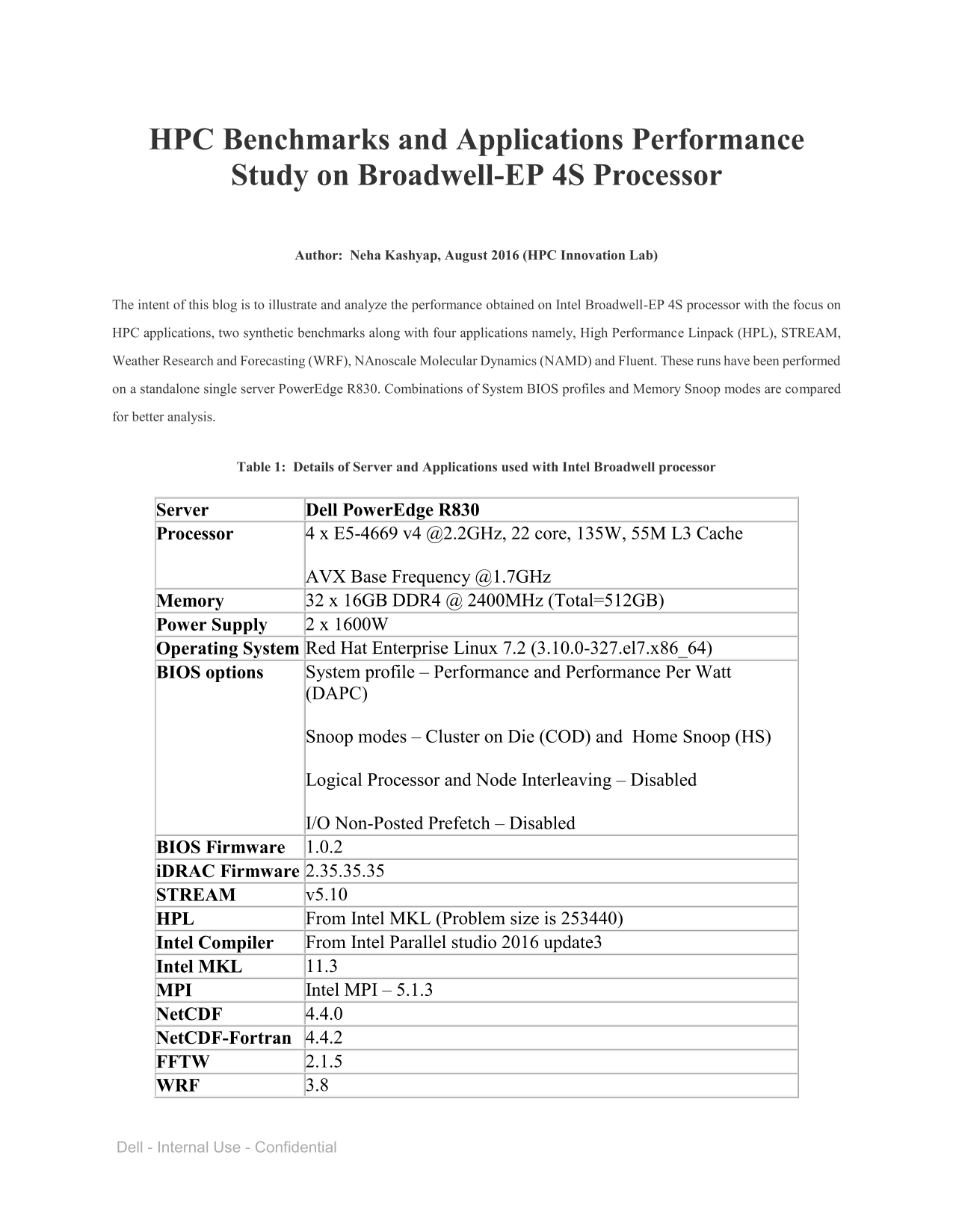
Table 1: Details of Server and Applications used with Intel Broadwell processor
Server Dell Power Edge R830 Processor 4 x E5-4669 v4 @2.2GHz, 22 core, 135W, 55M L3 Cache
AVX Base Frequency @1.7GHz
Memory 32 x 16GB DDR4 @ 2400MHz (Total=512GB) Power Supply 2 x 1600W Operating System Red Hat Enterprise Linux 7.2 (3.10.0-327.el7.x86_64) BIOS options System profile – Performance and Performance Per Watt
(DAPC)
Snoop modes – Cluster on Die (COD) and Home Snoop (HS)
Logical Processor and Node Interleaving – Disabled
I/O Non-Posted Prefetch – Disabled
BIOS Firmware 1.0.2 i DRAC Firmware 2.35.35.35 STREAM v5.10 HPL From Intel MKL (Problem size is 253440) Intel Compiler From Intel Parallel studio 2016 update3 Intel MKL 11.3 MPI Intel MPI – 5.1.3 Net CDF 4.4.0 Net CDF-Fortran 4.4.2 FFTW 2.1.5 WRF 3.8
Dell - Internal Use - Confidential
Page Summary Contents For Dell HPC Benchmarks and Applications Performance Study on Broadwell
Manual Details
| Brand | Dell |
|---|---|
| Pages | 7 |
| File Size | 485.00 KB |
| Published | June 24, 2026 |
Enter the captcha to get the download link:

Frequently Asked Questions
Which BIOS profile provides the best performance?
The DAPC.COD system BIOS profile yields the best results for HPC workloads like STREAM, HPL, NAMD, and Fluent.
What is the total memory bandwidth on the PowerEdge R830?
The full system memory bandwidth is approximately 226 GB/s in the DAPC.COD configuration.
What snoop modes are supported on the Intel Broadwell-EX processor?
The processor supports Home Snoop (HS) and Cluster on Die (COD) modes, with COD being available on models with more than 12 cores.
How does COD mode compare to Home Snoop mode in terms of performance?
COD mode performs 2.9-3.0% better in STREAM, 6.1-6.7% better in NAMD, and 2-5% better in Fluent compared to HS mode.