Toshiba TOSHIBA TLP296G User's Manual(1)(1)
Summary
The TLP296G is a robust bi-directional optocoupler designed to provide reliable electrical switching and galvanic isolation in complex circuits. This manual provides comprehensive technical specifications for its integration, covering maximum ratings up to 2500V rms, operational voltage ranges, and precise performance parameters for efficient system design. It is the ideal component for engineers building general electronics, industrial automation systems, measuring instruments, and consumer devices requiring stable, non-contact relay replacement.
Page 1 Text Content
TLP296G
TOSHIBA Photocoupler Photo Relay
TLP296G
Telecommunication
Unit in mm
Data Acquisition Measurement Instrumentation
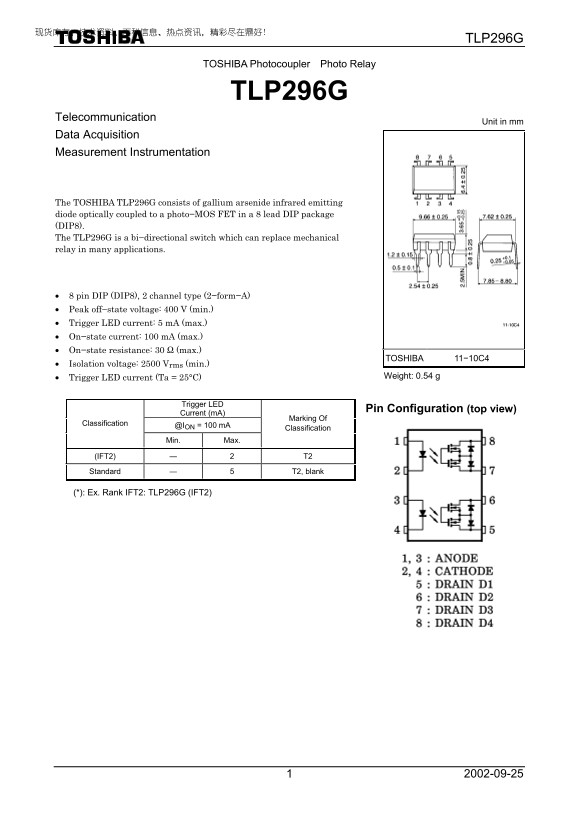
The TOSHIBA TLP296G consists of gallium arsenide infrared emitting diode optically coupled to a photo−MOS FET in a 8 lead DIP package (DIP8). The TLP296G is a bi−directional switch which can replace mechanical relay in many applications.
8 pin DIP (DIP8), 2 channel type (2−form−A) Peak off−state voltage: 400 V (min.) Trigger LED current: 5 m A (max.) On−state current: 100 m A (max.) On−state resistance: 30 Ω (max.)
TOSHIBA 11−10C4
Isolation voltage: 2500 Vrms (min.)
Trigger LED current (Ta = 25°C) Weight: 0.54 g
Trigger LED
Pin Configuration (top view)
Current (m A)
Marking Of
@ION = 100 m A Classification
Classification
Min. Max.
(IFT2) ― 2 T2 Standard ― 5 T2, blank
(*): Ex. Rank IFT2: TLP296G (IFT2)
Page Summary Contents For Toshiba TOSHIBA TLP296G User's Manual(1)(1)
Manual Details
| Brand | Toshiba |
|---|---|
| Pages | 6 |
| File Size | 470.24 KB |
| Published | June 02, 2026 |
Enter the captcha to get the download link:

Frequently Asked Questions
What is the minimum isolation voltage of the TLP296G?
It offers a minimum isolation voltage of 2500 V rms.
Are there specific safety warnings regarding the materials used?
Yes, Gallium arsenide (GaAs) dust and fumes are toxic; do not break or pulverize the product.
Is this device suitable for life-support or medical instrumentation?
No, it is not warranted for equipment requiring extraordinary reliability or where failure could cause loss of human life.