Texas Instruments TUSB2043 4-Port Hub for the Universal Serial Bus with Optional Serial EEPROM Interface
Summary
This reliable 4-port USB 1.1 hub solution provides robust connectivity for embedded systems, supporting one upstream and four downstream ports. Engineered with a digital state machine that requires no firmware programming, it offers full compatibility with both low-speed and full-speed devices. Ideal for hardware engineers designing advanced electronics, the manual details sophisticated features including optional serial EEPROM ID customization, integrated power management (over-current detection), and high noise immunity.
Page 1 Text Content
TUSB2043
4-PORT HUB FOR THE UNIVERSAL SERIAL BUS WITH OPTIONAL SERIAL EEPROM INTERFACE
SLLS308A – FEBRUARY 1999 – REVISED AUGUST 1999
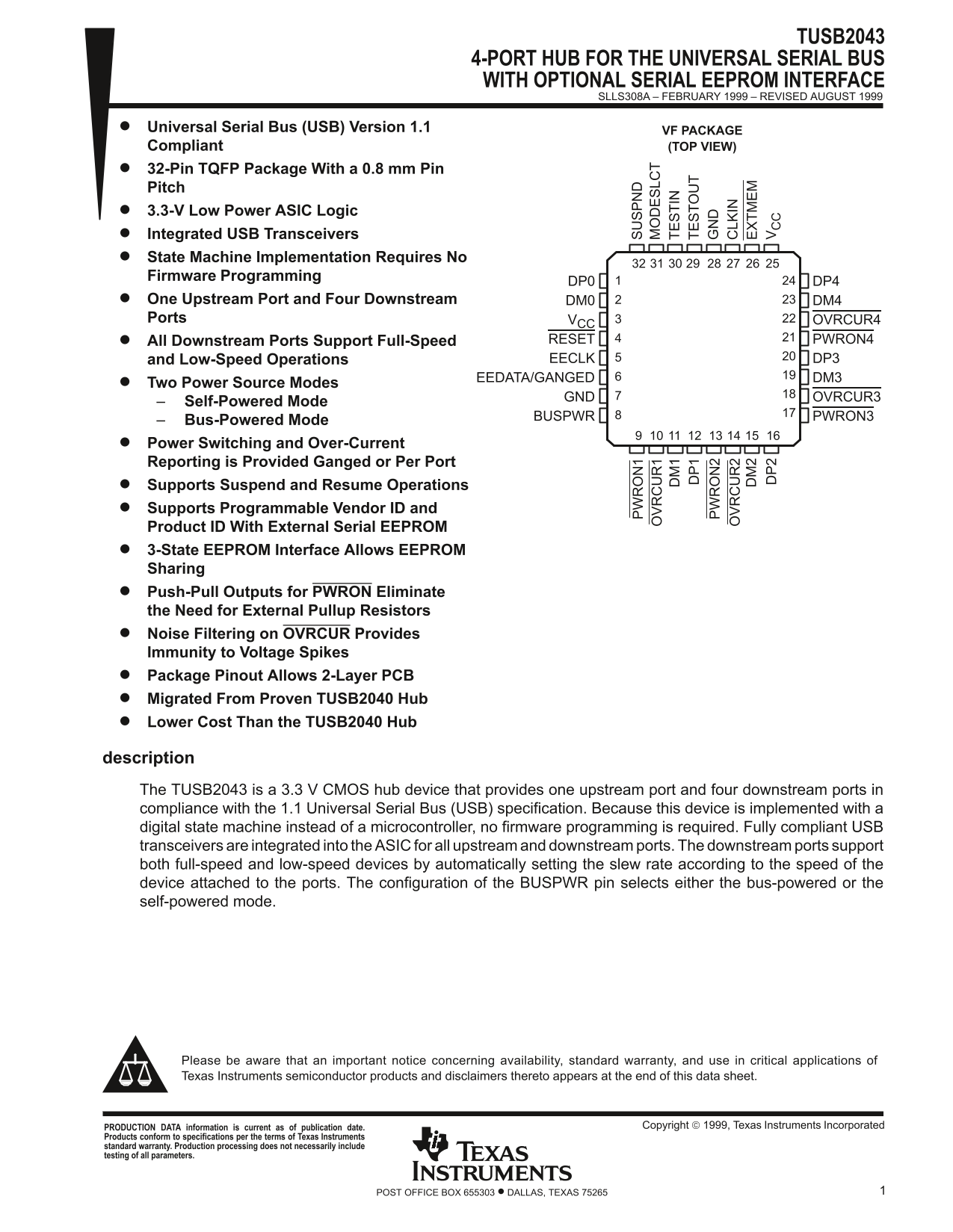
Universal Serial Bus (USB) Version 1.1 VF PACKAGE Compliant (TOP VIEW) 32-Pin TQFP Package With a 0.8 mm Pin Pitch 3.3-V Low Power ASIC Logic Integrated USB Transceivers State Machine Implementation Requires No Firmware Programming
DP0 DP4
One Upstream Port and Four Downstream DM0 DM4 Ports VCC OVRCUR4
All Downstream Ports Support Full-Speed RESET PWRON4 and Low-Speed Operations EECLK DP3
EEDATA/GANGED DM3
Two Power Source Modes
GND OVRCUR3
Self-Powered Mode
BUSPWR PWRON3
Bus-Powered Mode Power Switching and Over-Current Reporting is Provided Ganged or Per Port Supports Suspend and Resume Operations Supports Programmable Vendor ID and Product ID With External Serial EEPROM 3-State EEPROM Interface Allows EEPROM Sharing Push-Pull Outputs for PWRON Eliminate the Need for External Pullup Resistors Noise Filtering on OVRCUR Provides Immunity to Voltage Spikes LC
Package Pinout Allows 2-Layer PCB IN
Migrated From Proven TUSB2040 Hub Lower Cost Than the TUSB2040 Hub
LK IN
description The TUSB2043 is a 3.3 V CMOS hub device that provides one upstream port and four downstream ports in compliance with the 1.1 Universal Serial Bus (USB) specification. Because this device is implemented with a digital state machine instead of a microcontroller, no firmware programming is required. Fully compliant USB transceivers are integrated into the ASIC for all upstream and downstream ports. The downstream ports support both full-speed and low-speed devices by automatically setting the slew rate according to the speed of the device attached to the ports. The configuration of the BUSPWR pin selects either the bus-powered or the self-powered mode.
Please be aware that an important notice concerning availability, standard warranty, and use in critical applications of Texas Instruments semiconductor products and disclaimers thereto appears at the end of this data sheet.
Copyright 1999, Texas Instruments Incorporated PRODUCTION DATA information is current as of publication date.
Products conform to specifications per the terms of Texas Instruments standard warranty. Production processing does not necessarily include testing of all parameters.
1POST OFFICE BOX 655303 • DALLAS, TEXAS 75265
Page Summary Contents For Texas Instruments TUSB2043 4-Port Hub for the Universal Serial Bus with Optional Serial EEPROM Interface
Manual Details
| Brand | Texas Instruments |
|---|---|
| Pages | 16 |
| File Size | 228.36 KB |
| Published | July 12, 2026 |
Enter the captcha to get the download link:

Frequently Asked Questions
Does the TUSB2043 require firmware programming?
No, because it is implemented with a digital state machine instead of a microcontroller.
How do I customize the USB Product ID (PID) and Vendor ID (VID)?
Set the EXTMEM pin to low (EXTMEM = 0). This enables the optional EEPROM interface for custom descriptors.
What is supported power management for downstream ports?
The GANGED input determines if all PWRON outputs switch together or operate on a per-port basis, allowing for controlled over-current detection and power switching.
Does this hub support different operating speeds?
Yes, all downstream ports support both full-speed and low-speed operations by automatically setting the slew rate based on the attached device.