Roland KR-111 Digital Intelligent Mini-Grand Piano Addendum User Manual
Summary
Master the complexities of classical music with this essential guide to historical temperaments. It details how to select and utilize diverse tunings, including Just Intonation, Mean Tone, and Equal Temperament, for highly accurate musical performances. Whether you are exploring Baroque sonorities or mastering ancient tuning systems, this manual provides detailed instructions on adapting your device to play in any key while maintaining historically true tonal quality. Ideal for musicians seeking advanced control over pitch and style.
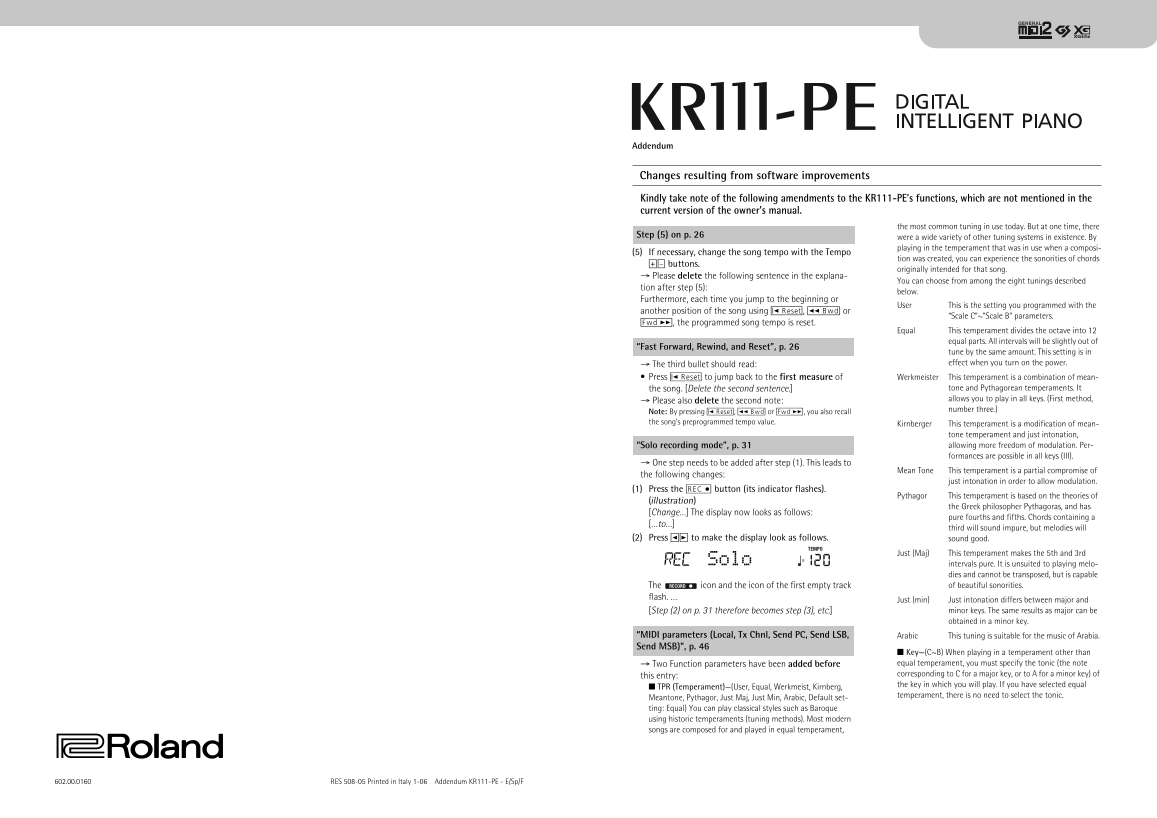
Page 1 Text Content
Addendum
Changes resulting from software improvements Kindly take note of the following amendments to the KR111-PE’s functions, which are not mentioned in the current version of the owner’s manual.
the most common tuning in use today. But at one time, there
Step (5) on p. 26
were a wide variety of other tuning systems in existence. By playing in the temperament that was in use when a composi-
(5) If necessary, change the song tempo with the Tempo
tion was created, you can experience the sonorities of chords
[+][–] buttons.
originally intended for that song.
Please delete the following sentence in the explana-
You can choose from among the eight tunings described
tion after step (5):
below.
Furthermore, each time you jump to the beginning or
User This is the setting you programmed with the
another position of the song using [|√¥Reset] [√√¥Bwd] or
“Scale C”~“Scale B” parameters.
[Fwd¥®®] , the programmed song tempo is reset.
Equal This temperament divides the octave into 12
equal parts. All intervals will be slightly out of
“Fast Forward, Rewind, and Reset”, p. 26
tune by the same amount. This setting is in The third bullet should read: effect when you turn on the power.
Press [|ôReset] to jump back to the first measure of Werkmeister This temperament is a combination of mean-
the song. [ Delete the second sentence. tone and Pythagorean temperaments. It Please also delete the second note: allows you to play in all keys. (First method, number three.)
Note: By pressing [|√¥Reset] [√√¥Bwd] or [Fwd¥®®] , you also recall the song’s preprogrammed tempo value. Kirnberger This temperament is a modification of mean-
tone temperament and just intonation, “Solo recording mode”, p. 31 allowing more freedom of modulation. Per- formances are possible in all keys (III).
One step needs to be added after step (1). This leads to
Mean Tone This temperament is a partial compromise of
the following changes:
just intonation in order to allow modulation.
(1) Press the [REC¥∏] button (its indicator flashes).
Pythagor This temperament is based on the theories of
illustration
the Greek philosopher Pythagoras, and has
Change… ] The display now looks as follows:
pure fourths and fifths. Chords containing a
[… to …]
third will sound impure, but melodies will
(2) Press [√][®] to make the display look as follows. sound good.
Just (Maj) This temperament makes the 5th and 3rd
=Solo
intervals pure. It is unsuited to playing melo- dies and cannot be transposed, but is capable
The icon and the icon of the first empty track RECORD of beautiful sonorities. flash. …
Just (min) Just intonation differs between major and
Step (2) on p. 31 therefore becomes step (3), etc. minor keys. The same results as major can be obtained in a minor key.
“MIDI parameters (Local, Tx Chnl, Send PC, Send LSB, Arabic This tuning is suitable for the music of Arabia. Send MSB)”, p. 46
Key— (C~B) When playing in a temperament other than Two Function parameters have been added before equal temperament, you must specify the tonic (the note this entry: corresponding to C for a major key, or to A for a minor key) of the key in which you will play. If you have selected equal
TPR (Temperament)— (User, Equal, Werkmeist, Kirnberg,
temperament, there is no need to select the tonic.
Meantone, Pythagor, Just Maj, Just Min, Arabic, Default set- ting: Equal) You can play classical styles such as Baroque using historic temperaments (tuning methods). Most modern songs are composed for and played in equal temperament,
602.00.0160 RES 508-05 Printed in Italy 1-06 Addendum KR111-PE - E/Sp/F
Page Summary Contents For Roland KR-111 Digital Intelligent Mini-Grand Piano Addendum User Manual
Manual Details
| Brand | Roland |
|---|---|
| Pages | 2 |
| File Size | 78.05 KB |
| Published | May 29, 2026 |
Enter the captcha to get the download link:

Frequently Asked Questions
Qué sistema de afinación puedo usar para tocar música en todas las tonalidades (claves)?
El temperamento Kirnberger permite tocar en todas las claves y es una modificación del temperamento menor común-tono just intonation con influencia pitagórica.
Cómo puedo cambiar la velocidad (tempo) de una canción programada?
Puedes usar los botones [+][–] para aumentar o disminuir el tempo. Si saltas al principio o reinicias, el tempo se restablece automáticamente.
¿Qué es 'Temperamento Igual' y cuándo se aplica por defecto?
El Temperamento Igual divide la octava en 12 partes iguales, lo que hace que todos los intervalos sean ligeramente desiguales. Está activo cuando enciendes el equipo.
Si quiero jugar música clásica antigua (estilos barrocos), ¿cómo debo seleccionar el modo de afinación?
Debes usar uno de los temperamentos históricos como Werkmeister o Pythagor, ya que están diseñados para emular las afinaciones antiguas utilizadas en esa época.