RICOH RV5VG1 Series Rechargeable Lithium-Ion Cell Protectors
Summary
The RV5VG1 series are highly accurate circuit protectors designed for single-cell lithium-ion batteries. These devices prevent damage by monitoring and responding to overcharging, excessive discharging, and external short circuits. The comprehensive manual provides detailed technical specifications, including adjustable detection thresholds and sensing delays, allowing users maximum flexibility in protection settings. Ideal for engineers and designers of portable electronics, such as cellular phones, camcorders, and power packs, requiring reliable battery management solutions.
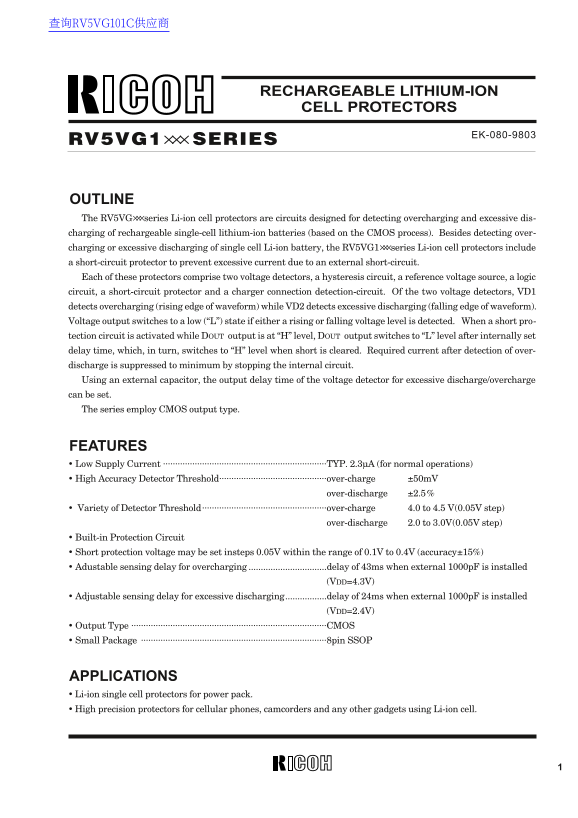
Page 1 Text Content
查询RV5VG101C供应商
RECHARGEABLE LITHIUM-ION CELL PROTECTORS
EK-080-9803
RV5VG1×××SERIES
OUTLINE The RV5VG×××series Li-ion cell protectors are circuits designed for detecting overcharging and excessive dis- charging of rechargeable single-cell lithium-ion batteries (based on the CMOS process). Besides detecting over- charging or excessive discharging of single cell Li-ion battery, the RV5VG1×××series Li-ion cell protectors include a short-circuit protector to prevent excessive current due to an external short-circuit. Each of these protectors comprise two voltage detectors, a hysteresis circuit, a reference voltage source, a logic circuit, a short-circuit protector and a charger connection detection-circuit. Of the two voltage detectors, VD1 detects overcharging (rising edge of waveform) while VD2 detects excessive discharging (falling edge of waveform). Voltage output switches to a low (“L”) state if either a rising or falling voltage level is detected. When a short pro-
tection circuit is activated while DOUT output is at “H” level, DOUT output switches to “L” level after internally set
delay time, which, in turn, switches to “H” level when short is cleared. Required current after detection of over- discharge is suppressed to minimum by stopping the internal circuit. Using an external capacitor, the output delay time of the voltage detector for excessive discharge/overcharge can be set. The series employ CMOS output type.
FEATURES
...................................................................TYP. 2.3µA (for normal operations)
Low Supply Current High Accuracy Detector Threshold............................................over-charge ±50m V
over-discharge ±2.5%
Variety of Detector Threshold...................................................over-charge 4.0 to 4.5 V(0.05V step)
over-discharge 2.0 to 3.0V(0.05V step)
Built-in Protection Circuit Short protection voltage may be set insteps 0.05V within the range of 0.1V to 0.4V (accuracy±15%) Adustable sensing delay for overcharging ................................delay of 43ms when external 1000p F is installed
(VDD=4.3V)
Adjustable sensing delay for excessive discharging.................delay of 24ms when external 1000p F is installed
(VDD=2.4V)
Output Type ................................................................................CMOS Small Package ............................................................................8pin SSOP
APPLICATIONS • Li-ion single cell protectors for power pack. • High precision protectors for cellular phones, camcorders and any other gadgets using Li-ion cell.
Page Summary Contents For RICOH RV5VG1 Series Rechargeable Lithium-Ion Cell Protectors
Manual Details
| Brand | Ricoh |
|---|---|
| Pages | 9 |
| File Size | 82.76 KB |
| Published | May 27, 2026 |
Enter the captcha to get the download link:

Frequently Asked Questions
What is the primary function of the RV5VG series?
It provides circuits to detect overcharging and excessive discharging in single-cell lithium-ion batteries, while also offering short-circuit protection.
How can the output delay for overcharge/overdischarge be adjusted?
The internal circuit allows adjusting the sensing delay using external capacitors connected to CT1 (for VD1) or CT2 (for VD2).
What are the operating limits and pin functions?
The device operates from -0.3V to +12V on VDD, with DOUT output detecting over-discharge; COUT detects overcharge.
Is this component suitable for high-reliability applications?
No, users planning extreme reliability systems (e.g., aircraft) must contact the manufacturer due to inherent failure probability of semiconductors.