National Semiconductor LMV551 Data Sheet
Summary
The LMV551/LMV552/LMV554 are high-performance, micropower operational amplifiers featuring up to 3 MHz bandwidth and rail-to-rail output. Ideal for low power applications, the manual provides detailed electrical characteristics, temperature ratings, and technical specifications necessary for designers. Designed with a wide operating voltage range (2.7V–5.5V) and robust performance down to -40°C, these op-amps are specifically suited for demanding environments like automotive systems, portable instrumentation, active filters, and battery-powered sensor applications.
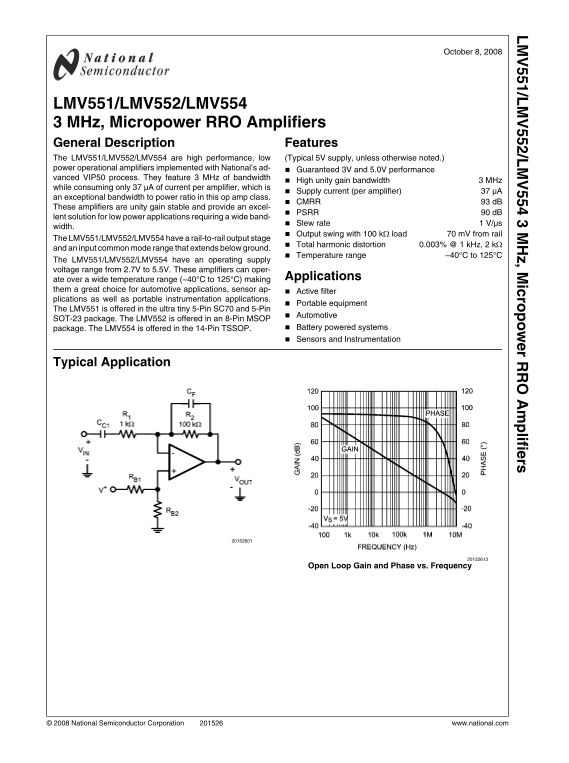
Page 1 Text Content
/L /L z, M ic ro r R lifie rs
October 8, 2008
LMV551/LMV552/LMV554 3 MHz, Micropower RRO Amplifiers General Description Features The LMV551/LMV552/LMV554 are high performance, low (Typical 5V supply, unless otherwise noted.) power operational amplifiers implemented with National’s ad- Guaranteed 3V and 5.0V performance vanced VIP50 process. They feature 3 MHz of bandwidth
High unity gain bandwidth 3 MHz
while consuming only 37 μA of current per amplifier, which is
Supply current (per amplifier) 37 µA
an exceptional bandwidth to power ratio in this op amp class.
CMRR 93 d B
These amplifiers are unity gain stable and provide an excel-
PSRR 90 d B
lent solution for low power applications requiring a wide band-
Slew rate 1 V/µs
width.
Output swing with 100 kΩ load 70 m V from rail
The LMV551/LMV552/LMV554 have a rail-to-rail output stage
Total harmonic distortion 0.003% @ 1 k Hz, 2 kΩ
and an input common mode range that extends below ground.
Temperature range −40°C to 125°C
The LMV551/LMV552/LMV554 have an operating supply voltage range from 2.7V to 5.5V. These amplifiers can oper-
ate over a wide temperature range (−40°C to 125°C) making Applications
them a great choice for automotive applications, sensor ap-
Active filter
plications as well as portable instrumentation applications.
Portable equipment
The LMV551 is offered in the ultra tiny 5-Pin SC70 and 5-Pin
Automotive
SOT-23 package. The LMV552 is offered in an 8-Pin MSOP
package. The LMV554 is offered in the 14-Pin TSSOP. Battery powered systems Sensors and Instrumentation
Typical Application
Open Loop Gain and Phase vs. Frequency
© 2008 National Semiconductor Corporation www.national.com
Page Summary Contents For National Semiconductor LMV551 Data Sheet
Manual Details
| Brand | National |
|---|---|
| Pages | 14 |
| File Size | 938.05 KB |
| Published | June 15, 2026 |
Enter the captcha to get the download link:

Frequently Asked Questions
What is the operating supply voltage range?
The amplifiers operate over a supply voltage range of 2.7V to 5.5V.
What temperature extremes can these amplifiers handle?
They can operate over a wide temperature range from -40°C to 125°C.
How much current do the LMV55x series consume?
The supply current is only 37 µA per amplifier, making them low-power designs.
Are these units suitable for automotive use?
Yes, their wide temperature range makes them a great choice for automotive applications and portable instrumentation.