MAXIM MAX6061-MAX6068 Precision, Micropower, Low-Dropout, High-Output-Current, SOT23 Voltage References
Summary
Discover the MAX6061–MAX6068 series: ultra-small, micropower voltage references designed for demanding low-voltage applications. These precision devices deliver stable, low-dropout voltages in a compact SOT23 package, ensuring efficiency and reliability in space-critical builds that require minimal external components. This guide provides comprehensive technical specifications, operational guidelines, and application details—making it ideal for battery-powered portable systems like ADCs, GPS units, cellular phones, and notebooks needing reliable voltage stability from -40°C to +85°C.
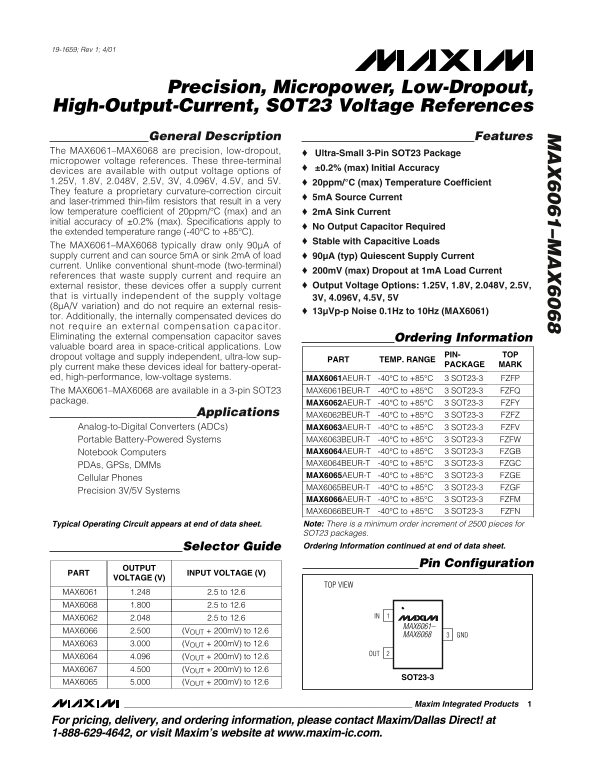
Page 1 Text Content
19-1659; Rev 1; 4/01
Precision, Micropower, Low-Dropout,
High-Output-Current, SOT23 Voltage References
General Description Features
The MAX6061–MAX6068 are precision, low-dropout,
Ultra-Small 3-Pin SOT23 Package
micropower voltage references. These three-terminal
±0.2% (max) Initial Accuracy
devices are available with output voltage options of 1.25V, 1.8V, 2.048V, 2.5V, 3V, 4.096V, 4.5V, and 5V. 20ppm/°C (max) Temperature Coefficient They feature a proprietary curvature-correction circuit
5m A Source Current
and laser-trimmed thin-film resistors that result in a very low temperature coefficient of 20ppm/°C (max) and an 2m A Sink Current initial accuracy of ±0.2% (max). Specifications apply to
No Output Capacitor Required
the extended temperature range (-40°C to +85°C).
Stable with Capacitive Loads
The MAX6061–MAX6068 typically draw only 90µA of supply current and can source 5m A or sink 2m A of load 90µA (typ) Quiescent Supply Current current. Unlike conventional shunt-mode (two-terminal)
200m V (max) Dropout at 1m A Load Current
references that waste supply current and require an
external resistor, these devices offer a supply current Output Voltage Options: 1.25V, 1.8V, 2.048V, 2.5V,
that is virtually independent of the supply voltage 3V, 4.096V, 4.5V, 5V (8µA/V variation) and do not require an external resis-
13µVp-p Noise 0.1Hz to 10Hz (MAX6061)
tor. Additionally, the internally compensated devices do not require an external compensation capacitor. Eliminating the external compensation capacitor saves Ordering Information valuable board area in space-critical applications. Low
dropout voltage and supply independent, ultra-low sup-
PART TEMP. RANGE
PACKAGE MARK
ply current make these devices ideal for battery-operat- ed, high-performance, low-voltage systems. MAX6061AEUR-T -40°C to +85°C 3 SOT23-3 FZFP
The MAX6061–MAX6068 are available in a 3-pin SOT23 MAX6061BEUR-T -40°C to +85°C 3 SOT23-3 FZFQ
package. MAX6062AEUR-T -40°C to +85°C 3 SOT23-3 FZFY
Applications MAX6062BEUR-T -40°C to +85°C 3 SOT23-3 FZFZ
Analog-to-Digital Converters (ADCs) MAX6063AEUR-T -40°C to +85°C 3 SOT23-3 FZFV
Portable Battery-Powered Systems MAX6063BEUR-T -40°C to +85°C 3 SOT23-3 FZFW Notebook Computers MAX6064AEUR-T -40°C to +85°C 3 SOT23-3 FZGB PDAs, GPSs, DMMs MAX6064BEUR-T -40°C to +85°C 3 SOT23-3 FZGC MAX6065AEUR-T -40°C to +85°C 3 SOT23-3 FZGE
Cellular Phones
MAX6065BEUR-T -40°C to +85°C 3 SOT23-3 FZGF
Precision 3V/5V Systems
MAX6066AEUR-T -40°C to +85°C 3 SOT23-3 FZFM MAX6066BEUR-T -40°C to +85°C 3 SOT23-3 FZFN Typical Operating Circuit appears at end of data sheet. Note: There is a minimum order increment of 2500 pieces for SOT23 packages. Selector Guide Ordering Information continued at end of data sheet.
Pin Configuration
OUTPUT
PART INPUT VOLTAGE (V)
VOLTAGE (V)
TOP VIEW
MAX6061 1.248 2.5 to 12.6 MAX6068 1.800 2.5 to 12.6
MAX6062 2.048 2.5 to 12.6
MAX6061–
MAX6066 2.500 (VOUT + 200m V) to 12.6
MAX6068 GND
MAX6063 3.000 (VOUT + 200m V) to 12.6
MAX6064 4.096 (VOUT + 200m V) to 12.6 MAX6067 4.500 (VOUT + 200m V) to 12.6
SOT23-3
MAX6065 5.000 (VOUT + 200m V) to 12.6
Maxim Integrated Products
For pricing, delivery, and ordering information, please contact Maxim/Dallas Direct! at 1-888-629-4642, or visit Maxim’s website at www.maxim-ic.com.
Page Summary Contents For MAXIM MAX6061-MAX6068 Precision, Micropower, Low-Dropout, High-Output-Current, SOT23 Voltage References
Manual Details
| Brand | Current |
|---|---|
| Pages | 16 |
| File Size | 545.90 KB |
| Published | May 28, 2026 |
Enter the captcha to get the download link:

Frequently Asked Questions
Are these references suitable for battery-powered equipment?
Yes, they are ideal for battery-operated, high-performance, low-voltage systems because they have ultra-low dropout and a supply-independent current.
Do I need to use an external compensation capacitor?
No, the internally compensated devices eliminate the requirement for an external compensation capacitor, saving board space.
What is the typical operating temperature range?
The standard operating temperature range listed is -40°C to +85°C.
How do these references perform compared to conventional shunt-mode types?
They draw a supply current that is virtually independent of the supply voltage and avoid wasting supply current.