MAXIM INTEGRATED PRODUCTS MAX8520 MAX8521 Smallest TEC Power Drivers for Optical Modules
Summary
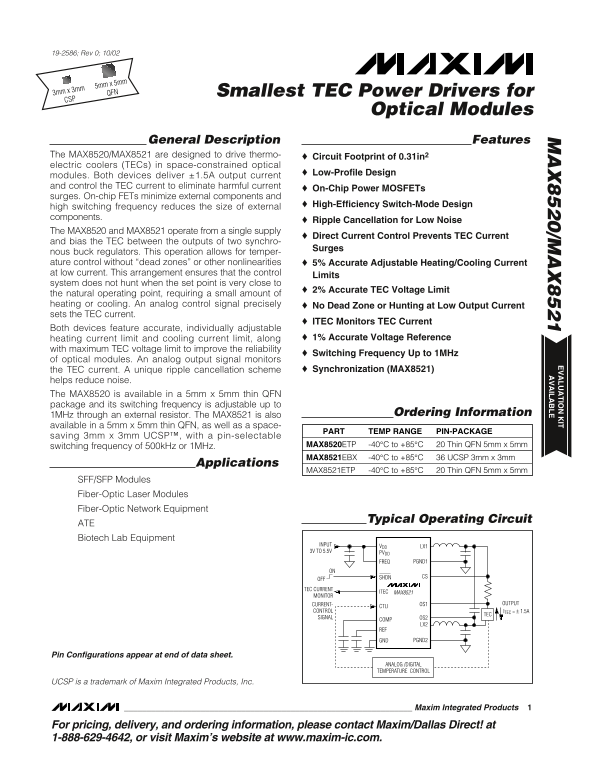
Optimize temperature control for high-density optical modules using the MAX8520/MAX8521 TEC Power Drivers. These compact, high-efficiency drivers deliver precise $\pm$1.5A current output while maintaining stable operation and eliminating noise in space-constrained systems. Ideal for network equipment, fiber optics, and biotech applications needing reliable thermal management. The manual provides essential details on implementation, specifications, and integration guidelines needed for superior performance.
Page 1 Text Content
IO IT /M IL
19-2586; Rev 0; 10/02
5mm x 5mm
3mm x 3mm QFN Smallest TEC Power Drivers for CSP
Optical Modules
General Description Features
The MAX8520/MAX8521 are designed to drive thermo- Circuit Footprint of 0.31in2 electric coolers (TECs) in space-constrained optical
Low-Profile Design
modules. Both devices deliver ±1.5A output current and control the TEC current to eliminate harmful current
On-Chip Power MOSFETs
surges. On-chip FETs minimize external components and
High-Efficiency Switch-Mode Design
high switching frequency reduces the size of external components.
Ripple Cancellation for Low Noise
The MAX8520 and MAX8521 operate from a single supply
Direct Current Control Prevents TEC Current
and bias the TEC between the outputs of two synchro-
Surges
nous buck regulators. This operation allows for temper- ature control without “dead zones” or other nonlinearities 5% Accurate Adjustable Heating/Cooling Current at low current. This arrangement ensures that the control
Limits
system does not hunt when the set point is very close to
2% Accurate TEC Voltage Limit
the natural operating point, requiring a small amount of heating or cooling. An analog control signal precisely No Dead Zone or Hunting at Low Output Current sets the TEC current.
ITEC Monitors TEC Current
Both devices feature accurate, individually adjustable
heating current limit and cooling current limit, along 1% Accurate Voltage Reference
with maximum TEC voltage limit to improve the reliability
Switching Frequency Up to 1MHz
of optical modules. An analog output signal monitors
the TEC current. A unique ripple cancellation scheme Synchronization (MAX8521)
helps reduce noise. The MAX8520 is available in a 5mm x 5mm thin QFN package and its switching frequency is adjustable up to
1MHz through an external resistor. The MAX8521 is also Ordering Information
available in a 5mm x 5mm thin QFN, as well as a space-
PART TEMP RANGE PIN-PACKAGE
saving 3mm x 3mm UCSP™, with a pin-selectable
switching frequency of 500k Hz or 1MHz. MAX8520ETP -40°C to +85°C 20 Thin QFN 5mm x 5mm MAX8521EBX -40°C to +85°C 36 UCSP 3mm x 3mm
Applications
MAX8521ETP -40°C to +85°C 20 Thin QFN 5mm x 5mm
SFF/SFP Modules Fiber-Optic Laser Modules Fiber-Optic Network Equipment
Typical Operating Circuit
ATE Biotech Lab Equipment
INPUT VDD LX1 3V TO 5.5V PVDD
FREQ PGND1
SHDN CS
TEC CURRENT
ITEC MAX8521
MONITOR
CURRENT- OS1 OUTPUT
CONTROL ITEC = ± 1.5A
SIGNAL OS2
GND PGND2
Pin Configurations appear at end of data sheet.
ANALOG /DIGITAL TEMPERATURE CONTROL
UCSP is a trademark of Maxim Integrated Products, Inc.
Maxim Integrated Products
For pricing, delivery, and ordering information, please contact Maxim/Dallas Direct! at 1-888-629-4642, or visit Maxim’s website at www.maxim-ic.com.
Page Summary Contents For MAXIM INTEGRATED PRODUCTS MAX8520 MAX8521 Smallest TEC Power Drivers for Optical Modules
Manual Details
| Brand | Maxim Integrated |
|---|---|
| Pages | 19 |
| File Size | 605.71 KB |
| Published | May 26, 2026 |
Enter the captcha to get the download link:

Frequently Asked Questions
What voltage range can the device operate from?
The MAX8520/MAX8521 devices operate from a single supply ranging between 3V and 5.5V.
How do these drivers handle high-frequency noise?
They use a unique ripple cancellation scheme to reduce noise, and the MAX8521 supports TEC current synchronization.
Is this product suitable for highly space-constrained modules?
Yes, they are designed specifically for optical modules in space-constrained environments and offer low-profile packages.
What is the maximum switching frequency supported?
The device's switching frequency can be adjustable up to 1MHz through an external resistor.