MAXIM INTEGRATED PRODUCTS DS1603 Elapsed Time Counter Module User's Manual
Summary
The DS1603 is a precision Real-Time Clock/Elapsed Time Counter module designed for seamless integration into embedded systems. This dual-counter device accurately tracks seconds with exceptional reliability, featuring one dedicated 32-bit counter that retains data even when external power fails, alongside an integral battery backup lasting over ten years. Data communication occurs via a simple, efficient serial port protocol. It is essential for engineers developing applications that require highly accurate continuous timing measurement, monitoring equipment operational time, and deriving precise date metrics in portable or critical environments.
Page 1 Text Content
DS1603
www.maxim-ic.com
Elapsed Time Counter Module
www.maxim-ic.com
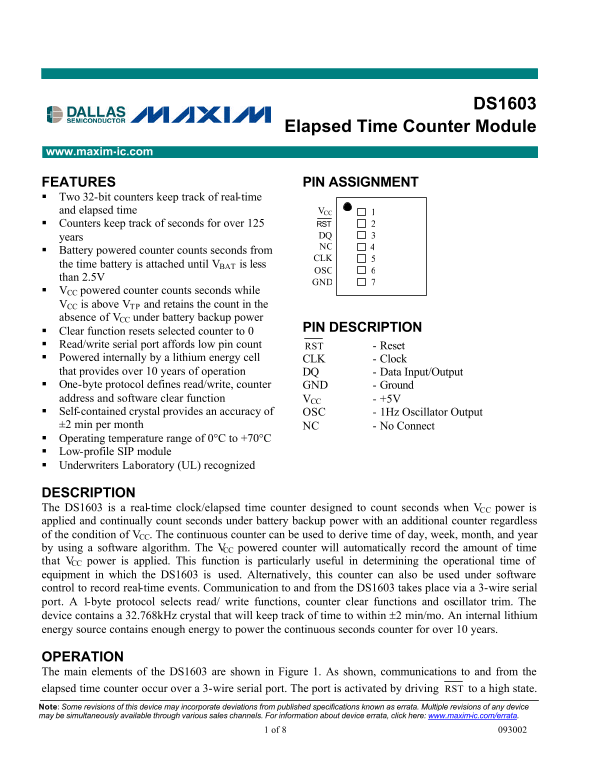
FEATURES PIN ASSIGNMENT § Two 32-bit counters keep track of real-time and elapsed time VCC § Counters keep track of seconds for over 125 RST
years DQ NC
§ Battery powered counter counts seconds from
the time battery is attached until VBAT is less
than 2.5V
§ VCC powered counter counts seconds while VCC is above VTP and retains the count in the absence of VCC under battery backup power
PIN DESCRIPTION
§ Clear function resets selected counter to 0 § Read/write serial port affords low pin count RST - Reset § Powered internally by a lithium energy cell CLK - Clock that provides over 10 years of operation DQ - Data Input/Output § One-byte protocol defines read/write, counter GND - Ground address and software clear function VCC - +5V § Self-contained crystal provides an accuracy of OSC - 1Hz Oscillator Output ±2 min per month NC - No Connect § Operating temperature range of 0°C to +70°C § Low-profile SIP module § Underwriters Laboratory (UL) recognized
DESCRIPTION The DS1603 is a real-time clock/elapsed time counter designed to count seconds when VCC power is applied and continually count seconds under battery backup power with an additional counter regardless of the condition of VCC. The continuous counter can be used to derive time of day, week, month, and year by using a software algorithm. The VCC powered counter will automatically record the amount of time that VCC power is applied. This function is particularly useful in determining the operational time of equipment in which the DS1603 is used. Alternatively, this counter can also be used under software control to record real-time events. Communication to and from the DS1603 takes place via a 3-wire serial port. A 1-byte protocol selects read/ write functions, counter clear functions and oscillator trim. The device contains a 32.768k Hz crystal that will keep track of time to within ±2 min/mo. An internal lithium energy source contains enough energy to power the continuous seconds counter for over 10 years.
OPERATION The main elements of the DS1603 are shown in Figure 1. As shown, communications to and from the elapsed time counter occur over a 3-wire serial port. The port is activated by driving RST to a high state. Note: Some revisions of this device may incorporate deviations from published specifications known as errata. Multiple revisions of any device may be simultaneously available through various sales channels. For information about device errata, click here: www.maxim-ic.com/errata.
1 of 8 093002
Page Summary Contents For MAXIM INTEGRATED PRODUCTS DS1603 Elapsed Time Counter Module User's Manual
Manual Details
| Brand | Maxim Integrated |
|---|---|
| Pages | 9 |
| File Size | 223.70 KB |
| Published | May 26, 2026 |
Enter the captcha to get the download link:

Frequently Asked Questions
How long can the DS1603 function using internal backup power?
The lithium energy cell contains enough energy to power the continuous seconds counter for over 10 years.
What happens when external V power drops below its minimum threshold?
The device switches to internal power, disabling the serial port while the continuous counter continues running and retaining previous counts.
What are the temperature restrictions for using this time module?
The operating temperature range is limited between 0°C and +70°C.
Are there specific cautions when soldering the DS1603 onto a circuit board?
Temperature exposure to the lithium energy source must not exceed +85°C, and ultrasonic vibration during post-solder cleaning is prohibited.