LINEAR LTC4425 User Guide
Summary
This technical manual introduces the LTC4425, a specialized supercapacitor charger designed to optimize energy storage for critical power ride-through systems. It provides comprehensive guidance on charging stacked capacitors and delivering regulated output voltage crucial for applications needing short-term, high burst power over traditional batteries. Ideal for system designers building advanced electronics that require extended operational time and high efficiency.
Page 1 Text Content
design features
Supercapacitor Charger and Ideal Diode for Power Supply Ride-Through Systems George H. Barbehenn
CH AR GE UR RE NT
Supercapacitors, capacitors with up to 100F of charge storage, are emerging as an alternative to batteries in applications where the importance of power delivery trumps that of total energy storage. Supercapacitors have a number of advantages over batteries that make them a superior solution when short term, high power is needed, such as in power ride-through applications. These advantages include lower effective series resistance (ESR) and enhanced durability in the face of repeated charging. Like batteries, supercapacitors have Supercapacitor technology can now capacitors is 2.7V or less. Because most some specialized application needs that offer capacitors as large as 100F, but systems require operating voltages higher make using a dedicated IC desirable. the maximum working voltage on these than this, many supercapacitors are
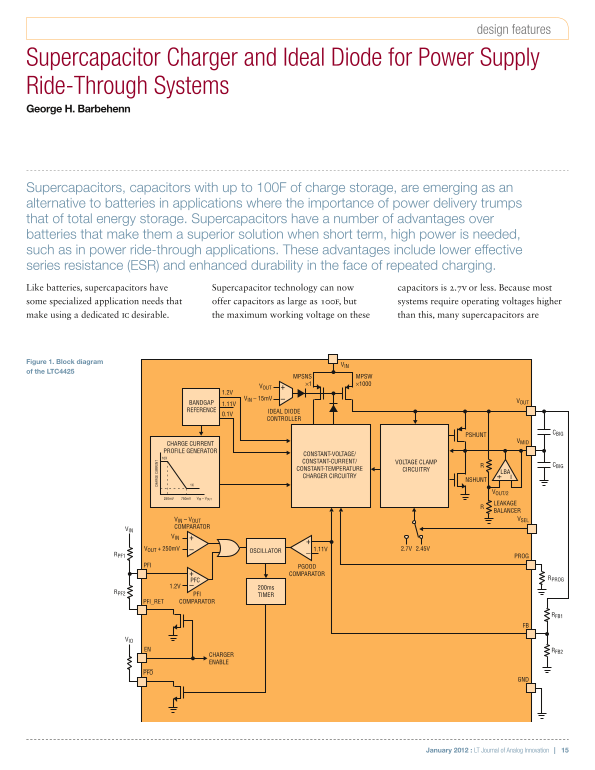
Figure 1. Block diagram
of the LTC4425
MPSNS MPSW ×1 ×1000
1.2V VIN – 15m V
BANDGAP VOUT
REFERENCE IDEAL DIODE
CONTROLLER
PSHUNT
CHARGE CURRENT PROFILE GENERATOR
CONSTANT-VOLTAGE/
CONSTANT-CURRENT/ VOLTAGE CLAMP
CONSTANT-TEMPERATURE CIRCUITRY
CHARGER CIRCUITRY
NSHUNT
VOUT/2
250m V 750m V VIN – VOUT
LEAKAGE BALANCER
VIN – VOUT VSEL
COMPARATOR
VOUT + 250m V 2.7V 2.45V1.11V
OSCILLATOR
RPF1 PROG
PFI PGOOD
COMPARATOR
RPROG
PFC 1.2V 200ms
PFI TIMER PFI_RET COMPARATOR
VIO EN RFB2
CHARGER ENABLE
January 2012 : LT Journal of Analog Innovation | 15
Page Summary Contents For LINEAR LTC4425 User Guide
Manual Details
| Brand | Linear |
|---|---|
| Pages | 6 |
| File Size | 2.31 MB |
| Published | June 18, 2026 |
Enter the captcha to get the download link:

Frequently Asked Questions
What is the maximum working voltage on a single supercapacitor?
The maximum working voltage on a single supercapacitor is 2.7V or less.
How does the LTC4425 manage output current during charging?
It limits the current in two ways: by reducing the current from V and by thermal limiting.
What advantage do supercapacitors offer over standard batteries?
They are superior for short term, high power needs due to lower effective series resistance (ESR) and enhanced durability.
What is "LDO mode" for in the LTC4425 charger?
It provides linear thermal regulation by controlling the current from V based on the output voltage, maintaining constant temperature.
How can energy scavenging improve power ride-through time?
Sourcing energy back to the supercapacitor significantly increases the total run time, allowing prolonged operation.