LINEAR LTC2991 User Guide
Summary
The LTC2991 is a flexible system monitor designed to measure voltages, currents, and temperatures on large circuit boards. This documentation highlights advanced instrumentation applications, detailing how the device can be configured to accurately calculate relative humidity using psychrometric principles. It is ideal for engineers and developers building sophisticated environmental monitoring systems that require precise measurements across multiple variables, including temperature, pressure, and moisture content.
Page 1 Text Content
System Monitor with Instrumentation-Grade Accuracy Used to Measure Relative Humidity Leo Chen
The LTC2991 is designed to measure supply voltages, currents and temperatures on large circuit boards when used in system monitor applications. It is also capable of delivering ±1°C accuracy when using a 1-cent MMBT3904 transistor as a temperature sensor, making it suitable for many instrumentation applications. Temperature is the most measured physical parameter, with sensor selection a function of accuracy requirements, durability, cost and compatibility with the medium being measured. An inexpensive NPN transistor is an ideal sensor for applications calling for disposable sensors, or those that require a large number of sensors.
A PSYCHROMETER: NOT NEARLY AS −6 3. Figure 1 shows the LTC2991-based psy-
•( WET= )−
OMINOUS AS IT SOUNDS
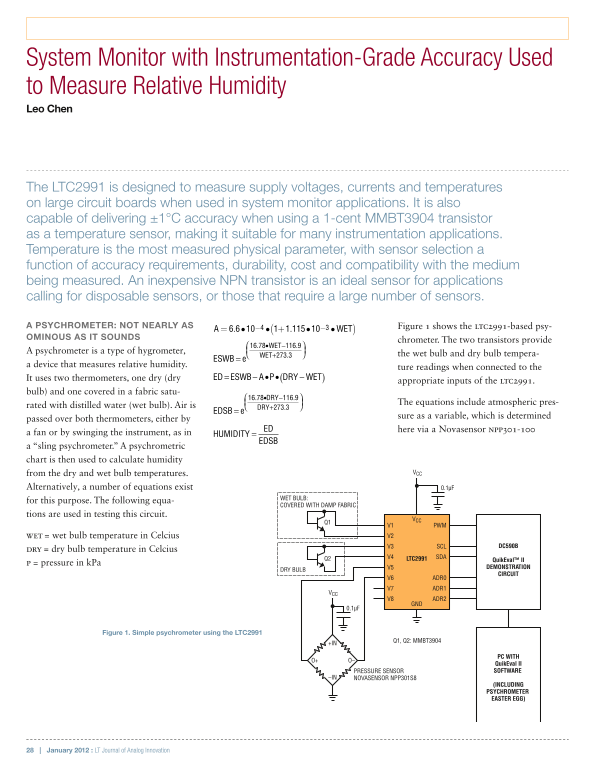
chrometer. The two transistors provide
A psychrometer is a type of hygrometer,
WET= the wet bulb and dry bulb tempera-
a device that measures relative humidity.
ture readings when connected to the
It uses two thermometers, one dry (dry ED ESWB DRY −( WET=
appropriate inputs of the LTC2991.
bulb) and one covered in a fabric satu-
The equations include atmospheric pres-
rated with distilled water (wet bulb). Air is DRY=
sure as a variable, which is determined
passed over both thermometers, either by
ED here via a Novasensor NPP301-100
a fan or by swinging the instrument, as in HUMIDITY
a “sling psychrometer.” A psychrometric chart is then used to calculate humidity
from the dry and wet bulb temperatures. VCC
Alternatively, a number of equations exist 0.1µF
WET BULB:
for this purpose. The following equa-
COVERED WITH DAMP FABRIC
tions are used in testing this circuit.
V1 PWM
WET = wet bulb temperature in Celcius V2
V3 SCL DC590B
DRY = dry bulb temperature in Celcius
Q2 V4 LTC2991 SDA
Quik Eval™ II
P = pressure in k Pa
V5 DEMONSTRATION
DRY BULB
CIRCUIT
V6 ADR0 V7 ADR1
V8 ADR2
Figure 1. Simple psychrometer using the LTC2991
Q1, Q2: MMBT3904
PC WITH
Quik Eval II PRESSURE SENSOR SOFTWARE
–IN NOVASENSOR NPP301S8
(INCLUDING PSYCHROMETER EASTER EGG)
28 | January 2012 : LT Journal of Analog Innovation
Page Summary Contents For LINEAR LTC2991 User Guide
Manual Details
| Brand | Linear |
|---|---|
| Pages | 2 |
| File Size | 1.64 MB |
| Published | June 03, 2026 |
Enter the captcha to get the download link:

Frequently Asked Questions
What physical parameters can the LTC2991 measure?
It is designed to measure supply voltages, currents, and temperatures on large circuit boards.
How is relative humidity determined using a psychrometer setup?
It uses two thermometers (wet bulb and dry bulb) and atmospheric pressure to compute the reading via a psychrometric chart.
What type of sensor is recommended for disposable or numerous temperature readings?
An inexpensive NPN transistor is an ideal choice for applications requiring many sensors.
How can I enable the psychrometric features in the software?
You must add a file named “tester.txt” to the install directory of your DC1785A software.