LINEAR LTM8025 User Guide
Summary
Streamline your power design with the LTM8025, a high-integration 3A µModule DC/DC buck converter. It delivers reliable, efficient step-down regulation across vast input ranges (3.6V–36V) while generating stable outputs from 0.8V to 24V. This compact module simplifies complex power solutions in constrained spaces, supporting everything from single low-voltage rails to high-current parallel setups. The accompanying documentation provides detailed schematics and application guides, making it ideal for engineers building advanced electronic systems requiring robust and highly efficient power delivery.
Page 1 Text Content
L DESIGN IDEAS
Self-Contained 3A µModule Buck Regulator Produces 0.8V–24V Output
from 3.6V–36V Input by David Ng
AUX PGOOD
Introduction Easy Layout
GND GND
RT RADJ
Ask any group of engineers, “What The LTM8025’s high level of integration would you do with a 3A DC/DC con- simplifies the design of just about any verter?” and you will probably get a 3A power supply. Just add two resis-
wide range of answers—from powering SHDN tors, input and output capacitance to
VOUT BIAS
a DSP rail at 1.8V to running a bank make a complete power supply. Layout
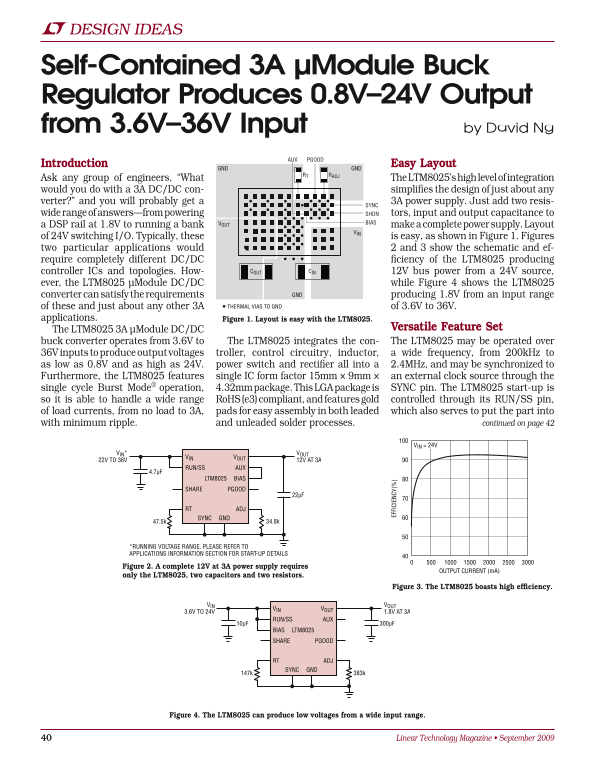
of 24V switching I/O. Typically, these is easy, as shown in Figure 1. Figures two particular applications would 2 and 3 show the schematic and ef- require completely different DC/DC ficiency of the LTM8025 producing
controller ICs and topologies. How- CINCOUT 12V bus power from a 24V source,
ever, the LTM8025 µModule DC/DC while Figure 4 shows the LTM8025
converter can satisfy the requirements GND producing 1.8V from an input range
of these and just about any other 3A THERMAL VIAS TO GND of 3.6V to 36V.
applications. Figure 1. Layout is easy with the LTM8025.
The LTM8025 3A µModule DC/DC Versatile Feature Set
buck converter operates from 3.6V to The LTM8025 integrates the con- The LTM8025 may be operated over 36V inputs to produce output voltages troller, control circuitry, inductor, a wide frequency, from 200k Hz to as low as 0.8V and as high as 24V. power switch and rectifier all into a 2.4MHz, and may be synchronized to Furthermore, the LTM8025 features single IC form factor 15mm × 9mm × an external clock source through the single cycle Burst Mode® operation, 4.32mm package. This LGA package is SYNC pin. The LTM8025 start-up is
EF FI CI EN CY
so it is able to handle a wide range Ro HS (e3) compliant, and features gold controlled through its RUN/SS pin, of load currents, from no load to 3A, pads for easy assembly in both leaded which also serves to put the part into with minimum ripple. and unleaded solder processes. continued on page 42
VIN = 24V
VIN* VOUT
VIN VOUT
22V TO 36V 12V AT 3A
RUN/SS AUX
LTM8025 BIAS SHARE PGOOD
RT ADJ SYNC GND
*RUNNING VOLTAGE RANGE. PLEASE REFER TO APPLICATIONS INFORMATION SECTION FOR START-UP DETAILS
Figure 2. A complete 12V at 3A power supply requires
OUTPUT CURRENT (m A)
only the LTM8025, two capacitors and two resistors.
Figure 3. The LTM8025 boasts high efficiency.
VIN VOUT
VIN VOUT
3.6V TO 24V 1.8V AT 3A
RUN/SS AUX
BIAS LTM8025 SHARE PGOOD
RT ADJ SYNC GND
Figure 4. The LTM8025 can produce low voltages from a wide input range.
Linear Technology Magazine • September 2009
Page Summary Contents For LINEAR LTM8025 User Guide
Manual Details
| Brand | Linear |
|---|---|
| Pages | 2 |
| File Size | 186.90 KB |
| Published | May 30, 2026 |
Enter the captcha to get the download link:

Frequently Asked Questions
What is the recommended operating voltage range for the LTM8025?
It operates from a wide input range of 3.6V to 36V and can produce outputs as low as 0.8V and as high as 24V.
Can the LTM8025 be used in parallel for higher current requirements?
Yes, two or more modules can be operated in parallel using the SHARE pin to handle loads exceeding 3A.
What features make the LTM8025 easy to use in design?
Its high integration and single-IC form factor simplify the design of DC/DC converters. It also includes a PGOOD pin for output monitoring.
Does the regulator have varying efficiencies?
The manual highlights that various applications require different DC/DC efficiency levels, but specific percentages are not provided for all operating modes on this page.