LINEAR LTC4160 User Guide
Summary
The LTC4160 is a high-efficiency, versatile bidirectional power manager IC designed for advanced portable electronics and battery systems. This single-inductor solution provides robust power delivery, automatically supporting USB On-The-Go capabilities, rapid charging, and prioritized power routing between batteries and application loads. The manual details its operation across charging, discharging, and low-power modes, making it essential documentation for electrical engineers and system designers creating compact, feature-rich devices that require reliable, advanced power control and built-in protection features.
Page 1 Text Content
L DESIGN IDEAS
US (V
Bidirectional Power Manager Provides Efficient Charging and Automatic USB On-The-Go with a Single Inductor
by Sauparna Das
Introduction Bidirectional Switching Power
Imagine that your car won’t start—the Path for USB On-The-Go is not in input current limit. This
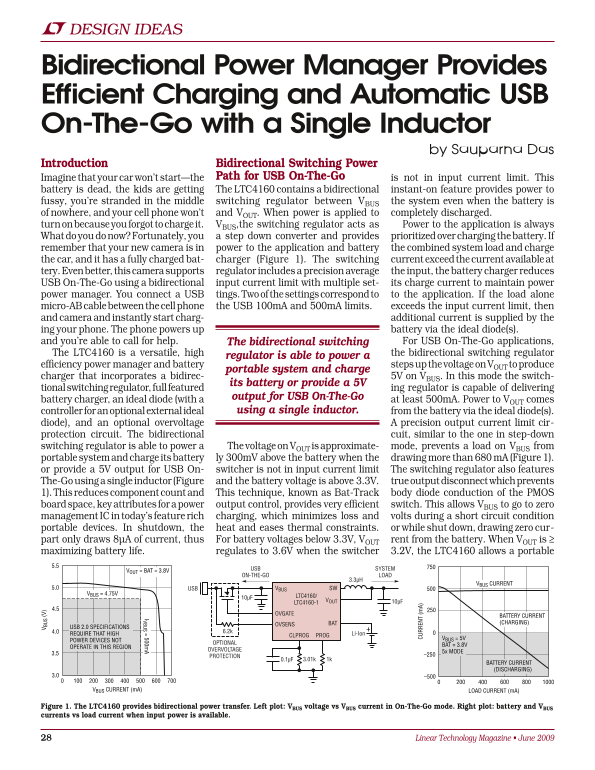
battery is dead, the kids are getting The LTC4160 contains a bidirectional instant-on feature provides power to fussy, you’re stranded in the middle switching regulator between VBUS the system even when the battery is of nowhere, and your cell phone won’t and VOUT. When power is applied to completely discharged. turn on because you forgot to charge it. VBUS,the switching regulator acts as Power to the application is always What do you do now? Fortunately, you a step down converter and provides prioritized over charging the battery. If remember that your new camera is in power to the application and battery the combined system load and charge the car, and it has a fully charged bat- charger (Figure 1). The switching current exceed the current available at tery. Even better, this camera supports regulator includes a precision average the input, the battery charger reduces USB On-The-Go using a bidirectional input current limit with multiple set- its charge current to maintain power power manager. You connect a USB tings. Two of the settings correspond to to the application. If the load alone micro-AB cable between the cell phone the USB 100m A and 500m A limits. exceeds the input current limit, then and camera and instantly start charg- additional current is supplied by the ing your phone. The phone powers up battery via the ideal diode(s). and you’re able to call for help. The bidirectional switching For USB On-The-Go applications, The LTC4160 is a versatile, high the bidirectional switching regulator
regulator is able to power a
efficiency power manager and battery steps up the voltage on VOUT to produce
portable system and charge
charger that incorporates a bidirec- 5V on VBUS. In this mode the switch-
its battery or provide a 5V
tional switching regulator, full featured ing regulator is capable of delivering
output for USB On-The-Go
battery charger, an ideal diode (with a at least 500m A. Power to VOUT comes
controller for an optional external ideal using a single inductor. from the battery via the ideal diode(s).
CU RR EN (m A)
diode), and an optional overvoltage A precision output current limit cir- protection circuit. The bidirectional cuit, similar to the one in step-down switching regulator is able to power a The voltage on VOUT is approximate- mode, prevents a load on VBUS from IVBUS = 500m portable system and charge its battery ly 300m V above the battery when the drawing more than 680 m A (Figure 1). or provide a 5V output for USB On- switcher is not in input current limit The switching regulator also features The-Go using a single inductor (Figure and the battery voltage is above 3.3V. true output disconnect which prevents 1). This reduces component count and This technique, known as Bat-Track body diode conduction of the PMOS board space, key attributes for a power output control, provides very efficient switch. This allows VBUS to go to zero management IC in today’s feature rich charging, which minimizes loss and volts during a short circuit condition portable devices. In shutdown, the heat and eases thermal constraints. or while shut down, drawing zero cur- part only draws 8µA of current, thus For battery voltages below 3.3V, VOUT rent from the battery. When VOUT is ≥ maximizing battery life. regulates to 3.6V when the switcher 3.2V, the LTC4160 allows a portable 5.5
USB SYSTEM
VOUT = BAT = 3.8V
ON-THE-GO LOAD
VBUS CURRENT
5.0 VBUSUSB SW
VBUS = 4.75V
10µF LTC4160/
VOUT 10µF
LTC4160-1
OVGATE
BATTERY CURRENT BAT (CHARGING)
OVSENS
USB 2.0 SPECIFICATIONS
REQUIRE THAT HIGH CLPROG PROG Li-Ion
VBUS = 5V
POWER DEVICES NOT
OPTIONAL
BAT = 3.8V
OPERATE IN THIS REGION
OVERVOLTAGE
3.5 5x MODE PROTECTION –250
BATTERY CURRENT (DISCHARGING)
VBUS CURRENT (m A) LOAD CURRENT (m A)
Figure 1. The LTC4160 provides bidirectional power transfer. Left plot: VBUS voltage vs VBUS current in On-The-Go mode. Right plot: battery and VBUS currents vs load current when input power is available.
Linear Technology Magazine • June 2009
Page Summary Contents For LINEAR LTC4160 User Guide
Manual Details
| Brand | Linear |
|---|---|
| Pages | 2 |
| File Size | 195.46 KB |
| Published | June 20, 2026 |
Enter the captcha to get the download link:

Frequently Asked Questions
What makes this device suitable for portable systems?
It is a high efficiency bidirectional switcher that powers the load and charges the battery simultaneously using a single inductor.
How does the LTC4160 maintain power when external charging fails?
The integrated USB On-The-Go functionality allows it to maintain power from an external source like a cell phone via ideal diodes.
What special protection is offered for high voltage inputs?
It includes optional overvoltage protection against voltages up to 68V applied to the V pin.