LINEAR High Efficiency 4-Switch Buck-Boost Controller for Precise Output Current Limit - Design Note 499 Tage Bjorklund Owner's Manual User Guide
Summary
The LTC3789 is a high-efficiency, constant current mode buck-boost switching regulator designed for robust power management across challenging input voltages (4V to 38V). It utilizes a sophisticated 4-switch topology to maintain stable output voltage and features optional current limiting for maximum reliability. This guide provides detailed technical specifications, operational waveforms, and design guidance covering buck, boost, and buck-boost modes. Ideal for demanding applications such as automotive systems, telecom infrastructure, or battery-powered devices requiring high power density and stable performance regardless of fluctuating input conditions.
Page 1 Text Content
advertisement
High Effi ciency 4-Switch Buck-Boost Controller Provides Accurate Output Current Limit – Design Note 499 Tage Bjorklund Introduction The LTC3789 includes two internal series regulators that
A 4-switch buck-boost converter (Figure 1) is often a provide 5.5V for gate drivers and control circuitry. During better alternative to a transformer-based topology when start-up the current is drawn from VIN (40V maximum a converter’s input voltage can be above or below the rating), but switches to EXTVCC (14V maximum rating) regulated output voltage and isolation is not required. as soon as the voltage on EXTVCC exceeds 4.8V, to A buck-boost converter provides a wider input voltage decrease power loss.
range, better effi ciency and has no need of a bulky
This 4-switch topology allows the output to be dis-
transformer. A buck-boost converter is much more
connected from the input during shutdown. LTC3789
effi cient than a comparable SEPIC converter.
features adjustable soft-start, no reverse current during The LTC®3789 is a buck-boost switching regulator start-up and 1% output voltage accuracy.
controller that operates in current mode at a constant
SW2A SW1
switching frequency. Current mode control simplifi es
VIN VOUT
loop compensation and yields excellent load and line
CIN COUT
transient response with only small output and input
SENSE+
capacitance. Furthermore, an accurate inductor current
RSENSE
limit allows use of a small size inductor.
SENSE–
LTC3789 Features
The internal oscillator can be programmed by a resis- R1
tor, applied voltage, or phase-locked to an external
LTC3789 SENSE+
SENSE– R2
clock within a 200k Hz to 600k Hz frequency range. The
LTC3789’s wide 4V to 38V (40V maximum) input and DN499 F01
output range and seamless, low noise transitions be-
Figure 1. 4-Switch Buck-Boost Converter Using the
tween operating regions is ideal for automotive, telecom
LTC3789
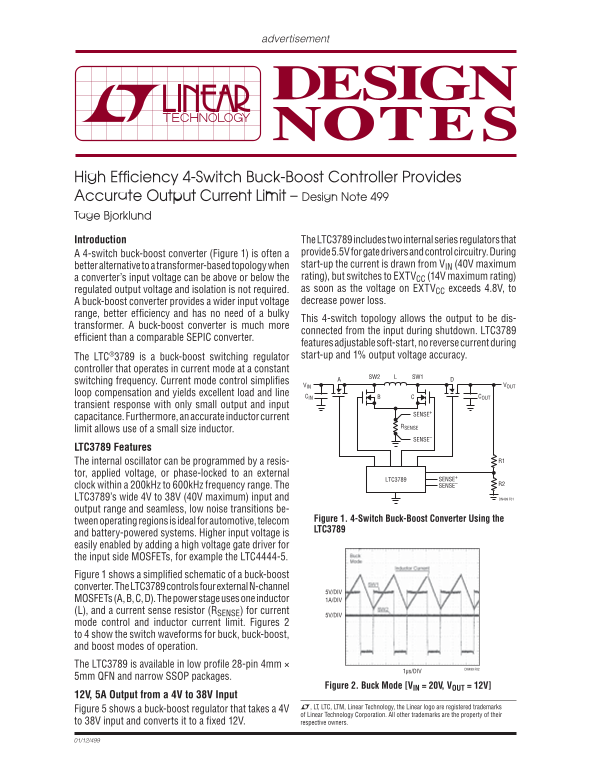
and battery-powered systems. Higher input voltage is easily enabled by adding a high voltage gate driver for the input side MOSFETs, for example the LTC4444-5. Figure 1 shows a simplifi ed schematic of a buck-boost converter. The LTC3789 controls four external N-channel
5V/DIV
MOSFETs (A, B, C, D). The power stage uses one inductor 1A/DIV (L), and a current sense resistor (RSENSE) for current
5V/DIV
mode control and inductor current limit. Figures 2 to 4 show the switch waveforms for buck, buck-boost, and boost modes of operation. The LTC3789 is available in low profi le 28-pin 4mm ×
DN499 F02
1μs/DIV
5mm QFN and narrow SSOP packages.
Figure 2. Buck Mode [VIN = 20V, VOUT = 12V]
12V, 5A Output from a 4V to 38V Input
L, LT, LTC, LTM, Linear Technology, the Linear logo are registered trademarks
Figure 5 shows a buck-boost regulator that takes a 4V
of Linear Technology Corporation. All other trademarks are the property of their
to 38V input and converts it to a fi xed 12V. respective owners.
Page Summary Contents For LINEAR High Efficiency 4-Switch Buck-Boost Controller for Precise Output Current Limit - Design Note 499 Tage Bjorklund Owner's Manual User Guide
Manual Details
| Brand | Current |
|---|---|
| Pages | 2 |
| File Size | 112.97 KB |
| Published | May 30, 2026 |
Enter the captcha to get the download link:

Frequently Asked Questions
What is the input voltage range for the LTC3789?
It accepts a wide input voltage range from 4V to 38V (40V maximum).
How does it maintain good efficiency across different loads?
It offers adjustable soft-start, operates in current mode control, and provides high efficiency compared to models like SEPIC.
Does the device provide constant output current limiting?
Yes, the optional output current feedback loop supports stable constant current applications, even during overcurrent conditions.
What modes of operation are available for the controller?
Users can select between pulse-skipping mode (lowest ripple) and forced continuous mode (constant frequency).
Is external clock synchronization supported?
Yes, the internal oscillator can be phase-locked to an external clock signal.