LINEAR dn407f Data Sheet
Summary
This Design Note 407 from Linear Technology presents a method for monitoring H-bridge load current using dual high-side current-sense amplifiers as an alternative to the classical in-line sense resistor approach. The design uses sign-magnitude PWM control where one half-bridge remains at 100 percent duty cycle, allowing load current to be measured through the fully-on switch unaffected by PWM activity on the other half-bridge. The circuit benefits from having sense resistors at a relatively cons
Page 1 Text Content
advertisement
Dual Current-Sense Amplifi ers Simplify H-Bridge Load Monitoring Design Note 407 Jon Munson Introduction A far more practical method is to monitor the supply
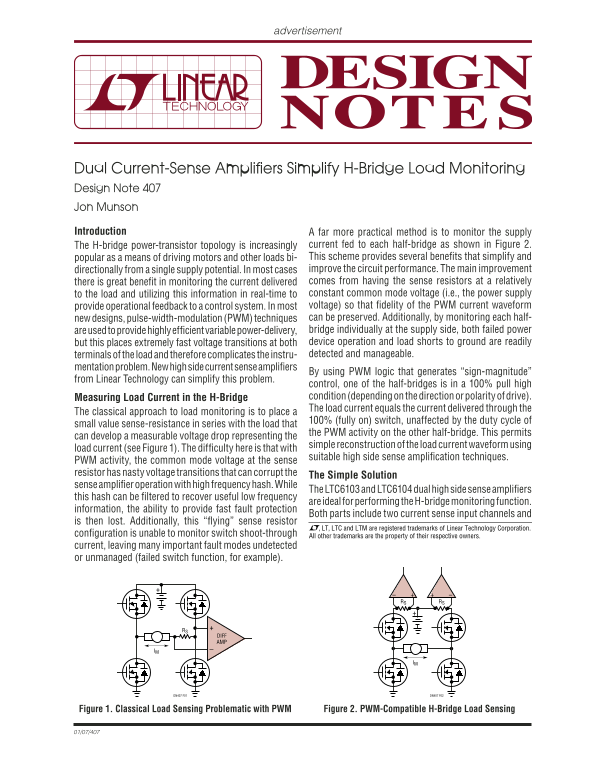
The H-bridge power-transistor topology is increasingly current fed to each half-bridge as shown in Figure 2. popular as a means of driving motors and other loads bi- This scheme provides several benefi ts that simplify and directionally from a single supply potential. In most cases improve the circuit performance. The main improvement there is great benefi t in monitoring the current delivered comes from having the sense resistors at a relatively to the load and utilizing this information in real-time to constant common mode voltage (i.e., the power supply provide operational feedback to a control system. In most voltage) so that fi delity of the PWM current waveform new designs, pulse-width-modulation (PWM) techniques can be preserved. Additionally, by monitoring each half- are used to provide highly effi cient variable power-delivery, bridge individually at the supply side, both failed power but this places extremely fast voltage transitions at both device operation and load shorts to ground are readily terminals of the load and therefore complicates the instru- detected and manageable.
mentation problem. New high side current sense amplifi ers
By using PWM logic that generates “sign-magnitude”
from Linear Technology can simplify this problem.
control, one of the half-bridges is in a 100% pull high Measuring Load Current in the H-Bridge condition (depending on the direction or polarity of drive). The load current equals the current delivered through the
The classical approach to load monitoring is to place a
100% (fully on) switch, unaffected by the duty cycle of
small value sense-resistance in series with the load that
the PWM activity on the other half-bridge. This permits
can develop a measurable voltage drop representing the
simple reconstruction of the load current waveform using
load current (see Figure 1). The diffi culty here is that with
suitable high side sense amplifi cation techniques.
PWM activity, the common mode voltage at the sense resistor has nasty voltage transitions that can corrupt the
The Simple Solution
sense amplifi er operation with high frequency hash. While
The LTC6103 and LTC6104 dual high side sense amplifi ers
this hash can be fi ltered to recover useful low frequency
are ideal for performing the H-bridge monitoring function.
information, the ability to provide fast fault protection
Both parts include two current sense input channels and
is then lost. Additionally, this “fl ying” sense resistor
, LT, LTC and LTM are registered trademarks of Linear Technology Corporation.
confi guration is unable to monitor switch shoot-through All other trademarks are the property of their respective owners. current, leaving many important fault modes undetected or unmanaged (failed switch function, for example).
RS RS
DIFF AMP
DN407 F01 DN407 F02
Figure 1. Classical Load Sensing Problematic with PWM Figure 2. PWM-Compatible H-Bridge Load Sensing
Page Summary Contents For LINEAR dn407f Data Sheet
Manual Details
| Brand | Linear |
|---|---|
| Pages | 2 |
| File Size | 88.72 KB |
| Published | June 18, 2026 |
Enter the captcha to get the download link:

Frequently Asked Questions
Why is monitoring supply current better for H-bridge loads?
Monitoring supply current fed to each half-bridge simplifies load monitoring because it provides operational feedback without suffering from nasty voltage transitions caused by PWM activity.
What advantage does using dual high side sense amplifiers provide?
The LTC6103 and LTC6104 offer two current sense inputs, allowing designers to monitor both sides of the H-bridge current independently for fault detection.
How do I get a bidirectional signal from the load monitoring circuit?
Use the LTC6104. Its output structure can provide a single bidirectional differential signal, suitable for various ADC connections.
Can these amplifiers detect motor failure modes?
Yes, they offer fast fault protection and overload sensing capabilities, enabling designers to monitor for failed switch function or short-circuit conditions.