LINEAR dn424f Data Sheet
Summary
The LTC3785 is a premium, high-efficiency buck-boost controller providing stable 3.3V at 3A from highly variable input sources (2.7V–10V). Utilizing an advanced single-inductor, 4-switch topology, this solution eliminates the complexity and low efficiency associated with conventional power converters. The manual provides a comprehensive guide to its seamless operation across buck, boost, and combined modes, proving exceptional performance even at light loads. It is designed for embedded systems powering sensitive electronics using Li-Ion or multiple battery chemistries needing robust, reliable, and high-efficiency power management.
Page 1 Text Content
Buck-Boost Controller Simplifi es Design of DC/DC Converters for Handheld Products – Design Note 424 David Burgoon
Introduction range. The high level of integration yields a simple, low parts-count solution. The LTC3785 provides for current-
A number of conventional solutions have been available for
limit and shutdown in all modes of operation (which is
the design of a DC/DC converter where the output voltage
not normally available with boost converters).
is within the input voltage range—a common scenario in Li-Ion battery-powered applications—but none were
Very high effi ciency is achieved by synchronous recti-
very attractive until now. Conventional topologies, such
fi cation, high side drive (allowing the use of N-channel
as SEPIC or boost followed by buck, have numerous
MOSFETs), RDS(ON) current sensing, and Burst Mode®
disadvantages, including low effi ciency, complex magnet-
operation for effi cient light load operation. Protection
ics, polarity inversion and/or circuit complexity/cost. The
features include soft-start, overvoltage, undervoltage
LTC®3785 buck-boost controller yields a simple, effi cient,
and foldback current-limit with burp-mode or latch-off
low parts-count, single-converter solution that is easy
for extended faults.
to implement, thus avoiding the drawbacks associated
3.3V, 3A Converter Operates from 2.7V – 10V Source
with traditional solutions.
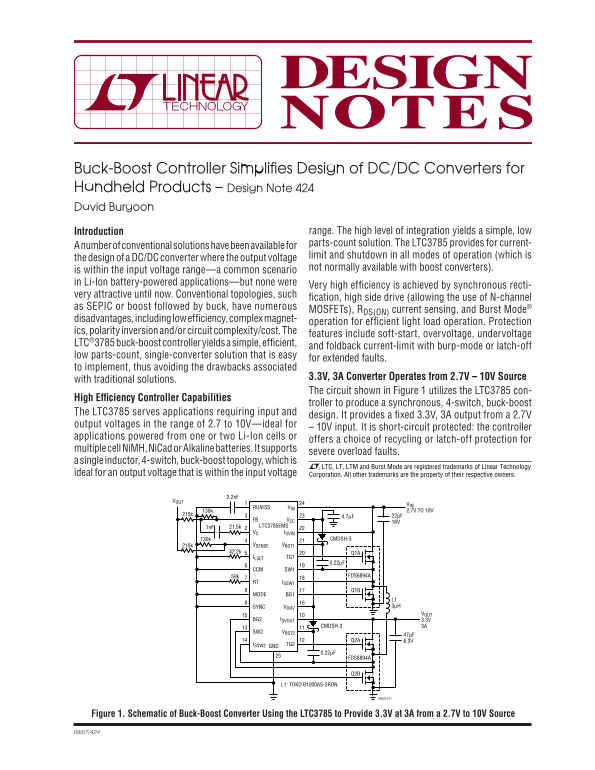
The circuit shown in Figure 1 utilizes the LTC3785 con-
High Effi ciency Controller Capabilities
troller to produce a synchronous, 4-switch, buck-boost
The LTC3785 serves applications requiring input and
design. It provides a fi xed 3.3V, 3A output from a 2.7V
output voltages in the range of 2.7 to 10V—ideal for
– 10V input. It is short-circuit protected: the controller
applications powered from one or two Li-Ion cells or
offers a choice of recycling or latch-off protection for
multiple cell Ni MH, Ni Cad or Alkaline batteries. It supports
severe overload faults.
a single inductor, 4-switch, buck-boost topology, which is
, LTC, LT, LTM and Burst Mode are registered trademarks of Linear Technology
ideal for an output voltage that is within the input voltage Corporation. All other trademarks are the property of their respective owners.
RUN/SS VIN
130k 2.7V TO 10V
FB VCC
1n F 21.5k LTC3785EMS VC ISVIN
130k CMDSH-3
215k VSENSE VBST1
ILSET TG1
CCM SW1
59k FDS6894A
RT ISSW1
MODE BG1
L1 SYNC VDRV 3μH
BG2 ISVOUT 3.3V
CMDSH-3 3A
SW2 VBST2
ISSW2 GND TG2
FDS6894A
L1: TOKO B1000AS-3RON
DN424 F01
Figure 1. Schematic of Buck-Boost Converter Using the LTC3785 to Provide 3.3V at 3A from a 2.7V to 10V Source 09/07/424
Page Summary Contents For LINEAR dn424f Data Sheet
Manual Details
| Brand | Linear |
|---|---|
| Pages | 2 |
| File Size | 119.95 KB |
| Published | May 29, 2026 |
Enter the captcha to get the download link:

Frequently Asked Questions
What voltage range can the LTC3785 controller handle?
It is designed to provide a fixed 3.3V, 3A output from an input voltage ranging from 2.7V to 10V.
Does this converter work efficiently at extremely light loads?
Yes, it achieves high efficiency even at light load conditions by utilizing Burst Mode and its controller features.
What is the primary benefit of using a buck-boost topology with this chip?
It allows for an output voltage (3.3V) that may be outside the input voltage range, effectively overcoming limitations of conventional topologies.
Does the device offer various types of fault protection?
It provides multiple protections, including overvoltage, undervoltage, and short-circuit protection, and can support severe overload faults.