LINEAR dn402 Data Sheet User Guide
Summary
Revolutionize your low-voltage power design with this advanced Electronic Circuit Breaker (ECB). The LTC4213 provides highly accurate Overvoltage Protection, eliminating the need for external sense resistors while maintaining robust current monitoring. This manual details its dual trip responses—fast and slow—and selectable thresholds, ensuring reliable protection against overcurrent and transient spikes during power-up. It is essential for engineers developing simple, high-performance systems needing precise circuit breaking functionality in minimal space.
Page 1 Text Content
advertisement
Electronic Circuit Breaker in Small DFN Package Eliminates Sense Resistor – Design Note 402 SH Lim Introduction Overvoltage Protection Traditionally, an Electronic Circuit Breaker (ECB) com-
The LTC4213 can provide load overvoltage protection
prises a MOSFET, a MOSFET controller and a current sense
(OVP) above the bias supply. When VSENSEP > VCC + 0.7V
resistor. The LTC®4213 does away with the sense resistor
for 65µs, an internal OVP circuit activates with the GATE
by using the RDS(ON) of the external MOSFET. The result
pin pulling low and the external MOSFET turning off. The
is a simple, small solution that offers a signifi cant low
OVP circuit protects the system from an incorrect plug-in
insertion loss advantage at low operating load voltage.
event where the VIN load supply is much higher than the
The LTC4213 features two circuit breaking responses to
VCC bias voltage.
varying overload conditions with three selectable trip
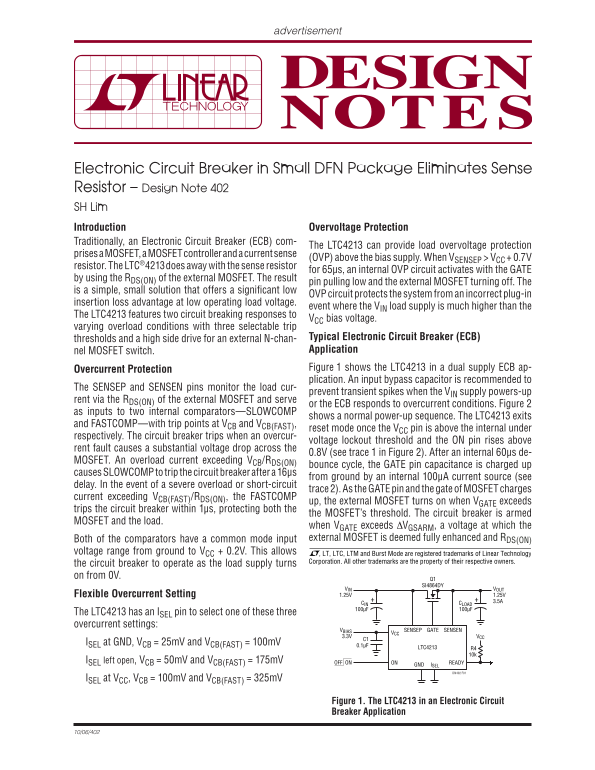
thresholds and a high side drive for an external N-chan- Typical Electronic Circuit Breaker (ECB) nel MOSFET switch. Application Overcurrent Protection Figure 1 shows the LTC4213 in a dual supply ECB ap- plication. An input bypass capacitor is recommended to
The SENSEP and SENSEN pins monitor the load cur-
prevent transient spikes when the VIN supply powers-up
rent via the RDS(ON) of the external MOSFET and serve
or the ECB responds to overcurrent conditions. Figure 2
as inputs to two internal comparators—SLOWCOMP
shows a normal power-up sequence. The LTC4213 exits
and FASTCOMP—with trip points at VCB and VCB(FAST),
reset mode once the VCC pin is above the internal under
respectively. The circuit breaker trips when an overcur-
voltage lockout threshold and the ON pin rises above
rent fault causes a substantial voltage drop across the
0.8V (see trace 1 in Figure 2). After an internal 60µs de-
MOSFET. An overload current exceeding VCB/RDS(ON)
bounce cycle, the GATE pin capacitance is charged up
causes SLOWCOMP to trip the circuit breaker after a 16µs
from ground by an internal 100µA current source (see
delay. In the event of a severe overload or short-circuit
trace 2). As the GATE pin and the gate of MOSFET charges
current exceeding VCB(FAST)/RDS(ON), the FASTCOMP
up, the external MOSFET turns on when VGATE exceeds
trips the circuit breaker within 1µs, protecting both the
the MOSFET’s threshold. The circuit breaker is armed
MOSFET and the load.
when VGATE exceeds ΔVGSARM, a voltage at which the Both of the comparators have a common mode input external MOSFET is deemed fully enhanced and RDS(ON)
voltage range from ground to VCC + 0.2V. This allows , LT, LTC, LTM and Burst Mode are registered trademarks of Linear Technology
Corporation. All other trademarks are the property of their respective owners.
the circuit breaker to operate as the load supply turns on from 0V.
Q1 SI4864DY
VIN VOUT Flexible Overcurrent Setting 1.25V 1.25V
+CIN 3.5A
CLOAD
The LTC4213 has an ISEL pin to select one of these three overcurrent settings:
GATE SENSENSENSEPVBIAS
3.3V VCC
ISEL at GND, VCB = 25m V and VCB(FAST) = 100m V 0.1µF
LTC4213 R4
ISEL left open, VCB = 50m V and VCB(FAST) = 175m V OFF ON ON READY
ISELGND
DN402 F01
ISEL at VCC, VCB = 100m V and VCB(FAST) = 325m V
Figure 1. The LTC4213 in an Electronic Circuit Breaker Application
Page Summary Contents For LINEAR dn402 Data Sheet User Guide
Manual Details
| Brand | Linear |
|---|---|
| Pages | 2 |
| File Size | 160.48 KB |
| Published | June 17, 2026 |
Enter the captcha to get the download link:

Frequently Asked Questions
Does the LTC4213 require a sense resistor?
No, the LTC4213 eliminates the need for an external sense resistor by using the RDS(ON) of the external MOSFET itself for current sensing.
How does the LTC4213 detect overcurrent events during power-up?
The device uses two comparators (SLOWCOMP and FASTCOMP) that monitor load current via the RDS(ON) to trip the circuit breaker based on predefined thresholds. The READY pin indicates it is ready for operation.
What determines the overcurrent threshold settings?
Users can select one of three overcurrent settings using the I pin: 25mV, 50mV, or 100mV.
Is external current sensing always more accurate than RDS(ON) sensing for ECB?
No. While traditional sense resistors offer a measurable voltage drop, the LTC4213's RDS(ON) method provides system simplicity and is designed to minimize insertion loss in low-voltage applications.