LINEAR dn365f Data Sheet
Summary
The LT3467 ThinSOT switching regulator provides a simple and effective solution for eliminating damaging inrush currents during power-up sequences. This resource details how its integrated soft-start feature ensures stable converter operation, even when sourcing power from batteries or current-limited components. Ideal for electrical engineers designing robust power supplies (SEPIC/Boost) that require reliable startup voltage under constrained input conditions.
Page 1 Text Content
advertisement
Thin SOT Switching Regulator Controls Inrush Current Design Note 365 Jesus Rosales Introduction Inrush current can be troublesome, especially when regu-
lators are operated from batteries or a current-limited
0.2A/DIV
source. In such cases, excessive inrush current can cause
the input source to collapse and prevent the converter
5V/DIV
from ever starting up. Inrush current can also trip input line fuses or cause the output to overshoot. There are
50µs/DIV DN365 F02
many ways to deal with this problem, but most of them are difficult to implement or have undesirable side effects, Figure 2. Input Current and Output Voltage at Turn-On
often making the cure worse than the cause. Without CSS Capacitor for Figure 1 Circuit
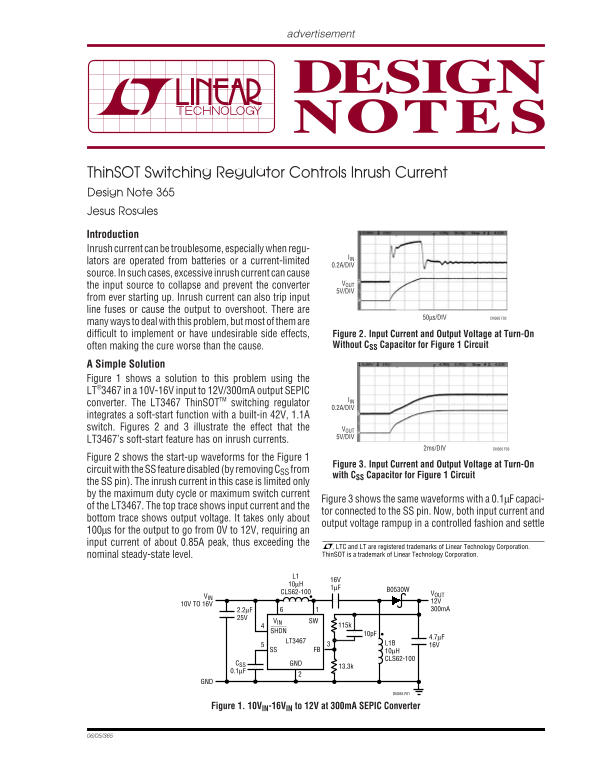
A Simple Solution Figure 1 shows a solution to this problem using the LT®3467 in a 10V-16V input to 12V/300m A output SEPIC
converter. The LT3467 Thin SOTTM switching regulator
0.2A/DIV
integrates a soft-start function with a built-in 42V, 1.1A switch. Figures 2 and 3 illustrate the effect that the VOUT
5V/DIV
LT3467’s soft-start feature has on inrush currents.
2ms/DIV DN365 F03
Figure 2 shows the start-up waveforms for the Figure 1
Figure 3. Input Current and Output Voltage at Turn-On
circuit with the SS feature disabled (by removing CSS from
with CSS Capacitor for Figure 1 Circuit
the SS pin). The inrush current in this case is limited only by the maximum duty cycle or maximum switch current
Figure 3 shows the same waveforms with a 0.1µF capaci-
of the LT3467. The top trace shows input current and the
tor connected to the SS pin. Now, both input current and
bottom trace shows output voltage. It takes only about
output voltage rampup in a controlled fashion and settle
100µs for the output to go from 0V to 12V, requiring an input current of about 0.85A peak, thus exceeding the
, LTC and LT are registered trademarks of Linear Technology Corporation. nominal steady-state level. Thin SOT is a trademark of Linear Technology Corporation.
CLS62-100 VOUT
10V TO 16V
VIN SW
LT3467
SS FB 10µH
CLS62-100
CSS GND
DN365 F01
Figure 1. 10VIN-16VIN to 12V at 300m A SEPIC Converter
Page Summary Contents For LINEAR dn365f Data Sheet
Manual Details
| Brand | Linear |
|---|---|
| Pages | 2 |
| File Size | 90.92 KB |
| Published | June 18, 2026 |
Enter the captcha to get the download link:

Frequently Asked Questions
What causes excessive inrush current during converter startup?
Excessive inrush current can cause the input source voltage (V OUT) to collapse, preventing the converter from starting up.
How does the LT3467 help solve the inrush current problem?
It integrates a soft-start function and provides a simple solution by using only one small capacitor between the SS pin and ground.
Can I use a large external capacitor to manage startup curves?
No, some methods involving capacitors can actually make the inrush current problem worse than the original cause.
What is the typical output characteristic of this regulator?
It provides seamless operation, allowing the output to ramp up and settle comfortably into its respective steady-state level.