LINEAR dn363f Data Handbook
Summary
Elevate your power redundancy with this ideal diode controller, designed for high-reliability telecom systems. It drastically outperforms traditional diode ORing by using optimized MOSFET technology, minimizing voltage drop and massive heat dissipation. This device ensures smooth, efficient current sharing between multiple supplies while conserving board space and eliminating need for bulky heatsinks. The manual details its operation, demonstrating superior efficiency, robust fault detection, and how it maintains system integrity even during supply failures or overcurrent events.
Page 1 Text Content
advertisement
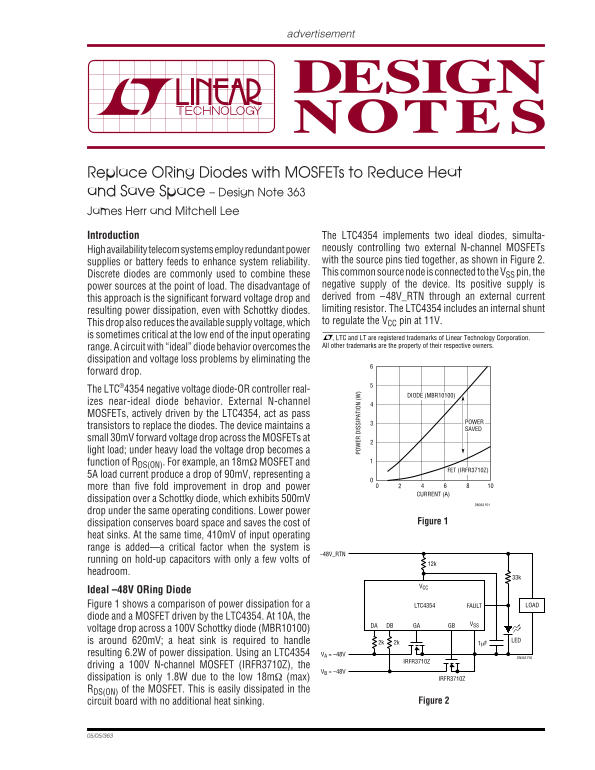
Replace ORing Diodes with MOSFETs to Reduce Heat and Save Space – Design Note 363 James Herr and Mitchell Lee Introduction The LTC4354 implements two ideal diodes, simulta-
High availability telecom systems employ redundant power neously controlling two external N-channel MOSFETs supplies or battery feeds to enhance system reliability. with the source pins tied together, as shown in Figure 2. Discrete diodes are commonly used to combine these This common source node is connected to the VSS pin, the power sources at the point of load. The disadvantage of negative supply of the device. Its positive supply is this approach is the significant forward voltage drop and derived from –48V_RTN through an external current resulting power dissipation, even with Schottky diodes. limiting resistor. The LTC4354 includes an internal shunt This drop also reduces the available supply voltage, which to regulate the VCC pin at 11V.
is sometimes critical at the low end of the input operating , LTC and LT are registered trademarks of Linear Technology Corporation.
All other trademarks are the property of their respective owners.
range. A circuit with “ideal” diode behavior overcomes the
dissipation and voltage loss problems by eliminating the PO ER IS SI PA TI ON (W
forward drop. The LTC®4354 negative voltage diode-OR controller real-
DIODE (MBR10100)
izes near-ideal diode behavior. External N-channel MOSFETs, actively driven by the LTC4354, act as pass
POWER
transistors to replace the diodes. The device maintains a SAVED small 30m V forward voltage drop across the MOSFETs at light load; under heavy load the voltage drop becomes a function of RDS(ON). For example, an 18mΩ MOSFET and
FET (IRFR3710Z)
5A load current produce a drop of 90m V, representing a more than five fold improvement in drop and power
CURRENT (A)
dissipation over a Schottky diode, which exhibits 500m V
DN363 F01
drop under the same operating conditions. Lower power
dissipation conserves board space and saves the cost of Figure 1
heat sinks. At the same time, 410m V of input operating range is added—a critical factor when the system is
–48V_RTN
running on hold-up capacitors with only a few volts of
headroom.
Ideal –48V ORing Diode
Figure 1 shows a comparison of power dissipation for a LTC4354 FAULT LOAD
diode and a MOSFET driven by the LTC4354. At 10A, the
DB GADA GB VSS
voltage drop across a 100V Schottky diode (MBR10100)
is around 620m V; a heat sink is required to handle LED1µF
resulting 6.2W of power dissipation. Using an LTC4354 VA = –48V
DN363 F02
IRFR3710Z
driving a 100V N-channel MOSFET (IRFR3710Z), the
VB = –48V
dissipation is only 1.8W due to the low 18mΩ (max) IRFR3710Z RDS(ON) of the MOSFET. This is easily dissipated in the
circuit board with no additional heat sinking. Figure 2
Page Summary Contents For LINEAR dn363f Data Handbook
Manual Details
| Brand | Linear |
|---|---|
| Pages | 2 |
| File Size | 58.23 KB |
| Published | May 31, 2026 |
Enter the captcha to get the download link:

Frequently Asked Questions
How does the LTC4354 improve upon traditional diode ORing?
It uses external N-channel MOSFETs to replace standard diodes, reducing forward voltage drops and power dissipation.
What are the benefits of using MOSFETs over Schottky diodes?
MOSFET use can reduce power dissipation by up to a fivefold improvement and conserves both board space and the need for heat sinks.
Can the LTC4354 detect abnormal conditions like supply failure?
Yes, it detects large reverse currents during supply failures (e.g., shorting to -48V_RTN) and turns off the MOSFET in under 1µs.
Does the device monitor for overcurrent faults or excessive voltage drop?
The LTC4354 monitors each MOSFET and reports fault conditions for overcurrent/overvoltage, providing information not available with traditional diode ORing.