Intel White Paper on Supporting Low-Power EO IR System Development Using FPGAs, Image and Sensor Processing IP
Summary
Accelerate development of next-generation Electro-Optical/Infrared (EO/IR) systems designed for demanding low-power field applications. This guide details how to leverage powerful, energy-efficient FPGAs and specialized IP solutions (such as MegaCore functions) to manage complex real-time sensor data processing. Ideal for defense or surveillance designers, it provides solutions for image fusion, filtering, compression, and video stream manipulation while strictly maintaining system performance within critical size, weight, and power (SWaP) constraints.
Page 1 Text Content
Enabling Low-Power EO/IR System Development with FPGAs and Image- and
Development with FPGAs and Image- and Sensor-Processing IPEnabling Low-Power EO/IR System
WP-01129-1.0 White Paper
Before embarking on the development of a next-generation electro-optical and infrared (EO/IR) system, it is important to not only understand the power and performance characteristics of the FPGA, but also the various functions developed both as IP and reference designs. Altera’s VIP Suite of Mega Core® functions provide sensor control and various image-processing capabilities, including buffering, scaling, filtering, and combining video streams in real time. Imagize’s FP-5500 compact video-processing engine offers sensor processing and image fusion on an Altera® Cyclone® FPGA platform, meeting system performance and size, weight, and power (SWa P) requirements for next-generation EO/IR systems. Implementing these functions on Altera’s Cyclone IV FPGAs can kick-start development efforts for next- generation EO/IR and display systems, as well as provide a canned solution for the “boring” aspects of system design, leaving the designer free to innovate on value-add functions.
Introduction
Military imaging systems are becoming increasingly sophisticated, incorporating multiple advanced sensors ranging from thermal infrared, to visible, to even ultraviolet focal planes. Not only do these sensor outputs need to be corrected, interpolated, etc., often images from multiple sensors must be combined and further processed for local display and/or for transmission.
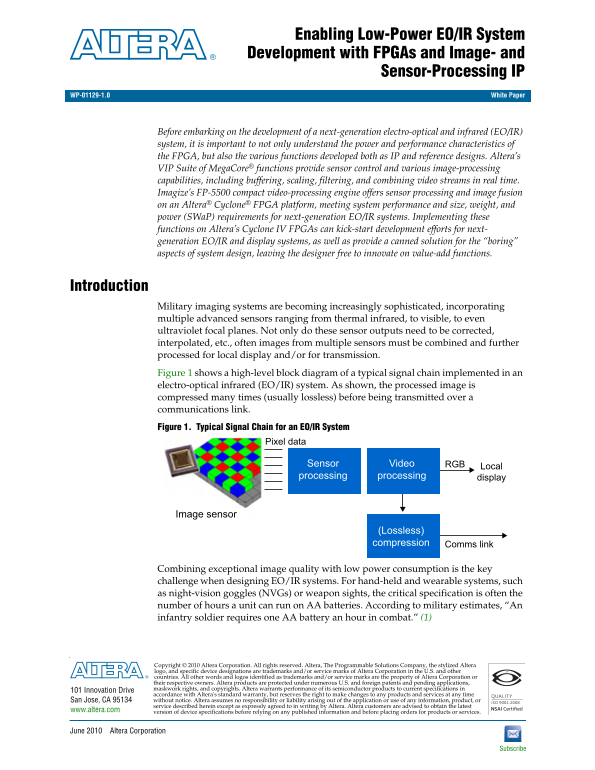
Figure 1 shows a high-level block diagram of a typical signal chain implemented in an electro-optical infrared (EO/IR) system. As shown, the processed image is compressed many times (usually lossless) before being transmitted over a communications link.
Figure 1. Typical Signal Chain for an EO/IR System
Pixel data
Sensor Video RGB
Local
processing processing display
Image sensor
(Lossless) compression Comms link
Combining exceptional image quality with low power consumption is the key challenge when designing EO/IR systems. For hand-held and wearable systems, such as night-vision goggles (NVGs) or weapon sights, the critical specification is often the number of hours a unit can run on AA batteries. According to military estimates, “An infantry soldier requires one AA battery an hour in combat.” (1)
Copyright © 2010 Altera Corporation. All rights reserved. Altera, The Programmable Solutions Company, the stylized Altera logo, and specific device designations are trademarks and/or service marks of Altera Corporation in the U.S. and other countries. All other words and logos identified as trademarks and/or service marks are the property of Altera Corporation or their respective owners. Altera products are protected under numerous U.S. and foreign patents and pending applications, maskwork rights, and copyrights. Altera warrants performance of its semiconductor products to current specifications in
101 Innovation Drive
accordance with Altera's standard warranty, but reserves the right to make changes to any products and services at any time San Jose, CA 95134 without notice. Altera assumes no responsibility or liability arising out of the application or use of any information, product, or service described herein except as expressly agreed to in writing by Altera. Altera customers are advised to obtain the latest
www.altera.com version of device specifications before relying on any published information and before placing orders for products or services.
June 2010 Altera Corporation
Subscribe
Page Summary Contents For Intel White Paper on Supporting Low-Power EO IR System Development Using FPGAs, Image and Sensor Processing IP
Manual Details
| Brand | Image |
|---|---|
| Pages | 12 |
| File Size | 872.41 KB |
| Published | June 03, 2026 |
Enter the captcha to get the download link:

Frequently Asked Questions
What image processing functions are included in the VIP Suite?
The Altera’s VIP Suite provides sensor control and various image-processing capabilities, such as buffering, scaling, filtering, and combining video streams.
Which FPGA family is suitable for high-volume, cost-sensitive EO/IR applications?
The Cyclone IV GX FPGAs are ideal for high-volume, cost-sensitive applications due to their low cost and power consumption rating.
What key challenge must be addressed when designing EO/IR systems?
The primary challenge is combining exceptional image quality with extremely low power consumption.
How does the system handle multiple sensor outputs in an EO/IR setup?
Multiple sensor images often need to be combined and further processed, utilizing functions like sensor processing and image fusion.