Design Note 493: LINEAR Bootstrap Biasing of High Input Voltage Step-Down Controller Increases Converter Efficiency - Goran Perica and Victor Khasiev
Summary
Optimize your high-voltage power conversion with advanced DC/DC controllers designed for demanding automotive and telecom applications. This guide details utilizing the External Bias (EXTV) feature, enabling superior efficiency by sourcing bias voltage from the converter's actual low output instead of the internal LDO. Learn how our solutions solve critical power loss issues in circuits operating across wide input ranges (4.5V to 60V).
Page 1 Text Content
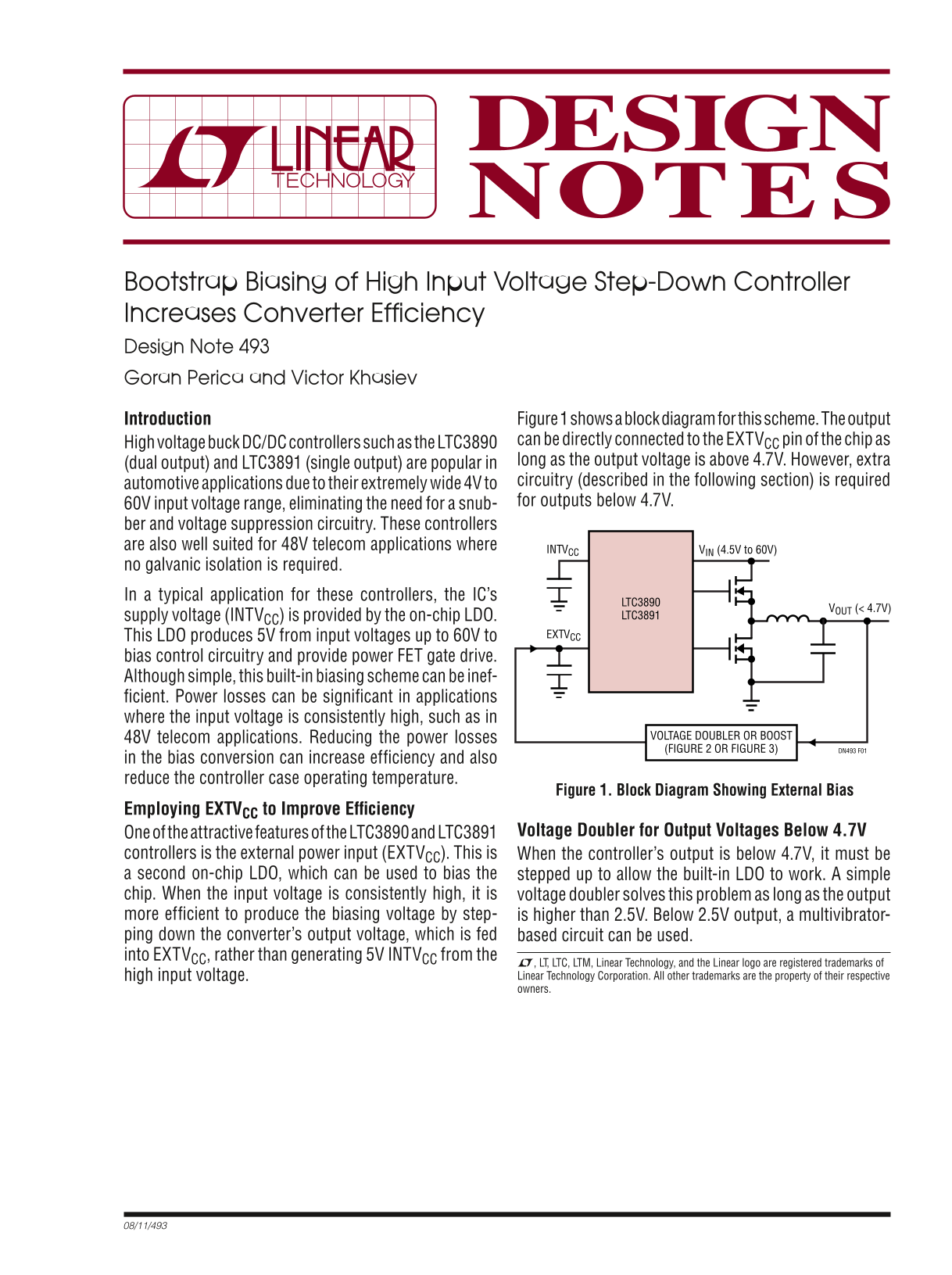
Bootstrap Biasing of High Input Voltage Step-Down Controller Increases Converter Efficiency Design Note 493 Goran Perica and Victor Khasiev Introduction Figure 1 shows a block diagram for this scheme. The output
High voltage buck DC/DC controllers such as the LTC3890 can be directly connected to the EXTVCC pin of the chip as (dual output) and LTC3891 (single output) are popular in long as the output voltage is above 4.7V. However, extra automotive applications due to their extremely wide 4V to circuitry (described in the following section) is required 60V input voltage range, eliminating the need for a snub- for outputs below 4.7V.
ber and voltage suppression circuitry. These controllers are also well suited for 48V telecom applications where
VIN (4.5V to 60V)INTVCC
no galvanic isolation is required. In a typical application for these controllers, the IC’s
LTC3890
VOUT (< 4.7V)
supply voltage (INTVCC) is provided by the on-chip LDO. LTC3891
This LDO produces 5V from input voltages up to 60V to EXTVCC
bias control circuitry and provide power FET gate drive. Although simple, this built-in biasing scheme can be inef- ficient. Power losses can be significant in applications where the input voltage is consistently high, such as in
48V telecom applications. Reducing the power losses VOLTAGE DOUBLER OR BOOST (FIGURE 2 OR FIGURE 3) DN493 F01
in the bias conversion can increase efficiency and also reduce the controller case operating temperature.
Figure 1. Block Diagram Showing External Bias
Employing EXTVCC to Improve Efficiency
One of the attractive features of the LTC3890 and LTC3891 Voltage Doubler for Output Voltages Below 4.7V
controllers is the external power input (EXTVCC). This is When the controller’s output is below 4.7V, it must be a second on-chip LDO, which can be used to bias the stepped up to allow the built-in LDO to work. A simple chip. When the input voltage is consistently high, it is voltage doubler solves this problem as long as the output more efficient to produce the biasing voltage by step- is higher than 2.5V. Below 2.5V output, a multivibrator- ping down the converter’s output voltage, which is fed based circuit can be used. into EXTVCC, rather than generating 5V INTVCC from the
L, LT, LTC, LTM, Linear Technology, and the Linear logo are registered trademarks of high input voltage. Linear Technology Corporation. All other trademarks are the property of their respective owners.
Page Summary Contents For Design Note 493: LINEAR Bootstrap Biasing of High Input Voltage Step-Down Controller Increases Converter Efficiency - Goran Perica and Victor Khasiev
Manual Details
| Brand | Linear |
|---|---|
| Pages | 2 |
| File Size | 105.23 KB |
| Published | July 15, 2026 |
Enter the captcha to get the download link:

Frequently Asked Questions
Why should I use the external power input (EXTV)?
It improves efficiency by sourcing the bias voltage from the controller’s output, rather than relying on the internal LDO.
How do I handle outputs below 4.7V?
The output must be passed through a secondary solution, such as an external LDO or voltage doubler, to properly bias the chip.
What circuit should I use if my output voltage is below 2.5V?
A boost circuit based on an astable multivibrator is recommended for voltages lower than 2.5V.