Dell OptiPlex 5090 Tower Statement of Volatility
Summary
Understand memory volatility and ensure data integrity with essential system documentation for the Dell OptiPlex 5090 Tower. This guide comprehensively details non-volatile components, explaining which parts retain data even after power loss, while outlining proper handling procedures to prevent hardware damage or data loss. Whether troubleshooting power states (S0 through S5) or managing memory modules, this manual is crucial for users and technicians needing detailed knowledge of system connectivity and optimal maintenance practices.
Page 1 Text Content
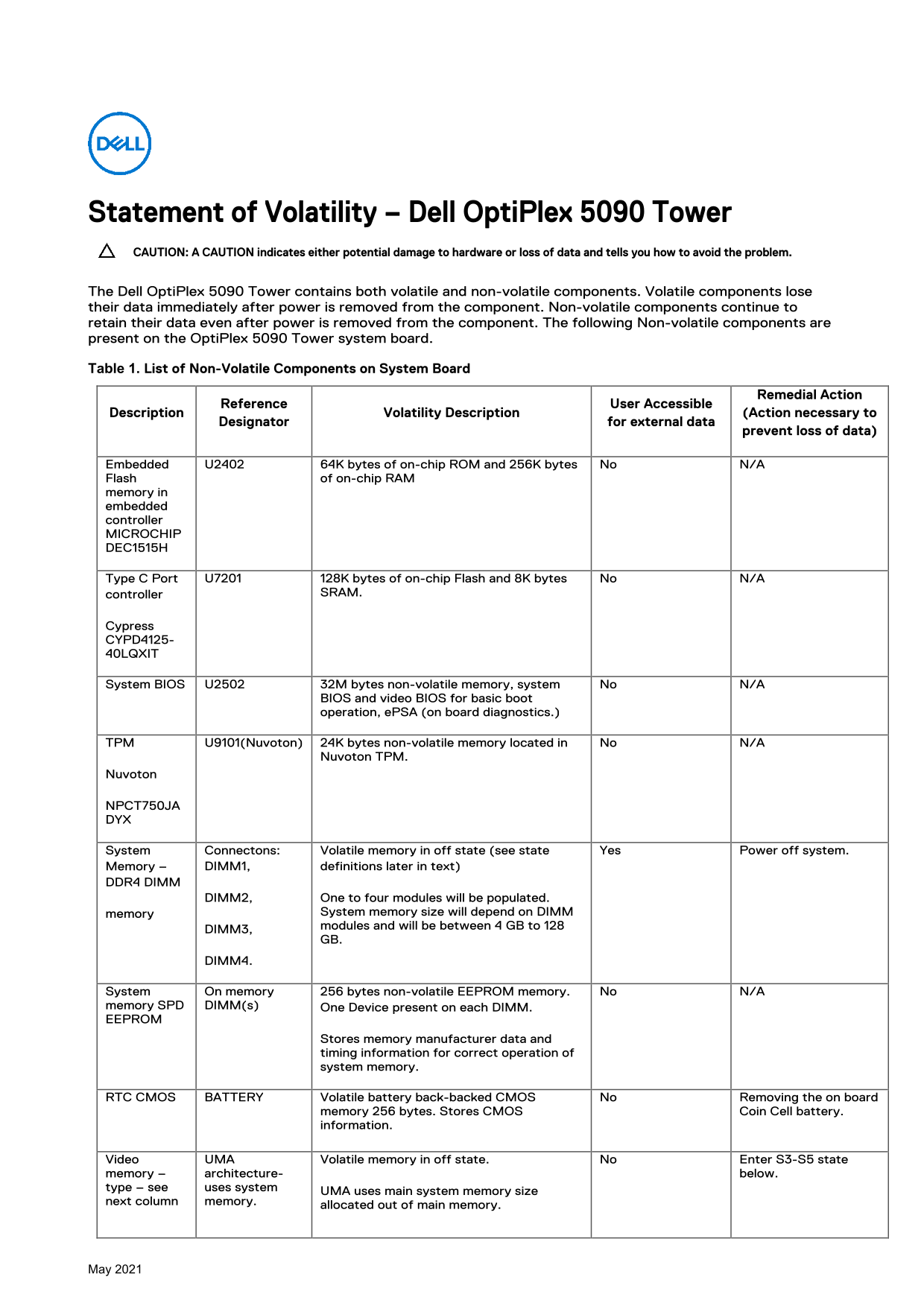
Statement of Volatility – Dell Opti Plex 5090 Tower CAUTION: A CAUTION indicates either potential damage to hardware or loss of data and tells you how to avoid the problem. The Dell Opti Plex 5090 Tower contains both volatile and non-volatile components. Volatile components lose their data immediately after power is removed from the component. Non-volatile components continue to retain their data even after power is removed from the component. The following Non-volatile components are present on the Opti Plex 5090 Tower system board. Table 1. List of Non-Volatile Components on System Board
Remedial Action
Reference User Accessible
Description Volatility Description (Action necessary to
Designator for external data
prevent loss of data)
Embedded U2402 64K bytes of on-chip ROM and 256K bytes No N/A Flash of on-chip RAM memory in embedded controller MICROCHIP DEC1515H
Type C Port U7201 128K bytes of on-chip Flash and 8K bytes No N/A
controller SRAM.
Cypress CYPD4125- 40LQXIT
System BIOS U2502 32M bytes non-volatile memory, system No N/A
BIOS and video BIOS for basic boot operation, e PSA (on board diagnostics.)
TPM U9101(Nuvoton) 24K bytes non-volatile memory located in No N/A
Nuvoton TPM.
Nuvoton
NPCT750JA DYX
System Connectons: Volatile memory in off state (see state Yes Power off system.
Memory – DIMM1, definitions later in text)
DDR4 DIMM
DIMM2, One to four modules will be populated.
memory System memory size will depend on DIMM modules and will be between 4 GB to 128
DIMM3,
DIMM4.
System On memory 256 bytes non-volatile EEPROM memory. No N/A memory SPD DIMM(s) One Device present on each DIMM. EEPROM
Stores memory manufacturer data and timing information for correct operation of system memory.
RTC CMOS BATTERY Volatile battery back-backed CMOS No Removing the on board
memory 256 bytes. Stores CMOS Coin Cell battery. information.
Video UMA Volatile memory in off state. No Enter S3-S5 state memory – architecture- below. type – see uses system
UMA uses main system memory size
next column memory.
allocated out of main memory.
May 2021
Page Summary Contents For Dell OptiPlex 5090 Tower Statement of Volatility
Manual Details
| Brand | Dell |
|---|---|
| Pages | 2 |
| File Size | 147.60 KB |
| Published | June 23, 2026 |
Enter the captcha to get the download link:

Frequently Asked Questions
What happens to data if I unplug the power cord?
Primary power loss destroys all user data on the memory, including DDR4 modules.
How is system memory capacity determined?
The size ranges from 4 GB up to 128 GB, depending on the installed DIMM modules.
What difference is there between S3 and S4 power states?
S3 (suspend to RAM) maintains dynamic RAM; S4 (hibernate/suspend to disk) writes system context to non-volatile storage with no power.
Can I use removable media like M.2 or SD cards in this tower?
Yes, these types of magnetic media are non-volatile and require a low-level format before use.