Dell OptiPlex 5060 Small Form Factor Statement of Volatility
Summary
This document is a Statement of Volatility for the Dell OptiPlex 5060 Small Form Factor desktop computer. It details the volatile and non-volatile memory components present on the motherboard, including BIOS, TPM, system memory (DDR4 DIMM), and embedded controllers. The manual provides technical specifications and remedial actions required to clear data from each component. Target users include IT security professionals, government agencies, and organizations requiring data sanitization compliance for Dell hardware.
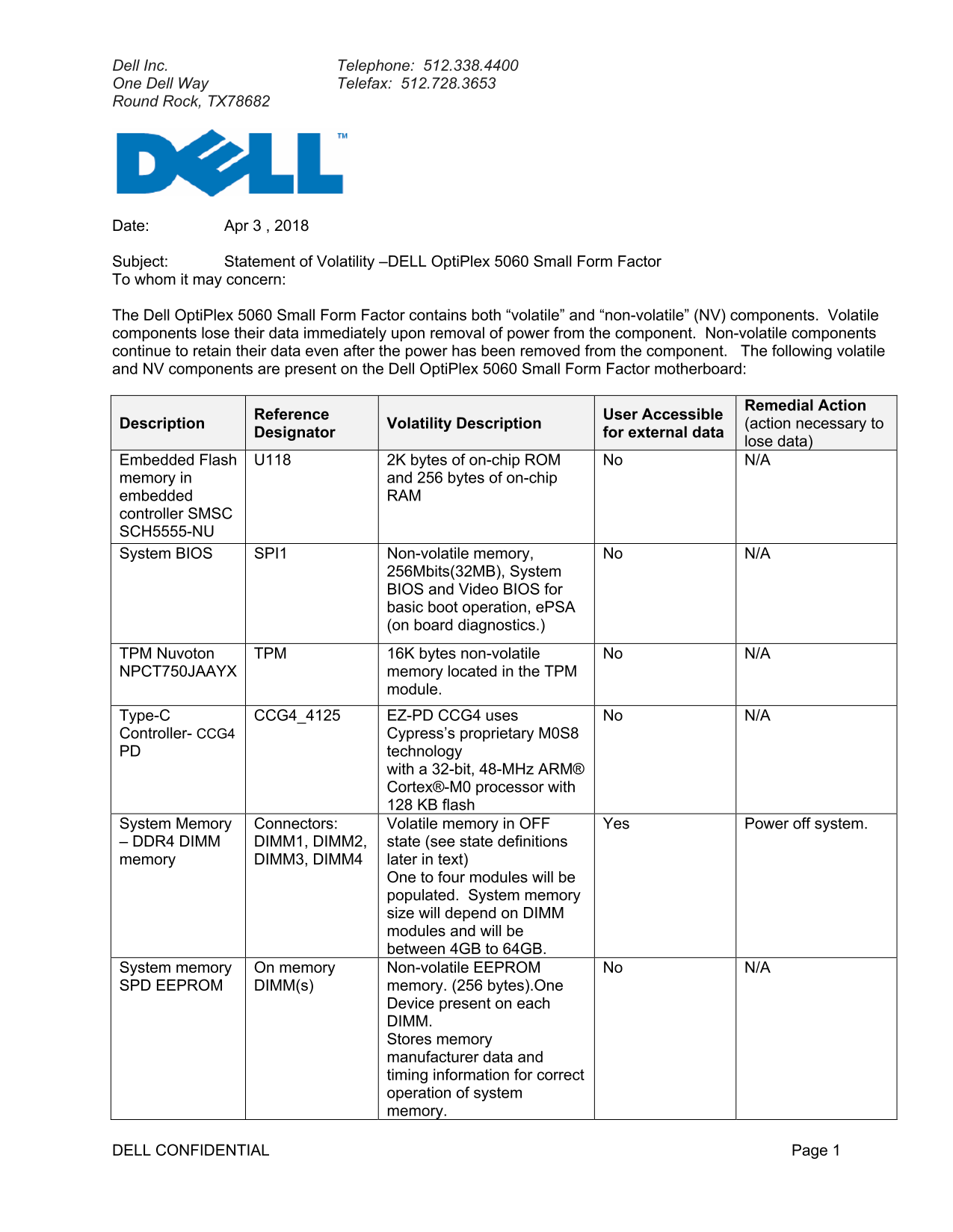
Page 1 Text Content
Dell Inc. Telephone: 512.338.4400 One Dell Way Telefax: 512.728.3653 Round Rock, TX78682
Date: Apr 3 , 2018
Subject: Statement of Volatility –DELL Opti Plex 5060 Small Form Factor To whom it may concern:
The Dell Opti Plex 5060 Small Form Factor contains both “volatile” and “non-volatile” (NV) components. Volatile components lose their data immediately upon removal of power from the component. Non-volatile components continue to retain their data even after the power has been removed from the component. The following volatile and NV components are present on the Dell Opti Plex 5060 Small Form Factor motherboard:
Remedial Action
Reference User Accessible
Description Volatility Description (action necessary to
Designator for external data
lose data)
Embedded Flash U118 2K bytes of on-chip ROM No N/A
memory in and 256 bytes of on-chip embedded RAM
controller SMSC SCH5555-NU System BIOS SPI1 Non-volatile memory, No N/A
256Mbits(32MB), System BIOS and Video BIOS for basic boot operation, e PSA (on board diagnostics.)
TPM Nuvoton TPM 16K bytes non-volatile No N/A NPCT750JAAYX memory located in the TPM
module.
Type-C CCG4_4125 EZ-PD CCG4 uses No N/A Controller- CCG4 Cypress’s proprietary M0S8 PD technology
with a 32-bit, 48-MHz ARM® Cortex®-M0 processor with 128 KB flash
System Memory Connectors: Volatile memory in OFF Yes Power off system. – DDR4 DIMM DIMM1, DIMM2, state (see state definitions memory DIMM3, DIMM4 later in text)
One to four modules will be populated. System memory size will depend on DIMM modules and will be between 4GB to 64GB.
System memory On memory Non-volatile EEPROM No N/A SPD EEPROM DIMM(s) memory. (256 bytes).One
Device present on each DIMM. Stores memory manufacturer data and timing information for correct operation of system memory.
DELL CONFIDENTIAL Page 1
Page Summary Contents For Dell OptiPlex 5060 Small Form Factor Statement of Volatility
Manual Details
| Brand | Dell |
|---|---|
| Pages | 3 |
| File Size | 95.88 KB |
| Published | June 25, 2026 |
Enter the captcha to get the download link:

Frequently Asked Questions
What happens when the primary power is lost?
Primary power loss (unplugging or removing the battery) will destroy all user data on volatile memory like DDR4 DIMMs.
Which components retain data after power is removed?
Non-volatile components, such as System BIOS, TPM memory, and storage devices (SD Card, M.2, HDD), retain their data.
How is the system context saved when using hibernation mode?
In S4 ('suspend to disk'/hibernate) state, the OS writes the system context to a non-volatile storage file for potential restoration.
What is the difference between 'Soft Off' (S5) and shutdown?
In S5 ('soft' off), no data remains in any component (cache or memory); the system requires a complete boot cycle upon wakeup.