Dell Comparative Performance Analysis on Skylake Processors - User Guide for LAMMPS Four Node Setup
Summary
Performance analysis whitepaper from Dell Ready Solutions Engineering comparing LAMMPS molecular dynamics benchmarks on Intel Xeon Gold 6150 (Skylake, 18-core, 2.7GHz, 1MB L2 per core, 24.75MB L3 cache, 6-channel DDR4) versus Xeon E5-2697 v4 (Broadwell) processors. Tests on Dell PowerEdge C6420 versus C6320 clusters with InfiniBand EDR, using the in.eam dataset simulating metallic Cu solid with 32,000 atoms. Measures timesteps/second across single-node and multi-node configurations on RHEL 7.3.
Page 1 Text Content
Ready Solutions Engineering Test Results
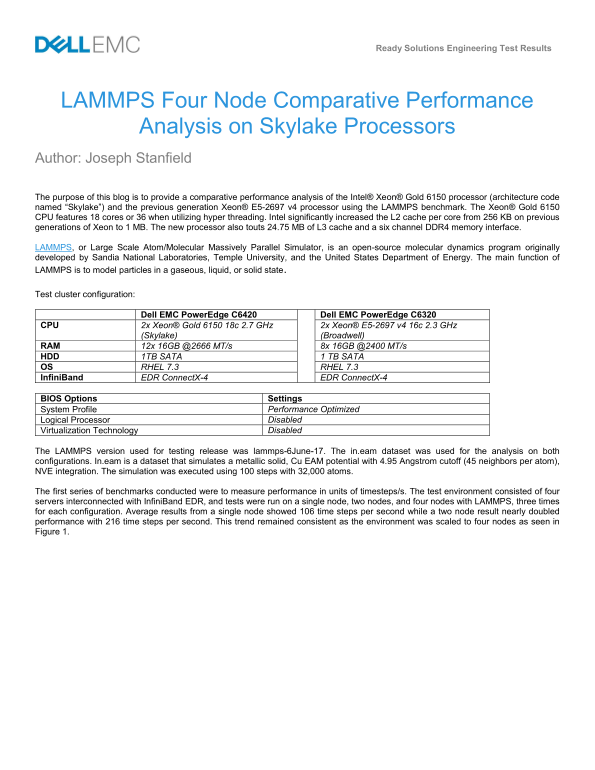
LAMMPS Four Node Comparative Performance Analysis on Skylake Processors Author: Joseph Stanfield The purpose of this blog is to provide a comparative performance analysis of the Intel® Xeon® Gold 6150 processor (architecture code named “Skylake”) and the previous generation Xeon® E5-2697 v4 processor using the LAMMPS benchmark. The Xeon® Gold 6150 CPU features 18 cores or 36 when utilizing hyper threading. Intel significantly increased the L2 cache per core from 256 KB on previous generations of Xeon to 1 MB. The new processor also touts 24.75 MB of L3 cache and a six channel DDR4 memory interface. LAMMPS, or Large Scale Atom/Molecular Massively Parallel Simulator, is an open-source molecular dynamics program originally developed by Sandia National Laboratories, Temple University, and the United States Department of Energy. The main function of LAMMPS is to model particles in a gaseous, liquid, or solid state. Test cluster configuration: Dell EMC Power Edge C6420 Dell EMC Power Edge C6320 CPU 2x Xeon® Gold 6150 18c 2.7 GHz 2x Xeon® E5-2697 v4 16c 2.3 GHz
(Skylake) (Broadwell)
RAM 12x 16GB @2666 MT/s 8x 16GB @2400 MT/s HDD 1TB SATA 1 TB SATA OS RHEL 7.3 RHEL 7.3 Infini Band EDR Connect X-4 EDR Connect X-4 BIOS Options Settings System Profile Performance Optimized Logical Processor Disabled Virtualization Technology Disabled The LAMMPS version used for testing release was lammps-6June-17. The in.eam dataset was used for the analysis on both configurations. In.eam is a dataset that simulates a metallic solid, Cu EAM potential with 4.95 Angstrom cutoff (45 neighbors per atom), NVE integration. The simulation was executed using 100 steps with 32,000 atoms. The first series of benchmarks conducted were to measure performance in units of timesteps/s. The test environment consisted of four servers interconnected with Infini Band EDR, and tests were run on a single node, two nodes, and four nodes with LAMMPS, three times for each configuration. Average results from a single node showed 106 time steps per second while a two node result nearly doubled performance with 216 time steps per second. This trend remained consistent as the environment was scaled to four nodes as seen in Figure 1.
Page Summary Contents For Dell Comparative Performance Analysis on Skylake Processors - User Guide for LAMMPS Four Node Setup
Manual Details
| Brand | Dell |
|---|---|
| Pages | 3 |
| File Size | 741.93 KB |
| Published | June 17, 2026 |
Enter the captcha to get the download link:

Frequently Asked Questions
What key performance improvements does the Xeon Gold 6150 processor offer over older generations?
It increases L2 cache per core to 1 MB, features 24.75 MB of L3 cache, and offers 18 cores (or 36 with hyperthreading).
How does LAMMPS performance scale when running across multiple nodes in a cluster?
The results show that the performance of LAMMPS scales linearly with the increased number of compute nodes up to four nodes.
What is LAMMPS, and what is its primary function?
LAMMPS (Large Scale Atom/Molecular Massively Parallel Simulator) is an open-source program used to model particles in gaseous, liquid, or solid states.
How does the Xeon Gold 6150 compare directly to the older Xeon E5 v4 processor?
The test results show that the Xeon Gold CPU outperforms the Xeon E5 v4 by approximately 120% during each benchmark run.