Texas Instruments LP111, LP211, LP311 Low-Power Differential Comparators with Strobes Data Manual
Summary
The LP111, LP211, and LP311 are highly efficient low-power differential comparators with strobes, designed as industry-leading alternatives for battery-powered electronics. Ideal for applications requiring reliable performance over wide voltage ranges while minimizing power drain (<300 $\mu$A), these ICs offer stable comparison capabilities and quick response times. This manual provides comprehensive technical documentation, including detailed operational specifications, absolute maximum ratings, various temperature grades (from –55°C to 125°C), and necessary guidelines for robust system integration by electrical engineers and designers.
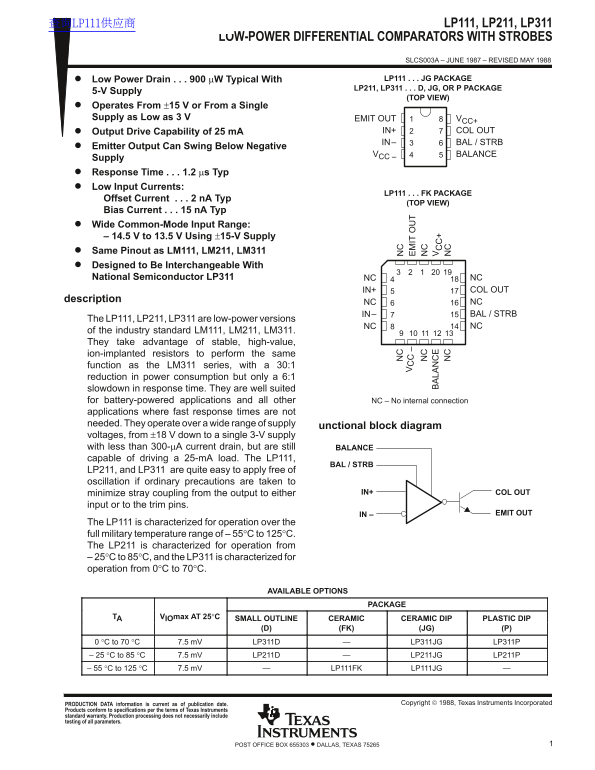
Page 1 Text Content
查询LP111供应商 LP111, LP211, LP311
LOW-POWER DIFFERENTIAL COMPARATORS WITH STROBES
SLCS003A – JUNE 1987 – REVISED MAY 1988
Low Power Drain 900 µW Typical With LP111 JG PACKAGE LP211, LP311 D, JG, OR P PACKAGE
5-V Supply
(TOP VIEW)
Operates From ±15 V or From a Single Supply as Low as 3 V EMIT OUT VCC+
Output Drive Capability of 25 m A IN+ COL OUT IN– BAL STRB
Emitter Output Can Swing Below Negative
VCC BALANCE
Supply Response Time 1.2 µs Typ Low Input Currents:
LP111 FK PACKAGE
Offset Current . 2 n A Typ
(TOP VIEW)
Bias Current 15 n A Typ Wide Common-Mode Input Range: – 14.5 V to 13.5 V Using ±15-V Supply Same Pinout as LM111, LM211, LM311 Designed to Be Interchangeable With National Semiconductor LP311 NC NC
IN+ COL OUT
description
NC NC IN– BAL STRB
The LP111, LP211, LP311 are low-power versions
NC NC
of the industry standard LM111, LM211, LM311. They take advantage of stable, high-value, ion-implanted resistors to perform the same function as the LM311 series, with a 30:1 reduction in power consumption but only a 6:1 slowdown in response time. They are well suited for battery-powered applications and all other NC – No internal connection applications where fast response times are not IT needed. They operate over a wide range of supply unctional block diagram voltages, from ±18 V down to a single 3-V supply LA with less than 300-µA current drain, but are still BALANCE capable of driving a 25-m A load. The LP111,
BAL STRB
LP211, and LP311 are quite easy to apply free of oscillation if ordinary precautions are taken to
minimize stray coupling from the output to either IN+ COL OUT
input or to the trim pins.
IN EMIT OUT
The LP111 is characterized for operation over the full military temperature range of – 55°C to 125°C. The LP211 is characterized for operation from – 25°C to 85°C, and the LP311 is characterized for operation from 0°C to 70°C.
AVAILABLE OPTIONS
PACKAGE
TA VIOmax AT 25°C SMALL OUTLINE CERAMIC CERAMIC DIP PLASTIC DIP
(D) (FK) (JG) (P)
0 °C to 70 °C 7.5 m V LP311D LP311JG LP311P – 25 °C to 85 °C 7.5 m V LP211D LP211JG LP211P – 55 °C to 125 °C 7.5 m V LP111FK LP111JG
Copyright 1988, Texas Instruments Incorporated PRODUCTION DATA information is current as of publication date.
Products conform to specifications per the terms of Texas Instruments standard warranty. Production processing does not necessarily include testing of all parameters.
1POST OFFICE BOX 655303 • DALLAS, TEXAS 75265
Page Summary Contents For Texas Instruments LP111, LP211, LP311 Low-Power Differential Comparators with Strobes Data Manual
Manual Details
| Brand | Texas Instruments |
|---|---|
| Pages | 4 |
| File Size | 51.55 KB |
| Published | May 31, 2026 |
Enter the captcha to get the download link:

Frequently Asked Questions
How does the low-power version compare to the original LM111 series?
They offer a 30:1 reduction in power consumption compared to the industry standard, while maintaining the same basic function and pinout.
What temperature ranges are available for the three models?
LP111 is rated from –55°C to 125°C; LP211 operates from –25°C to 85°C; and LP311 functions between 0°C and 70°C.
What kind of power supply can these comparators run off?
They operate over a wide range, from ±18 V down to a single 3-V supply with a current drain of less than 300 μA.
What specific precautions are needed during application design?
Users must take ordinary precautions to minimize stray coupling from the output to either input or to the trim pins to avoid oscillation.