Roland C-280 Classic OrganMIDI Implementation User's Manual
Summary
Discover robust control over your soundscape with this professional MIDI instrument manual. This guide provides expert-level technical specifications on advanced music technology, including Registered Parameter Numbers (RPN), Program Change protocols, and System Exclusive message formats. Essential for composers and sound designers, the manual details how to achieve intricate sound sculpting and precision parameter manipulation across all 16 MIDI channels, empowering you to craft sophisticated musical arrangements.
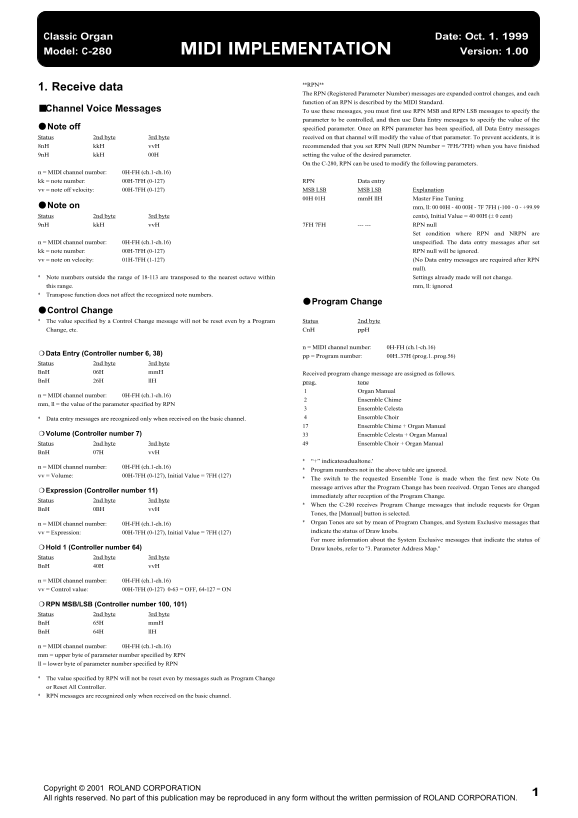
Page 1 Text Content
Classic Organ Date: Oct. 1. 1999 Model: C-280 MIDI IMPLEMENTATION Version: 1.00
**RPN**
1. Receive data
The RPN (Registered Parameter Number) messages are expanded control changes, and each function of an RPN is described by the MIDI Standard.
Channel Voice Messages To use these messages, you must first use RPN MSB and RPN LSB messages to specify the
parameter to be controlled, and then use Data Entry messages to specify the value of the
Note off specified parameter. Once an RPN parameter has been specified, all Data Entry messages Status 2nd byte 3rd byte received on that channel will modify the value of that parameter. To prevent accidents, it is 8n H kk H vv H recommended that you set RPN Null (RPN Number = 7FH/7FH) when you have finished 9n H kk H 00H setting the value of the desired parameter.
On the C-280, RPN can be used to modify the following parameters.
n = MIDI channel number: 0H-FH (ch.1-ch.16) kk = note number: 00H-7FH (0-127) RPN Data entry vv = note off velocity: 00H-7FH (0-127) MSB LSB MSB LSB Explanation
00H 01H mm H ll H Master Fine Tuning
Note on mm, ll: 00 00H - 40 00H - 7F 7FH (-100 - 0 - +99.99 Status 2nd byte 3rd byte cents), Initial Value = 40 00H (± 0 cent) 9n H kk H vv H 7FH 7FH --- --- RPN null
Set condition where RPN and NRPN are
n = MIDI channel number: 0H-FH (ch.1-ch.16) unspecified. The data entry messages after set kk = note number: 00H-7FH (0-127) RPN null will be ignored. vv = note on velocity: 01H-7FH (1-127) (No Data entry messages are required after RPN
null).
Note numbers outside the range of 18-113 are transposed to the nearest octave within Settings already made will not change. this range. mm, ll: ignored Transpose function does not affect the recognized note numbers.
Program Change
Control Change The value specified by a Control Change message will not be reset even by a Program Status 2nd byte Change, etc. Cn H pp H
n = MIDI channel number: 0H-FH (ch.1-ch.16)
Data Entry (Controller number 6, 38)
pp = Program number: 00H..37H (prog.1..prog.56)
Status 2nd byte 3rd byte Bn H 06H mm H Received program change message are assigned as follows. Bn H 26H ll H prog. tone
Organ Manual
n = MIDI channel number: 0H-FH (ch.1-ch.16)
Ensemble Chime
mm, ll = the value of the parameter specified by RPN
Ensemble Celesta Data entry messages are recognized only when received on the basic channel. Ensemble Choir Ensemble Chime + Organ Manual
Volume (Controller number 7) Ensemble Celesta + Organ Manual Status 2nd byte 3rd byte Ensemble Choir + Organ Manual Bn H 07H vv H
“+” indicatesadualtone.'
n = MIDI channel number: 0H-FH (ch.1-ch.16)
Program numbers not in the above table are ignored.
vv = Volume: 00H-7FH (0-127), Initial Value = 7FH (127)
The switch to the requested Ensemble Tone is made when the first new Note On message arrives after the Program Change has been received. Organ Tones are changed
Expression (Controller number 11)
immediately after reception of the Program Change.
Status 2nd byte 3rd byte
When the C-280 receives Program Change messages that include requests for Organ
Bn H 0BH vv H
Tones, the [Manual] button is selected. n = MIDI channel number: 0H-FH (ch.1-ch.16) Organ Tones are set by mean of Program Changes, and System Exclusive messages that vv = Expression: 00H-7FH (0-127), Initial Value = 7FH (127) indicate the status of Draw knobs. For more information about the System Exclusive messages that indicate the status of
Hold 1 (Controller number 64) Draw knobs, refer to "3. Parameter Address Map." Status 2nd byte 3rd byte Bn H 40H vv H
n = MIDI channel number: 0H-FH (ch.1-ch.16) vv = Control value: 00H-7FH (0-127) 0-63 = OFF, 64-127 = ON
RPN MSB/LSB (Controller number 100, 101) Status 2nd byte 3rd byte Bn H 65H mm H Bn H 64H ll H
n = MIDI channel number: 0H-FH (ch.1-ch.16) mm = upper byte of parameter number specified by RPN ll = lower byte of parameter number specified by RPN
The value specified by RPN will not be reset even by messages such as Program Change or Reset All Controller. RPN messages are recognized only when received on the basic channel.
Copyright © 2001 ROLAND CORPORATION All rights reserved. No part of this publication may be reproduced in any form without the written permission of ROLAND CORPORATION.
Page Summary Contents For Roland C-280 Classic OrganMIDI Implementation User's Manual
Manual Details
| Brand | Classic |
|---|---|
| Pages | 5 |
| File Size | 27.72 KB |
| Published | May 17, 2026 |
Enter the captcha to get the download link:

Frequently Asked Questions
How should I reset RPN parameters to prevent errors?
After setting an RPN value, it is recommended to set RPN Null (RPN Number = 7FH/7FH) to prevent accidental changes.
What controls the Ensemble Tone when Program Change is received?
The switch happens when the first new Note On message arrives after the specified Program Change has been received.
Can I change specific parameters on different MIDI channels?
Yes, data entry messages are recognized when sent to various MIDI channels (0H-FH) using specified status bytes.
What is the purpose of setting the checksum in System Exclusive messages?
The checksum ensures that the message was correctly received. It is calculated from the address and data values of the exclusive message.