Philips 74HC HCT574 Octal D-Type Flip-Flop Positive Edge-Trigger 3-State Data Sheet Manual
Summary
A high-speed 8-bit Octal D-type flip-flop designed for sophisticated data storage and bus-oriented applications. This integrated circuit features independent register functions and common 3-state output enable capability, making it ideal for complex MSI logic designs. The comprehensive datasheet provides detailed specifications on timing parameters, electrical characteristics, setup/hold times, and operational guidelines to ensure precise system integration for hardware engineers and electronics designers.
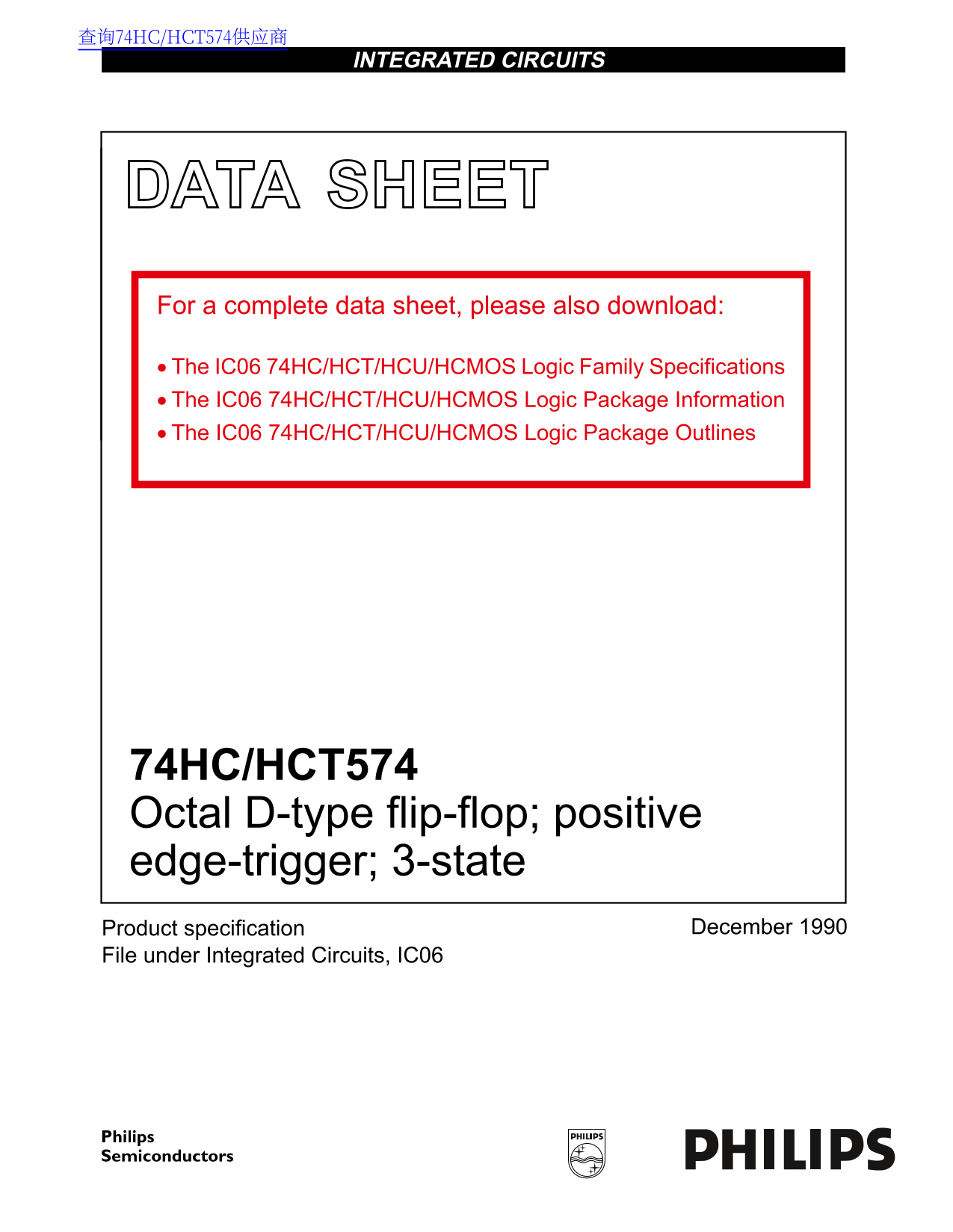
Page 1 Text Content
查询74HC/HCT574供应商
INTEGRATED CIRCUITS
DATA SHEET For a complete data sheet, please also download: The IC06 74HC/HCT/HCU/HCMOS Logic Family Specifications The IC06 74HC/HCT/HCU/HCMOS Logic Package Information The IC06 74HC/HCT/HCU/HCMOS Logic Package Outlines
74HC/HCT574 Octal D-type flip-flop; positive edge-trigger; 3-state
Product specification December
File under Integrated Circuits, IC06
Page Summary Contents For Philips 74HC HCT574 Octal D-Type Flip-Flop Positive Edge-Trigger 3-State Data Sheet Manual
Manual Details
| Brand | Philips |
|---|---|
| Pages | 7 |
| File Size | 52.67 KB |
| Published | July 04, 2026 |
Enter the captcha to get the download link:

Frequently Asked Questions
What type of flip-flop is the 74HC/HCT574?
It is an octal D-type, positive edge-triggered, 3-state flip-flop.
How do I enable or disable the outputs?
Use the OE (3-state output enable) input. LOW enables it, and HIGH puts the outputs in high impedance OFF-state.
What is the typical maximum operating frequency for this component?
For 74HC, it's 133 MHz; for 74HCT, it’s 24 MHz.
What determines the dynamic power dissipation (PD)?
The formula is PD = C × V × f + Σ(C × V × f).
Are there any functional differences between revisions?
Functionally, the “574” is identical to the “374”, but it has a different pinning.