PHILIPS 74ABT16821A 74ABTH16821A 20-bit bus-interface D-type flip-flop; positive-edge trigger (3-State) Data Sheet Manual User Guide
Summary
This comprehensive specification guide details the 74ABT16821A/74ABTH16821A, a high-speed 20-bit bus-interface D-type flip-flop register. Designed for advanced digital system architecture, this BiCMOS component offers low power consumption and positive-edge triggering for reliable data transfer in complex circuits. The manual provides exhaustive technical resources for hardware engineers, including electrical timing parameters, pin configuration diagrams, functional logic tables, and operational guidelines necessary for integrating the device into bus repeaters, microprocessors, or custom digital control systems.
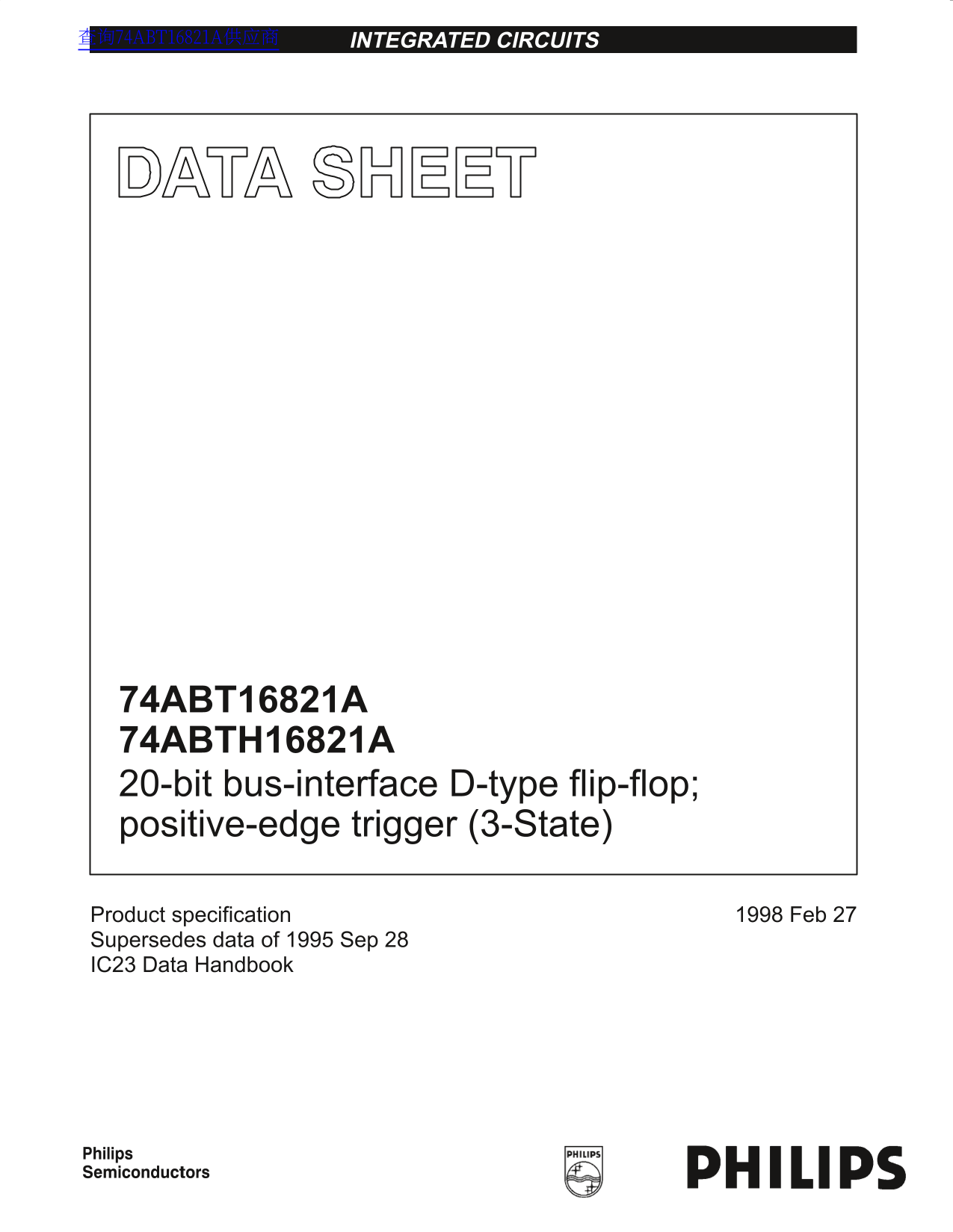
Page 1 Text Content
INTEGRATED CIRCUITS查询74ABT16821A供应商
74ABT16821A 74ABTH16821A 20-bit bus-interface D-type flip-flop; positive-edge trigger (3-State)
Product specification 1998 Feb 27 Supersedes data of 1995 Sep 28 IC23 Data Handbook
Page Summary Contents For PHILIPS 74ABT16821A 74ABTH16821A 20-bit bus-interface D-type flip-flop; positive-edge trigger (3-State) Data Sheet Manual User Guide
Manual Details
| Brand | Philips |
|---|---|
| Pages | 10 |
| File Size | 83.61 KB |
| Published | July 04, 2026 |
Enter the captcha to get the download link:

Frequently Asked Questions
What is the primary function of the 74ABT16821A?
It is a high-performance BiCMOS device featuring two independent 10-bit, edge-triggered registers designed as a 20-bit bus-interface D-type flip-flop.
How are the outputs controlled when not in use?
When Output Enable (nOE) is High, the 3-State output buffers are in high impedance, meaning they neither drive nor load the bus.
What capability does the 74ABTH16821A have over the basic model?
The 74ABTH16821A incorporates a bus-hold feature, which eliminates the need for external pull-up resistors to hold unused data inputs.
Is the device protected against electrical surges and shorts?
Yes, it includes Latch-up protection exceeding 500mA per JEDEC Std 17 and ESD protection exceeding 2000V per MIL STD 883 Method 3015.