LINEAR Safe Hot Swapping with LTC1421 - Design Note 139 by James Herr and Robert Reay
Summary
Safely manage power transitions and data integrity in complex backplane systems with this guide on integrating hot-swappable circuitry. This manual details how the LTC1421 solves massive inrush current challenges, enabling safe board insertion and removal from live, powered environments. It provides engineers with detailed specifications for staggered connector sensing, programmable ramp rates, transient surge protection, and system reset protocols, ensuring reliable operation across high-power computing architectures.
Page 1 Text Content
advertisement
Safe Hot Swapping Using the LTC1421 – Design Note 139 ST AG GE RE CO NN EC TO
James Herr and Robert Reay
When a circuit board is inserted into a live backplane, the driving the gates of external N-channel pass transistors, large bypass capacitors on the board can draw huge inrush board connection sensing, flexible supply voltage monitor- currents from the backplane power bus as they charge. The ing, power on reset output, short-circuit protection and inrush current, on the order of 10A to 100A, can destroy the soft or hard reset via software control. board’s bypass capacitors, metal traces or connector pins.
Typical Application
The inrush current can also cause a glitch on the backplane
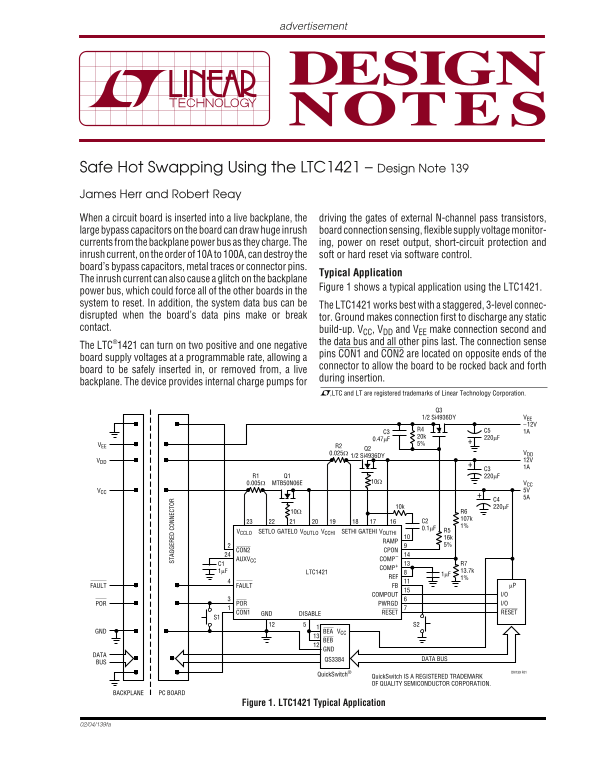
Figure 1 shows a typical application using the LTC1421.
power bus, which could force all of the other boards in the system to reset. In addition, the system data bus can be The LTC1421 works best with a staggered, 3-level connec- disrupted when the board’s data pins make or break tor. Ground makes connection first to discharge any static contact. build-up. VCC, VDD and VEE make connection second and
the data bus and all other pins last. The connection sense
The LTC®1421 can turn on two positive and one negative
pins CON1 and CON2 are located on opposite ends of the
board supply voltages at a programmable rate, allowing a
connector to allow the board to be rocked back and forth
board to be safely inserted in, or removed from, a live
during insertion.
backplane. The device provides internal charge pumps for
,LTC and LT are registered trademarks of Linear Technology Corporation.
1/2 Si4936DY VEE –12V
VEE 5%
0.025Ω VDD
1/2 Si4936DY
VDD 12V C3 1A
0.005Ω MTB50N06E 10Ω VCC
VCC 5V 5A
0.1µF VCCLO SETLO GATELO VOUTLO VCCHI SETHI GATEHI VOUTHI R5 16k
CON2 CPON AUXVCC COMP–
COMP+
1µF LTC1421 13.7k 1µF
REF 1%
FAULT FAULT FB µP COMPOUT I/O POR POR PWRGD I/O CON1 GND DISABLE RESET RESET
GND BEA VCC BEB GND
QS3384 DATA BUS
DN139 F01
Quick Switch®
Quick Switch IS A REGISTERED TRADEMARK OF QUALITY SEMICONDUCTOR CORPORATION.
PC BOARDBACKPLANE
Figure 1. LTC1421 Typical Application
02/04/139fa
Page Summary Contents For LINEAR Safe Hot Swapping with LTC1421 - Design Note 139 by James Herr and Robert Reay
Manual Details
| Brand | Linear |
|---|---|
| Pages | 2 |
| File Size | 103.29 KB |
| Published | June 06, 2026 |
Enter the captcha to get the download link:

Frequently Asked Questions
Why can inserting a board into a backplane cause a problem?
Large capacitors on the board and traces can draw huge inrush current (up to 100A), potentially damaging the reset circuit or causing system glitches.
How should data pins be connected to prevent disruptions?
Use a staggered connection sequence: GND first, followed by VCC/VDD, and finally the data bus and other pins.
What is the function of the LTC1421 device?
It safely manages board insertion into live backplanes by controlling power supply ramp rates (CON1 and CON2) to prevent inrush current damage.
How do I perform a hard vs. soft reset?
Pushing S1 shorts POR for a hard reset, which cycles power. Pushing S2 shorts FB for a soft reset that does not cycle power but immediately lowers PWRGD.