LINEAR LTC4099 User's Manual
Summary
Enhance the performance and reliability of portable electronics with expert guidance on advanced power management and signal conditioning. This technical resource provides detailed analyses of critical Li-Ion battery degradation mechanisms, offering solutions to intelligently extend operational lifespan. It also covers state-of-the-art data acquisition techniques using ultra-low-power ADCs and high-speed digital processing, making it essential for electrical engineers designing robust, reliable instruments for demanding consumer or industrial applications.
Page 1 Text Content
DESIGN IDEAS L
Battery Conditioner Extends the
Life of Li-Ion Batteries by George H. Barbehenn
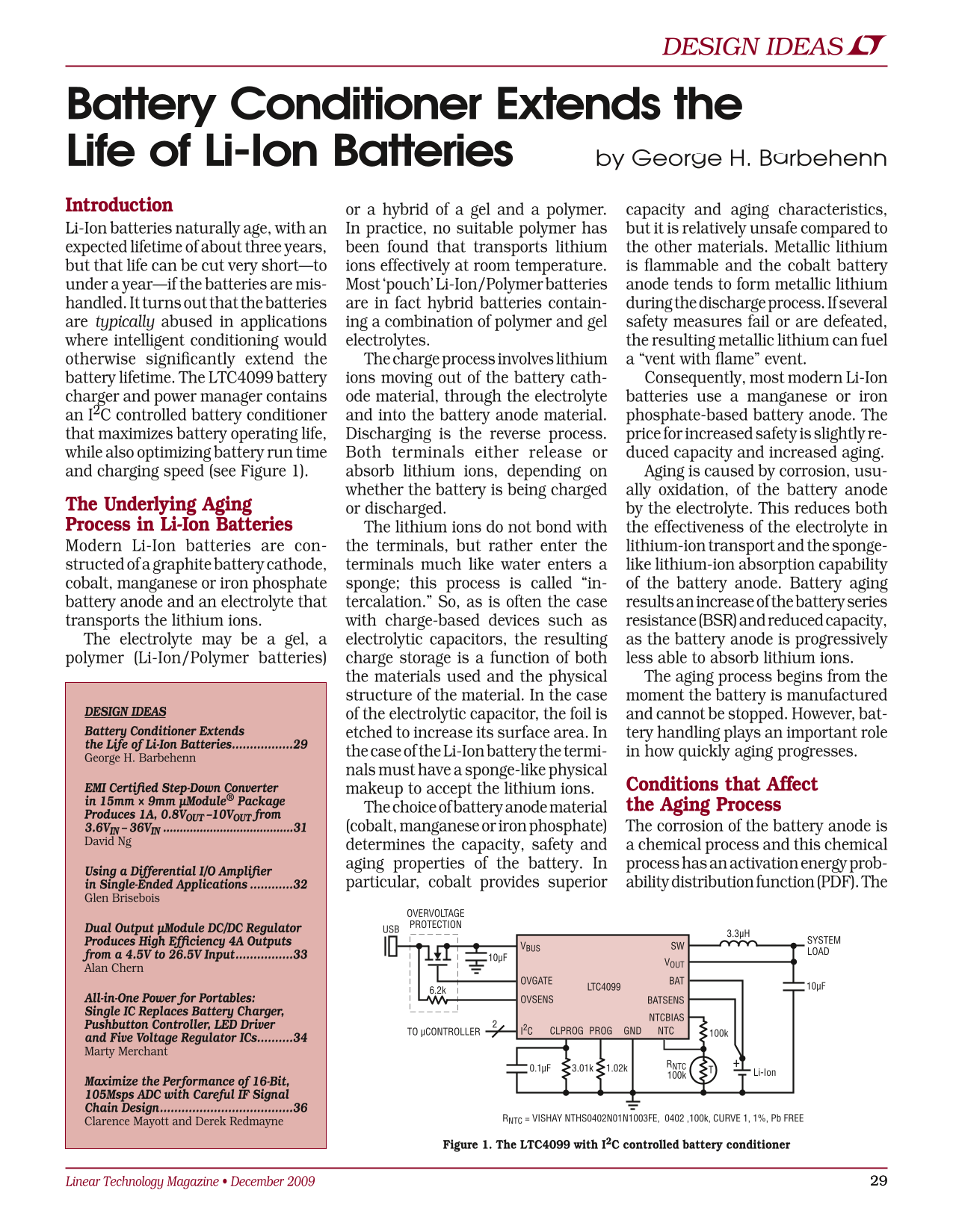
Introduction or a hybrid of a gel and a polymer. capacity and aging characteristics, Li-Ion batteries naturally age, with an In practice, no suitable polymer has but it is relatively unsafe compared to expected lifetime of about three years, been found that transports lithium the other materials. Metallic lithium but that life can be cut very short—to ions effectively at room temperature. is flammable and the cobalt battery under a year—if the batteries are mis- Most ‘pouch’ Li-Ion/Polymer batteries anode tends to form metallic lithium handled. It turns out that the batteries are in fact hybrid batteries contain- during the discharge process. If several are typically abused in applications ing a combination of polymer and gel safety measures fail or are defeated, where intelligent conditioning would electrolytes. the resulting metallic lithium can fuel otherwise significantly extend the The charge process involves lithium a “vent with flame” event. battery lifetime. The LTC4099 battery ions moving out of the battery cath- Consequently, most modern Li-Ion charger and power manager contains ode material, through the electrolyte batteries use a manganese or iron an I2C controlled battery conditioner and into the battery anode material. phosphate-based battery anode. The that maximizes battery operating life, Discharging is the reverse process. price for increased safety is slightly re- while also optimizing battery run time Both terminals either release or duced capacity and increased aging. and charging speed (see Figure 1). absorb lithium ions, depending on Aging is caused by corrosion, usu-
whether the battery is being charged ally oxidation, of the battery anode
The Underlying Aging or discharged. by the electrolyte. This reduces both Process in Li-Ion Batteries The lithium ions do not bond with the effectiveness of the electrolyte in Modern Li-Ion batteries are con- the terminals, but rather enter the lithium-ion transport and the sponge- structed of a graphite battery cathode, terminals much like water enters a like lithium-ion absorption capability cobalt, manganese or iron phosphate sponge; this process is called “in- of the battery anode. Battery aging battery anode and an electrolyte that tercalation.” So, as is often the case results an increase of the battery series transports the lithium ions. with charge-based devices such as resistance (BSR) and reduced capacity, The electrolyte may be a gel, a electrolytic capacitors, the resulting as the battery anode is progressively polymer (Li-Ion/Polymer batteries) charge storage is a function of both less able to absorb lithium ions.
the materials used and the physical The aging process begins from the structure of the material. In the case moment the battery is manufactured
DESIGN IDEAS of the electrolytic capacitor, the foil is and cannot be stopped. However, bat- Battery Conditioner Extends etched to increase its surface area. In tery handling plays an important role the Life of Li-Ion Batteries .................29
the case of the Li-Ion battery the termi- in how quickly aging progresses.
George H. Barbehenn
nals must have a sponge-like physical
EMI Certified Step-Down Converter makeup to accept the lithium ions. Conditions that Affect
in 15mm × 9mm µModule® Package
The choice of battery anode material the Aging Process
Produces 1A, 0.8VOUT –10VOUT from
3.6VIN – 36VIN .......................................31 (cobalt, manganese or iron phosphate) The corrosion of the battery anode is
David Ng
determines the capacity, safety and a chemical process and this chemical aging properties of the battery. In process has an activation energy prob-
Using a Differential I/O Amplifier
in Single-Ended Applications ............32 particular, cobalt provides superior ability distribution function (PDF). The
Glen Brisebois
OVERVOLTAGE PROTECTION
Dual Output µModule DC/DC Regulator USB
Produces High Efficiency 4A Outputs SYSTEM
VBUS SW
from a 4.5V to 26.5V Input ................33 10µF
Alan Chern
OVGATE BAT
LTC4099 10µF
All-in-One Power for Portables: OVSENS BATSENS Single IC Replaces Battery Charger,
NTCBIAS
Pushbutton Controller, LED Driver
TO µCONTROLLER I2C CLPROG PROG GND NTC 100k
and Five Voltage Regulator ICs ..........34 Marty Merchant
100k Li-Ion
Maximize the Performance of 16-Bit, 105Msps ADC with Careful IF Signal Chain Design .....................................36
RNTC = VISHAY NTHS0402N01N1003FE, 0402 ,100k, CURVE 1, 1%, Pb FREE
Clarence Mayott and Derek Redmayne
Figure 1. The LTC4099 with I2C controlled battery conditioner
Linear Technology Magazine • December 2009
Page Summary Contents For LINEAR LTC4099 User's Manual
Manual Details
| Brand | Linear |
|---|---|
| Pages | 2 |
| File Size | 182.11 KB |
| Published | July 16, 2026 |
Enter the captcha to get the download link:

Frequently Asked Questions
What causes Li-Ion batteries to lose capacity or age?
Capacity loss is caused by anode corrosion and electrolyte oxidation, which reduces performance over time.
How does a specialized battery conditioner help the battery?
It intelligently conditions the battery system to significantly extend its operational life while optimizing run time for increased safety.
What danger is associated with poor handling of Li-Ion batteries?
Poor handling can cause metallic lithium formation, leading potentially to an uncontrolled discharge event and a 'vent with flame' reaction.