LINEAR LTC6412 User's Manual
Summary
The LTC6412 is a high-performing analog Variable Gain Amplifier (VGA) designed for sophisticated signal management in communication and imaging equipment. This guide details why analog control offers unparalleled stability compared to traditional digital methods, eliminating issues like gain glitches and temperature-related errors. It is essential reading for engineers designing radar receivers, satellite systems, or other applications requiring highly stable amplitude adjustment across extreme temperatures and wide frequency ranges.
Page 1 Text Content
DESIGN FEATURES L
GA IN (d B)
Analog VGA Simplifies Design and Outperforms Competing
Gain Control Methods by Walter Strifler
Introduction Variable gain amplifiers (VGAs) are
SHDN EN GNDVCCVCCVCCVCC GND
widely used in communications and imaging applications such as cel-
REFERENCE AND BIAS CONTROL
lular radio, satellite receivers, global
+IN +OUT
positioning, radar, and ultrasound ap-
GA IN (d B)
plications. Most of these applications
BUFFER/ involve transmit and receive signals • • • OUTPUT AMPLIFIER
of varying amplitude that need to be
–IN –OUT
managed within the constraints of the
DECL1
overall system design. On the transmit
ATTENUATOR REFERENCE AND
side, the signal amplitude is usually VCM DECL2
CONTROL BIAS CONTROL
adjusted near a maximum limit im-
EXPOSED posed by the transmit power amplifier +VG VREF –VG GND GND GND GND GND PAD
or below a power limit imposed by the receivers or reflectors of the signal. On
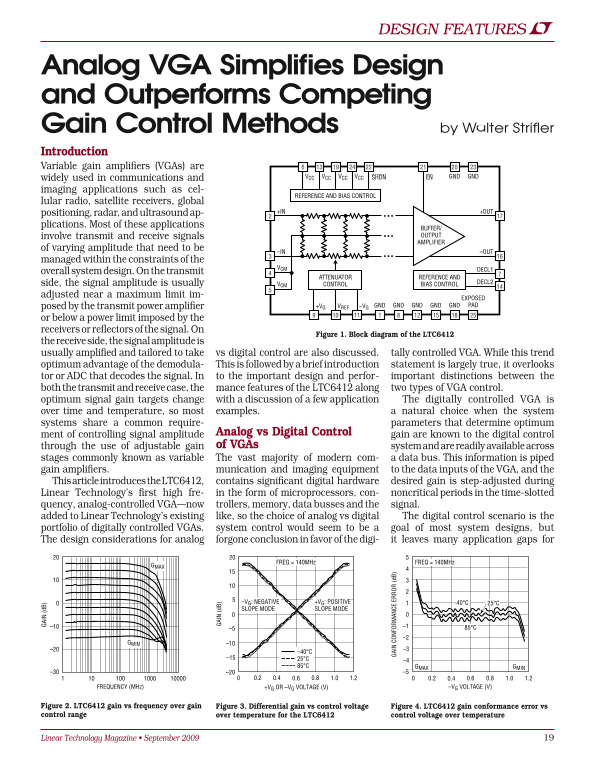
Figure 1. Block diagram of the LTC6412
the receive side, the signal amplitude is usually amplified and tailored to take vs digital control are also discussed. tally controlled VGA. While this trend optimum advantage of the demodula- This is followed by a brief introduction statement is largely true, it overlooks tor or ADC that decodes the signal. In to the important design and perfor- important distinctions between the both the transmit and receive case, the mance features of the LTC6412 along two types of VGA control.
GA IN ON FO RM AN CE RR OR (d B)
optimum signal gain targets change with a discussion of a few application The digitally controlled VGA is over time and temperature, so most examples. a natural choice when the system systems share a common require- parameters that determine optimum
ment of controlling signal amplitude Analog vs Digital Control gain are known to the digital control through the use of adjustable gain of VGAs system and are readily available across
stages commonly known as variable The vast majority of modern com- a data bus. This information is piped gain amplifiers. munication and imaging equipment to the data inputs of the VGA, and the This article introduces the LTC6412, contains significant digital hardware desired gain is step-adjusted during Linear Technology’s first high fre- in the form of microprocessors, con- noncritical periods in the time-slotted quency, analog-controlled VGA—now trollers, memory, data busses and the signal. added to Linear Technology’s existing like, so the choice of analog vs digital The digital control scenario is the portfolio of digitally controlled VGAs. system control would seem to be a goal of most system designs, but The design considerations for analog forgone conclusion in favor of the digi- it leaves many application gaps for
FREQ = 140MHz FREQ = 140MHz
–VG: NEGATIVE +VG: POSITIVE –40°C 25°C SLOPE MODE SLOPE MODE
GMIN –10
85°C GMAX GMIN
FREQUENCY (MHz) +VG OR –VG VOLTAGE (V) –VG VOLTAGE (V)
Figure 2. LTC6412 gain vs frequency over gain Figure 3. Differential gain vs control voltage Figure 4. LTC6412 gain conformance error vs control range over temperature for the LTC6412 control voltage over temperature
Linear Technology Magazine • September 2009
Page Summary Contents For LINEAR LTC6412 User's Manual
Manual Details
| Brand | Linear |
|---|---|
| Pages | 4 |
| File Size | 828.29 KB |
| Published | May 30, 2026 |
Enter the captcha to get the download link:

Frequently Asked Questions
What is the LTC6412 designed to control?
It is a variable gain amplifier (VGA), offering unparalleled analog VGA performance and minimal size.
How does the LTC6412 manage gain variation in various conditions?
It compensates for temperature variations and gain drift, providing continuous operation without interruptions or glitches.
What advantage does the LTC6412 have over digital VGAs?
Unlike digital options, it does not suffer from step changes or glitches during variable gain adjustment.
In what types of applications is a VGA required?
VGAs are widely used in communications and imaging for tasks like cellular radio, satellite receivers, radar, and ultrasound positioning.