Intel White Paper Why Intel® Optane™ SSD Is a Better Choice Than NAND Flash SSD in Storage Cache Tier
Summary
Discover why Intel Optane SSDs offer a superior choice over traditional NAND Flash in critical storage cache tiers. This guide details how Optane's exceptional performance, low latency, and significantly higher endurance enhance distributed storage architectures (like VMware vSAN). It helps data center professionals determine the ideal hardware for high-performance, reliable storage scaling, ensuring peak efficiency and longevity for demanding enterprise workloads.
Page 1 Text Content
White Paper December 2021 Data Center | Storage
Why Intel® Optane™ SSDs Are a Better Option than NAND Flash SSDs in the Storage Cache Tier
Consistently high performance, low latency, and excellent endurance enable Intel Optane SSDs to outshine NAND Flash SSDs
Author Executive Summary Flavio Fomin
This paper explores how NAND Flash and Intel® Optane™ SSDs’ capabilities affect
Solutions Architect, Intel Corporation
a VMware v SAN configuration—in particular, the storage cache tier. Considerations include cost, performance, footprint, and risk of data loss.
Table of Contents
Generic performance and endurance guidelines are commonly used to select
Executive Summary .
cache drives. These guidelines help prevent the selection of inadequate drives, but Introduction . when they are used as recommendations for which drive to use, the opportunity to optimize for cost and performance can be missed. And in some cases, there’s a risk
VMware v SAN Architectural
of using a drive that does not provide acceptable endurance for certain workloads,
Components and I/O Flow .
increasing exposure to data loss events.
Test Environment .
In this paper we provide additional information that is not included in the generic
Hardware and Software
sizing guidelines. We describe how Intel Optane technology adds value to a multi-
Configuration .
tier distributed storage implementation, such as VMware v SAN, when deployed as
VM Configuration .
a cache tier. This value results from the Intel Optane SSD’s higher throughput and
Workloads and Methods .
endurance, compared to NAND Flash SSDs:
Reporting Tools .
• When processing a 50 percent read/write load, Intel Optane SSDs can provide
Test Results .
up to 2.5X more throughput.1
v Disk Preparation—Elapsed Time .
• The Intel Optane SSD’s lifetime endurance is 16X more than a NAND Flash SSD.2
70/30 Read/Write 32 KB Effect of Cache-to-Disk De-staging on VM Latency . I/O Activity at the Physical Layer . Risk of Using Lower-Endurance Cache Drives . Implications of SSD Performance and Endurance to v SAN Cluster Sizing . Sizing for a Light I/O Workload . Sizing for a Moderate I/O Workload . Conclusion
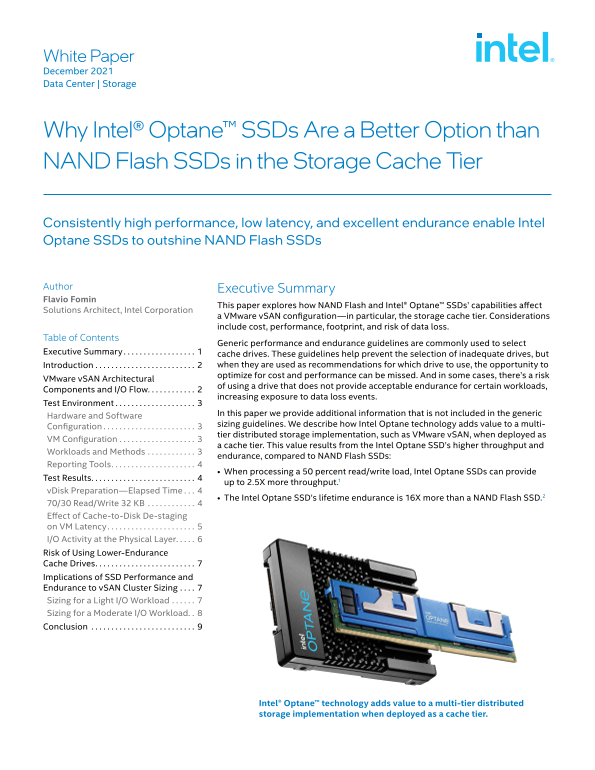
Intel® Optane™ technology adds value to a multi-tier distributed storage implementation when deployed as a cache tier.
Page Summary Contents For Intel White Paper Why Intel® Optane™ SSD Is a Better Choice Than NAND Flash SSD in Storage Cache Tier
Manual Details
| Brand | Intel |
|---|---|
| Pages | 9 |
| File Size | 567.05 KB |
| Published | June 05, 2026 |
Enter the captcha to get the download link:

Frequently Asked Questions
How much more throughput do Intel Optane SSDs offer at a 50% read/write load compared to NAND Flash SSDs?
Intel Optane SSDs can provide up to 2.5X more throughput when processing a 50 percent read/write load.
What is the difference in lifetime endurance between Intel Optane and NAND Flash SSDs?
The Intel Optane SSD’s lifetime endurance is stated to be 16X more than a NAND Flash SSD.
Why is using generic performance guidelines insufficient for sizing cache drives?
Relying only on minimum endurance levels can lead to the use of drives that may wear out before their warranty due to variable data loss risks and workload types.