Intel White Paper: Intel Optane SSD Enhances Virtual Server Performance for Intel Memory Manufacturing Automation
Summary
Boost virtual server performance and operational efficiency with Intel Optane SSDs. This white paper details how using Optane as a cache tier within VMware vSAN clusters significantly accelerates write-intensive tasks for demanding, mission-critical environments. Ideal for large manufacturing automation facilities running web, application, and database services, Optane provides superior reliability and throughput necessary to maintain high performance without increasing physical complexity.
Page 1 Text Content
White Paper Intel® Optane™ Solid State Drives Manufacturing Automation
Intel® Optane™ Solid State Drives Boost Virtual Server Performance for Intel® Memory Manufacturing Automation
Using Intel Optane SSDs in the VMware v SAN cache tier increased virtual server performance at Intel manufacturing fabs.
Intel manufacturing facilities are complex environments, with each factory managed
Author
by hundreds of servers running 24/7 across two data centers for full redundancy.
Jose Kurian,
Reliability and efficient performance are key for automation management, process
control, inventory, and analytics. Although the automation execution servers
Software Architect, Manufacturing
are stand-alone machines, most application, website, and database services
Automation, Intel
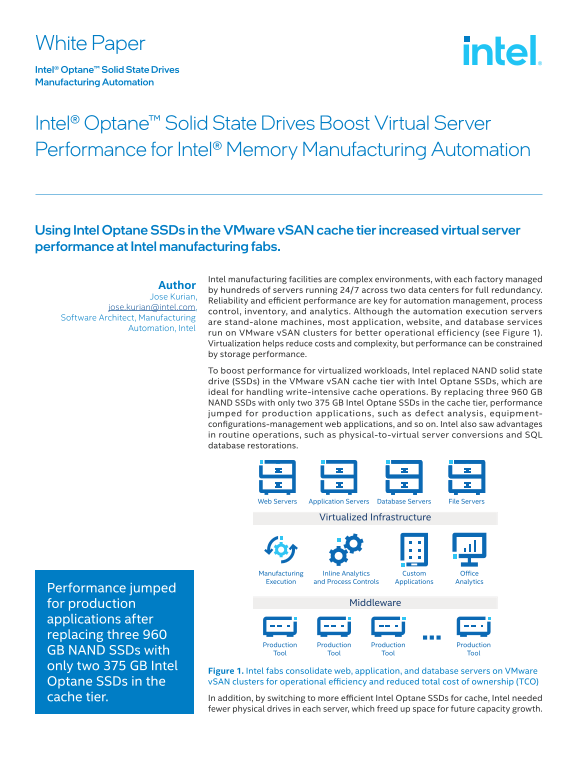
run on VMware v SAN clusters for better operational efficiency (see Figure 1). Virtualization helps reduce costs and complexity, but performance can be constrained by storage performance. To boost performance for virtualized workloads, Intel replaced NAND solid state drive (SSDs) in the VMware v SAN cache tier with Intel Optane SSDs, which are ideal for handling write-intensive cache operations. By replacing three 960 GB NAND SSDs with only two 375 GB Intel Optane SSDs in the cache tier, performance jumped for production applications, such as defect analysis, equipment- configurations-management web applications, and so on. Intel also saw advantages in routine operations, such as physical-to-virtual server conversions and SQL database restorations.
Web Servers Application Servers Database Servers File Servers
Virtualized Infrastructure
Manufacturing Inline Analytics Custom Office Execution and Process Controls Applications Analytics
Performance jumped
for production Middleware
applications after replacing three 960
Production Production Production Production
GB NAND SSDs with Tool Tool Tool Tool only two 375 GB Intel
Figure 1. Intel fabs consolidate web, application, and database servers on VMware Optane SSDs in the v SAN clusters for operational efficiency and reduced total cost of ownership (TCO) cache tier. In addition, by switching to more efficient Intel Optane SSDs for cache, Intel needed fewer physical drives in each server, which freed up space for future capacity growth.
Page Summary Contents For Intel White Paper: Intel Optane SSD Enhances Virtual Server Performance for Intel Memory Manufacturing Automation
Manual Details
| Brand | Server |
|---|---|
| Pages | 6 |
| File Size | 1.15 MB |
| Published | June 04, 2026 |
Enter the captcha to get the download link:

Frequently Asked Questions
Why are Intel Optane SSDs better than NAND for cache?
Optane SSDs are byte-addressable, so there is no need for periodic clearing through garbage collection cycles required by NAND SSDs.
What types of workloads benefit most from using Optane SSDs in vSAN?
Write-intensive cache operations, such as defect analysis and database restorations, see significant performance increases.
How does the use of fewer drives impact hardware capacity?
By consolidating the cache tier with far fewer physical Intel Optane SSDs, space is freed up for future physical capacity growth.
What combination of technologies power this optimized vSAN cluster setup?
The setup combines Intel Optane SSDs within a VMware vSAN cluster hosted on high-performance Intel Xeon Scalable processors.