Intel White Paper: Intel® SGX and Intel® EPID Provisioning and Attestation Service
Summary
Ensure secure computation with Intel Software Guard Extensions (SGX), which creates protected enclaves for sensitive applications. This guide details advanced remote attestation and EPID provisioning services, allowing third parties to cryptographically verify that your code is running securely on an authentic platform. It covers key management, recovery mechanisms, and enhanced privacy features necessary to establish trust in a protected execution environment. Ideal for developers building mission-critical or data-sensitive applications requiring verifiable integrity.
Page 1 Text Content
Intel® Software Guard Extensions: EPID Provisioning and Attestation Services
Simon Johnson, Vinnie Scarlata, Carlos Rozas, Ernie Brickell, Frank Mckeen
Intel Corporation
{ simon.p.johnson, vincent.r.scarlata, carlos.v.rozas, ernie.brickell, frank.mckeen }@intel.com
Section 2 provides a high level overview of how ABSTRACT initial implementations of Intel® SGX provide a recovery mechanism that allows the platform to be
Intel® Software Guard Extensions (SGX) has an
updated, and attest to this update.
attestation capability that can be used to remotely
Section 3 outlines the Intel® Enhanced Privacy
provision secrets to an enclave. Use of Intel® SGX
Identifier (EPID) architecture used to support Intel®
attestation and sealing has been described in [1]. This
SGX architecture. EPID is the algorithm of choice for
paper describes how the SGX attestation key are
SGX attestations.
remotely provisioned to Intel® SGX enabled
Section 4 details the provisioning and
platforms, the hardware primitives used to support
attestation verification services Intel has established
the process, and the Intel Verification Service that
to support SGX.
simplifies the verification of an SGX attestation. The
1.1 Attestation Primer
paper also includes a short primer on the Intel®
Enhanced Privacy Identifier which is signature Attestation is the process of demonstrating that a algorithm used by Intel® SGX attestation architecture. software executable has been properly instantiated on a platform. The Intel® SGX attestation allows a remote party to gain confidence that the intended
1 Introduction
software is securely running within an enclave on an
Intel® SGX is a set of processor extensions for
Intel® SGX enabled platform. The attestation conveys
establishing a protected execution environment
the following information in an assertion:
inside an application [2]. This execution environment
Identities of software being attested.
is called an enclave. SGX enclaves are created without
Details of unmeasured state (e.g. the mode
secrets. Secrets are delivered after the enclave has
software is running in).
been instantiated on the platform. The process of
Data which software associates with itself.
proving that the enclave has been established in a
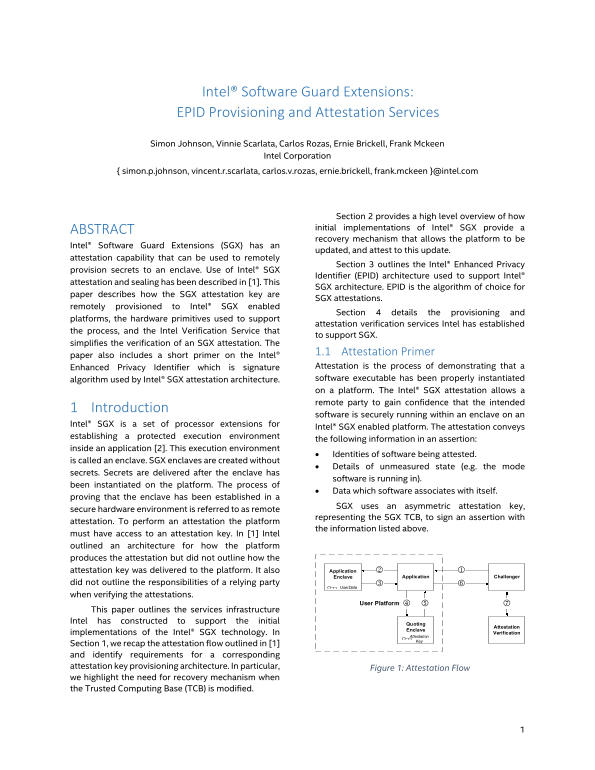
SGX uses an asymmetric attestation key,
secure hardware environment is referred to as remote
representing the SGX TCB, to sign an assertion with
attestation. To perform an attestation the platform
the information listed above.
must have access to an attestation key. In [1] Intel outlined an architecture for how the platform produces the attestation but did not outline how the
attestation key was delivered to the platform. It also Application
Enclave Application Challenger
did not outline the responsibilities of a relying party
User Data
when verifying the attestations.
User Platform
This paper outlines the services infrastructure Intel has constructed to support the initial Quoting
Attestation
Enclave
implementations of the Intel® SGX technology. In Verification
Attestation Key
Section 1, we recap the attestation flow outlined in [1] and identify requirements for a corresponding attestation key provisioning architecture. In particular, Figure 1: Attestation Flow we highlight the need for recovery mechanism when the Trusted Computing Base (TCB) is modified.
Page Summary Contents For Intel White Paper: Intel® SGX and Intel® EPID Provisioning and Attestation Service
Manual Details
| Brand | Intel |
|---|---|
| Pages | 10 |
| File Size | 674.79 KB |
| Published | June 03, 2026 |
Enter the captcha to get the download link:

Frequently Asked Questions
What is the purpose of remote attestation in Intel SGX?
It demonstrates to a remote party that the intended software executable has been properly and securely instantiated within an enclave on the platform.
When can secrets be provisioned into an SGX enclave?
Secrets are only delivered after the enclave has been successfully established and verified running inside the secure hardware environment.
What must happen if the Trusted Computing Base (TCB) is modified?
The architecture requires providing a defined recovery mechanism to address changes in the TCB.